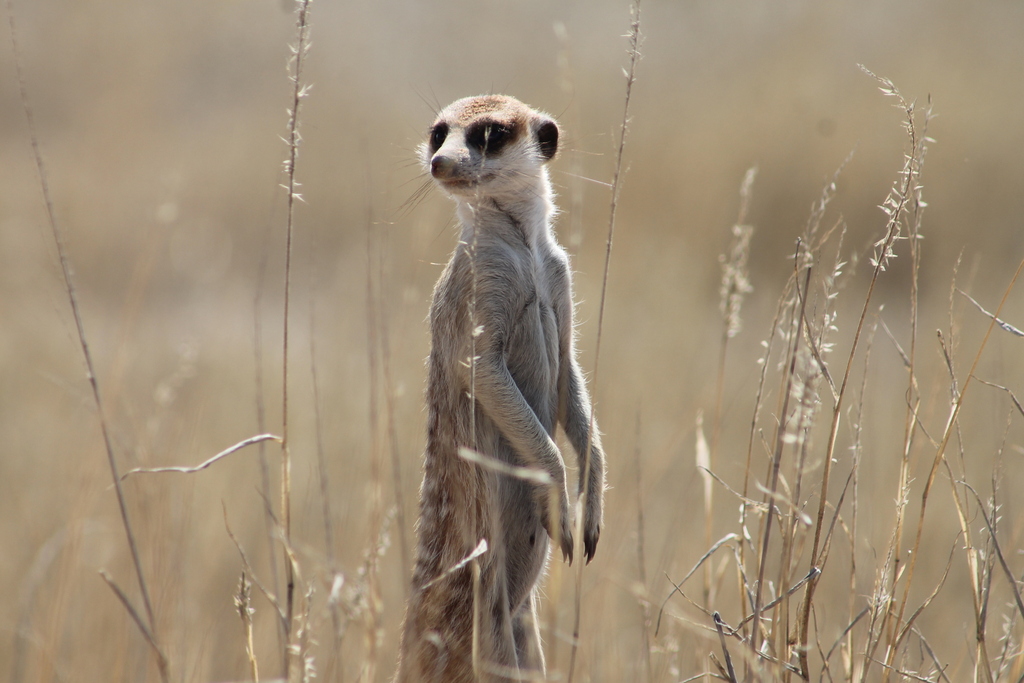
Meerkat
Photo © Rebecca Ryen-Stols
Photo © Rebecca Ryen-Stols — CC BY-SA 4.0 — Source: iNaturalist photo #603643173Identification
The meerkat is a small mongoose with a distinctive appearance that makes it instantly recognisable. It is characterised by a broad head, large eyes, a pointed snout, long legs, a thin tapering tail, and a brindled coat pattern. The head-and-body length is around 24–35 cm (9.4–13.8 in), making it smaller than most other mongooses, and typically weighs between 0.62 and 0.97 kg (1.4 and 2.1 lb). The coat is light grey to yellowish-brown with alternate, poorly defined light and dark bands on the back. Meerkats possess foreclaws specially adapted for digging, and they have the remarkable ability to thermoregulate, allowing them to survive in their harsh, dry habitat.
Range & Habitat
Meerkats are found in southern Africa, with their range extending across southwestern Botswana, western and southern Namibia, and northern and western South Africa, barely reaching into southwestern Angola. They inhabit arid, open habitats with little woody vegetation. These highly social animals live either in rock crevices in stony, often calcareous areas, or in large burrow systems in plains. Their burrow systems are impressively engineered, typically 5 m (16 ft) in diameter with around 15 openings, consisting of two to three levels of tunnels that extend up to 1.5 m (5 ft) into the ground. These underground networks provide moderated internal temperatures and a protective microclimate that shields meerkats from harsh weather and extreme temperatures.
Behaviour & Diet
Meerkats are highly social animals, forming packs of two to 30 individuals that each occupy home ranges around 5 km² (1.9 sq mi) in area. A clear social hierarchy exists within packs—generally dominant individuals breed and produce offspring, while nonbreeding, subordinate members provide altruistic care to the pups. Breeding occurs year-round, with peaks during heavy rainfall, and litters typically contain three to seven pups after a gestation period of 60 to 70 days. Active during the day, mostly in early morning and late afternoon, meerkats remain continuously alert and retreat to burrows when sensing danger. They use a wide variety of calls to communicate among themselves, including alarm calls to warn of predators. Primarily insectivorous, meerkats feed heavily on beetles and lepidopterans, along with other arthropods, amphibians, small birds, reptiles, and plants.
Best Time & Places to See It
Meerkats are most active during early morning and late afternoon, making these the best times for observation and photography. Their range spans southwestern Botswana, western and southern Namibia, and northern and western South Africa. The species is listed as Least Concern on the IUCN Red List with no significant threats to the population, making it relatively stable throughout its range. Travellers visiting southern Africa's arid regions have good opportunities to encounter these engaging animals in their natural habitat.
Photography Tips
Photograph meerkats during the early morning and late afternoon hours when they are most active and light conditions are often optimal. Their distinctive upright posture and alert behaviour make them engaging subjects, particularly when they are scanning for predators or interacting within their pack. The contrast between their light grey to yellowish-brown coats and their dark bands provides good compositional opportunities. Patience is rewarded, as meerkats' continuous alertness and varied behaviours—from digging to communicating with pack members—offer numerous photographic moments. Their arid, open habitat with minimal vegetation generally provides clean backgrounds that help isolate your subjects.
Nxai Pan National Park
Botswana
+226 birds+16 mammals
Across the northwestern reaches of Botswana stretches a landscape of profound seasonal transformation—a sprawling pan system where shallow depressions fill and empty with the rains, creating…
VIEW NATIONAL PARKMokala National Park
Siyancuma Local Municipality, South Africa
+246 birds+35 mammals
Across the semi-arid savanna of the Northern Cape, where red earth meets sparse acacia woodland and open grassland punctuated by rocky outcrops, lies a landscape shaped…
VIEW NATIONAL PARKMountain Zebra National Park
Inxuba Yethemba Local Municipality, South Africa
+265 birds+35 mammals
Across the windswept plateaus and deeply incised valleys of the Eastern Cape's interior, Mountain Zebra National Park unfolds as a landscape of geological drama and ecological…
VIEW NATIONAL PARKAugrabies Falls National Park
Kai !Garib Local Municipality, South Africa
+176 birds+20 mammals
Where the Orange River cuts a dramatic scar through the Northern Cape's arid interior, Augrabies Falls National Park sprawls across nearly 1,200 square kilometers of raw,…
VIEW NATIONAL PARKAddo Elephant National Park
Sundays River Valley Local Municipality, South Africa
+388 birds+55 mammals
Where the Eastern Cape's semi-arid scrublands meet transitional woodland, Addo sprawls across 13,478 square kilometres of one of southern Africa's most biodiverse landscapes. The terrain rises…
VIEW NATIONAL PARKCamdeboo National Park
Camdeboo Local Municipality, South Africa
+272 birds+24 mammals
Granite ridges and weathered sandstone cliffs rise across a semi-arid landscape where the Karoo transitions into the eastern escarpment of South Africa, creating Camdeboo National Park's…
VIEW NATIONAL PARKDorob National Park
Henties Bay, Namibia
+230 birds+13 mammals
Where the Skeleton Coast meets the Namib Desert's inland reaches, Dorob National Park sprawls across 34,021 square kilometres of one of southern Africa's most austere and…
VIEW NATIONAL PARKEtosha National Park
Namibia
+356 birds+58 mammals
Across northern Namibia's stark semi-arid plateau, a vast shallow depression transforms seasonally into one of Africa's most dramatic wildlife theaters. Etosha National Park, encompassing more than…
VIEW NATIONAL PARKMakgadikgadi Pans National Park
Gucta, Botswana
+272 birds+27 mammals
Where salt-crusted flatlands stretch endlessly toward a shimmering horizon, one of Africa's most extraordinary ecosystems awakens with the rains. The Makgadikgadi Pans comprise vast mineral-rich basins…
VIEW NATIONAL PARKNo community photos yet. Log in to add the first one.
No community observations of this species yet.