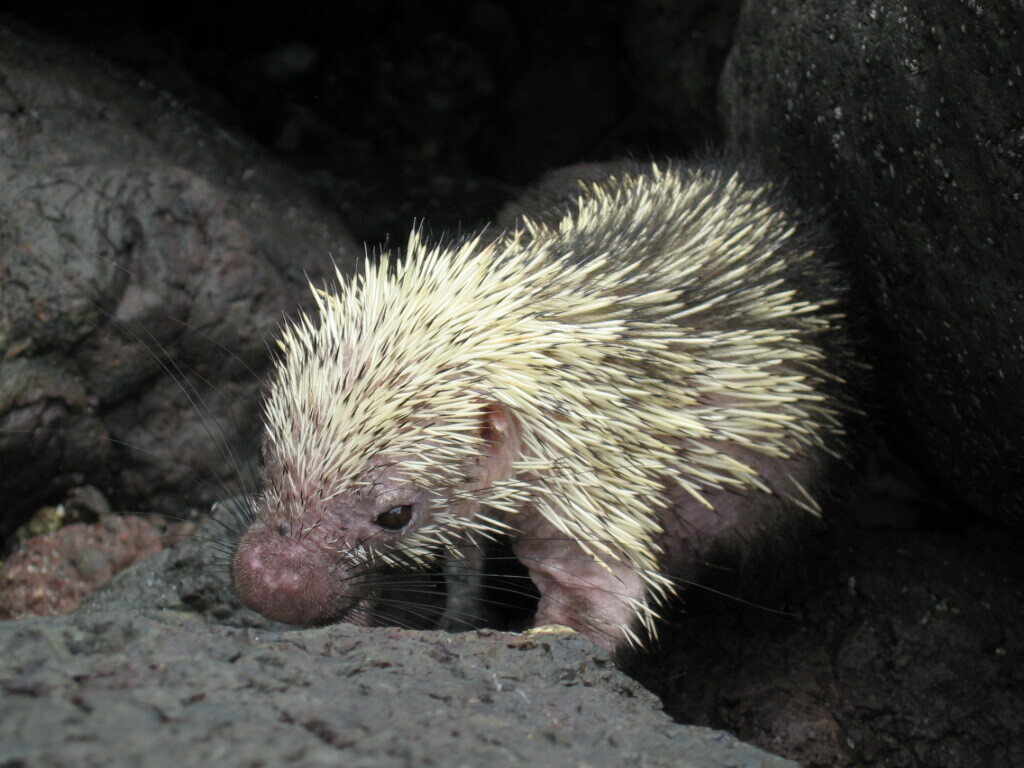
Mexican Hairy Porcupine
Photo © Sara Navarro
Photo © Sara Navarro — CC BY 4.0 — Source: iNaturalist photo #608241779Identification
The Mexican hairy porcupine is a distinctive small rodent with a striking two-tone appearance. Its most characteristic feature is a pale, nearly hairless head with yellowish spines clearly visible on the face, contrasting sharply with a dark, heavily furred body. The head-and-body length ranges from about 320 to 457 mm (12.6 to 18.0 inches), with a prehensile tail measuring 200 to 358 mm (8 to 14 inches) in length. These animals weigh up to about 2.6 kg (6 pounds), making them among the smaller porcupine species.
Despite being covered entirely in short yellowish spines, these are mostly hidden beneath a thick coat of long black hair. Only on the shoulders and back do spines occasionally project visibly through the fur. The snout is notably pink, broad, and bulbous, while the eyes are proportionally small. The prehensile tail is broad at its base and tapers to a fine point, serving as an important climbing aid. This species differs noticeably from the closely related Rothschild's porcupine, which is more obviously spiny and lacks the characteristic hairy coat.
Range & Habitat
The Mexican hairy porcupine is found across Central America and southern Mexico, with its range extending from Mexico south through Belize, Guatemala, El Salvador, Honduras, Nicaragua, Costa Rica, and into Panama. This wide distribution reflects its adaptability to various forest environments across the region.
As a strictly arboreal species, it inhabits forested areas where it can move freely through the canopy on its prehensile tail. During daylight hours, it shelters in hollow trees, conceals itself among leafy branches, or in highland regions, takes refuge in clumps of bamboo. The accumulation of droppings at these daytime retreats creates a distinctive and pungent odour that can aid in locating their favoured hiding spots.
Behaviour & Diet
This is a nocturnal species that is typically more active during dark nights, spending daylight hours in concealment. Mexican hairy porcupines are generally solitary and silent creatures, though they become notably more vocal during breeding season, emitting distinctive screams and yowls. Females usually give birth to a single offspring per breeding cycle.
Their diet consists of buds, young leaves, fruits, and seeds. They show particular preference for fruiting trees including Inga, Cecropia, Ficus, and Brosimum. The prehensile tail proves essential for their arboreal foraging lifestyle, allowing them to maintain secure positions on branches while feeding and moving through the forest canopy.
Best Time & Places to See It
Observing the Mexican hairy porcupine requires nocturnal wildlife watching, ideally during moonless nights when the species is most active. Night drives or night hikes in protected forest areas throughout their Central American and Mexican range offer the best opportunities. Look for them in humid lowland and highland forests where fruiting trees are abundant.
Searching for their daytime roosts can also increase your chances of locating them. Listen and smell for their characteristic dropping accumulations in hollow trees and bamboo clumps. Local guides familiar with forest ecology will greatly improve your success rate in finding these elusive nocturnal foragers.
Photography Tips
Photographing this species requires patience and specialized night equipment, including a powerful headlamp or spotlight and a camera capable of operating in low-light conditions. The pale head and dark body create striking visual contrast that photographs well when properly illuminated. Position yourself downwind of suspected daytime roosts to avoid disturbing the animal with human scent.
During nocturnal searches, move slowly and quietly through the forest, regularly scanning branches with your light source. The prehensile tail and climbing behaviour offer dynamic compositional opportunities. Capture images showing the animal gripping branches or demonstrating its characteristic posture in the canopy for images that convey its arboreal specialisation.
Corcovado National Park
Puerto Jiménez, Costa Rica
+444 birds+48 mammals
Where the Osa Peninsula juts into the Pacific, rainforest descends almost to the tide line, and Corcovado National Park protects one of Central America's most intact…
VIEW NATIONAL PARKManuel Antonio National Park
Quepos, Costa Rica
+426 birds+22 mammals
Where tropical rainforest descends steeply to a rocky Pacific coastline, Manuel Antonio National Park distills Central American biodiversity into one of Costa Rica's most compressed and…
VIEW NATIONAL PARKArenal Volcano National Park
Peñas Blancas, Costa Rica
+551 birds+21 mammals
Straddling the border between Alajuela and Guanacaste in northwestern Costa Rica, this national park rises dramatically around one of Central America's most active volcanic systems. The…
VIEW NATIONAL PARKTortuguero National Park
Roxana, Costa Rica
+420 birds+23 mammals
Canals and lagoons thread through a labyrinth of lowland rainforest where the Caribbean coast of Costa Rica meets the wetland frontier. This is terrain shaped by…
VIEW NATIONAL PARKSanta Rosa National Park
Santa Elena, Costa Rica
+359 birds+30 mammals
Where Pacific-facing slopes descend from volcanic uplands toward the Guanacaste lowlands, Santa Rosa National Park unfolds across a mosaic of tropical dry forest, gallery woodland, and…
VIEW NATIONAL PARKBaru Volcano National Park
Cerro Punta, Panama
+402 birds+6 mammals
Where the land rises sharply toward the Caribbean's western spine, Baru Volcano National Park sprawls across roughly 220 square kilometres of southwestern Panama, anchored by the…
VIEW NATIONAL PARKLaguna del Tigre National Park
Petén, Guatemala
+399 birds+29 mammals
Where the Petén lowlands dissolve into wetland and forest, Laguna del Tigre National Park protects one of Guatemala's most ecologically vital landscapes. This sprawling reserve encompasses…
VIEW NATIONAL PARKLos Quetzales National Park
Copey, Costa Rica
+232 birds+3 mammals
Cloud forest sweeps across the upper slopes of the Central Valley watershed, where elevation and persistent moisture forge an ecosystem unlike any other in Costa Rica.…
VIEW NATIONAL PARKRincón de la Vieja National Park
Liberia, Costa Rica
+451 birds+30 mammals
Where volcanic slopes rise abruptly from the Guanacaste lowlands, Rincón de la Vieja National Park sprawls across a landscape shaped by geothermal drama and seasonal extremes.…
VIEW NATIONAL PARKBarra del Colorado National Wildlife Refuge
Tortuguero, Costa Rica
+462 birds+36 mammals
Where the Caribbean's restless waters meet the Limón Province coastline, Barra del Colorado National Wildlife Sanctuary unfolds across a landscape of extraordinary ecological complexity. This equatorial…
VIEW WILDLIFE SANCTUARYNo community photos yet. Log in to add the first one.
No community observations of this species yet.