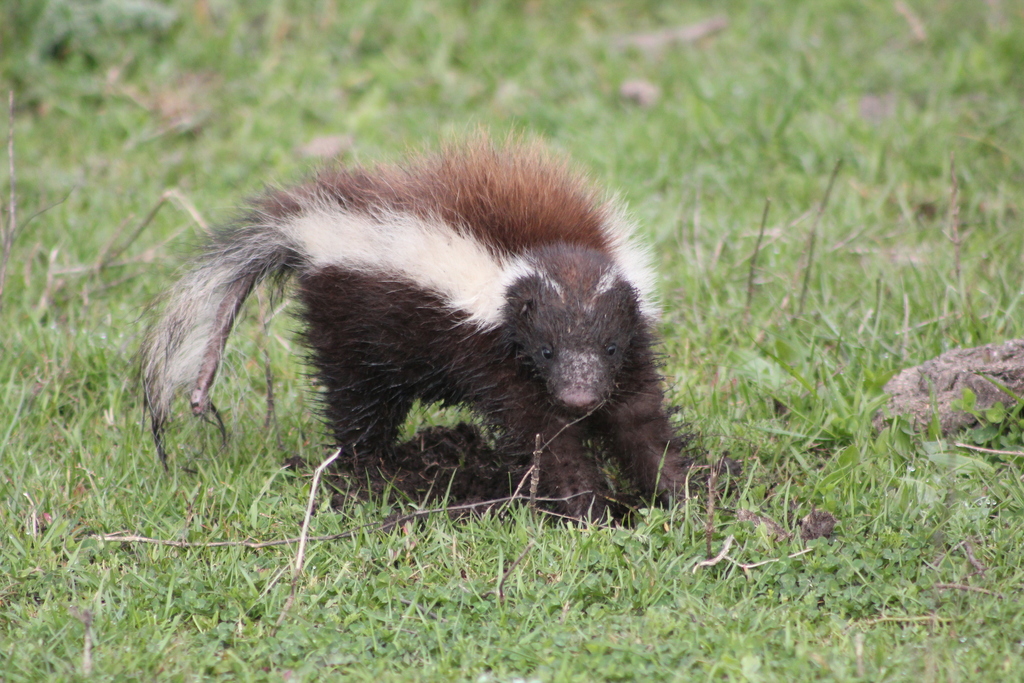
Molina’s Hog-nosed Skunk
Photo © Romi Galeota Lencina
Photo © Romi Galeota Lencina — CC BY 4.0 — Source: iNaturalist photo #54589830Molina's hog-nosed skunk, also called the Andes skunk (Conepatus chinga), is a skunk species from South America. It is found in Argentina, Bolivia, Brazil, Chile, Peru, Paraguay, and Uruguay, at elevations up to 5000 m. == Habitat == The Molina's hog-nosed skunk's native range is throughout mid to southern South America, Chile, Peru, northern Argentina, Bolivia, Paraguay, Uruguay, and southern Brazil. The mammal is therefore associated with temperate regions and open areas, mainly described as the Pampas biome and preferring to live in open vegetation, shrub forest and rocky sloped areas. == Population and distribution == Typically they will live alone in an average home range size of about 1.66 individuals/km2 with some overlapping and about six skunks per 3.5 km2. Although living in mostly solitary areas, the skunks will come together temporarily for mating purposes. == Diet == Foraging mainly at night, the skunk is omnivorous, eating birds, small mammals, eggs, insects, leaves, and fruit. The tooth morphology in the Molina's hog-nosed skunk, is different from most mammals in that their teeth are adapted to their omnivorous diet with grinding being the main function of the carnassial apparatus. == Conservation status == The skunk is listed as "least concern"…
Lauca National Park
Monte León National Park
Patagonia National Park
Torres del Paine National Park
Nothing matches these filters.
No community photos yet. Log in to add the first one.
No community observations of this species yet.