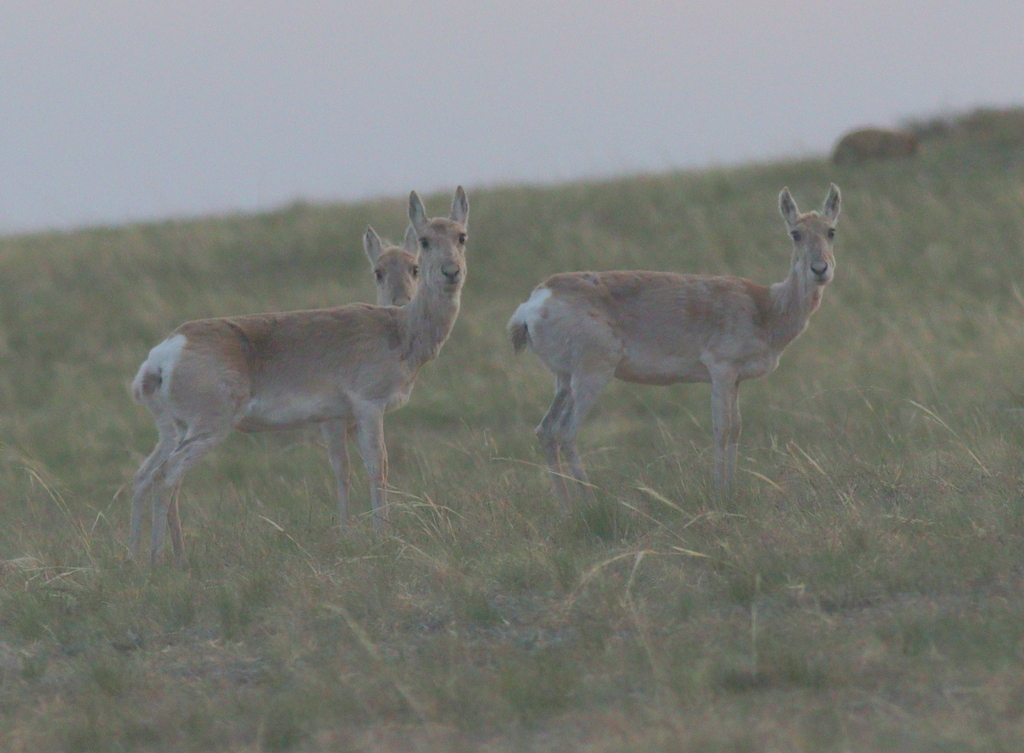
Mongolian Gazelle
Photo © Jan Ebr & Ivana Ebrová
Photo © Jan Ebr & Ivana Ebrová — CC BY 4.0 — Source: iNaturalist #215675745The Mongolian gazelle (Procapra gutturosa), or dzeren (Russian: дзерен), is a medium-sized antelope native to the semiarid Central Asian steppes of Mongolia, southern Siberia and northern China. The name dzeren is the Russian spelling and pronunciation of the Buryat zeeren (Buryat: зээрэн; akin to the Mongolian word zeer (Mongolian: зээр)). == Taxonomy == While the dzeren and its two sister-species (the Tibetan gazelle or goa and the rare Przewalski's gazelle of Qinghai, China) are commonly referred to as "gazelles", they are not technically "true" gazelles, as they are not placed within the Gazella genus. Rather, these three procaprid antelope species are placed together in their own genus, Procapra, falling under the tribe of Antilopini (of the subfamily Antilopinae), under the greater Bovidae family of the Artiodactyla Order. In general, the dzeren are fluffier-coated than true gazelles, possessing an almost "teddy bear"-like appearance, as opposed to the sleek and smooth, deer-like qualities of Gazella and other species. The dzeren's face is somewhat more comparable to a Chinese water deer than a true gazelle. == Description == In the summer, the dzeren has coat of tawny light brown with pale pinkish tones, which grows thicker, longer and paler during the winter. It…
Hustai National Park
Altanbulag, Mongolia
+198 birds+16 mammals
Where the steppe rolls endlessly beneath vast Mongolian skies, Hustai National Park preserves one of Central Asia's most dynamic grassland ecosystems. Rolling hills and open prairie…
VIEW NATIONAL PARKGobi Gurvan Saikhan National Park
Tsagaan Subarga Hural, Mongolia
+183 birds+23 mammals
Where rust-coloured badlands rise from the southern Gobi steppe, the terrain transforms into a landscape of geological drama that few visitors expect to find in Mongolia's…
VIEW NATIONAL PARKNo community photos yet. Log in to add the first one.
No community observations of this species yet.