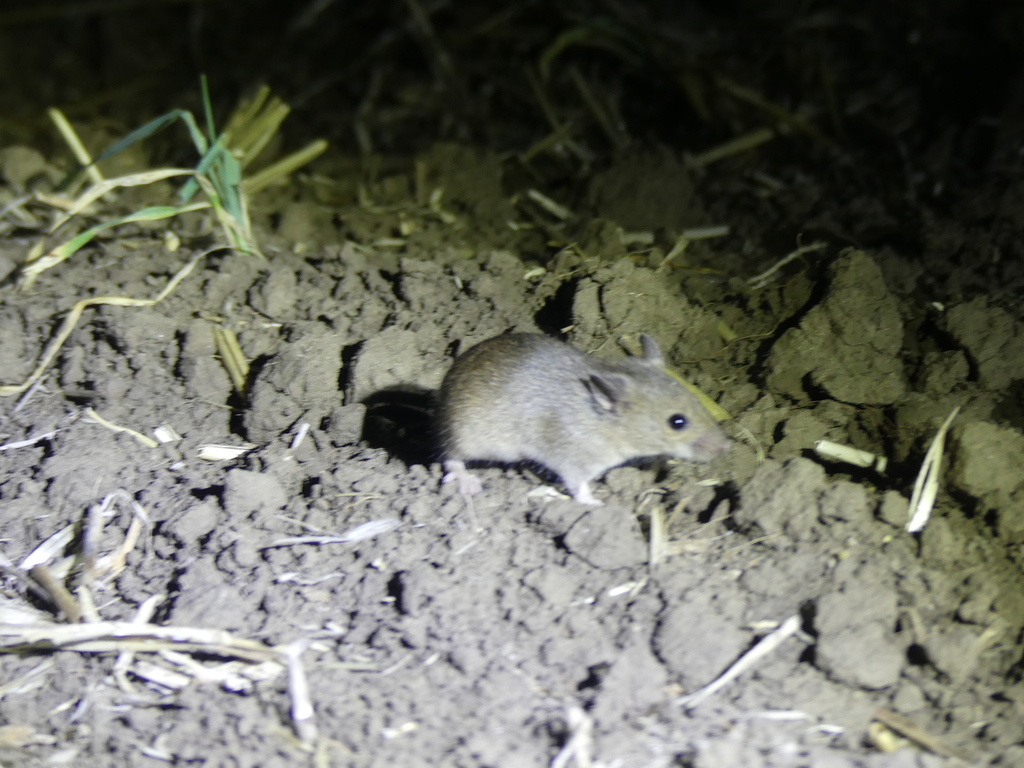
Mound-building Mouse
Photo © Valentin Moser
Photo © Valentin Moser — CC BY 4.0 — Source: iNaturalist photo #321300265The steppe mouse or mound-building mouse (Mus spicilegus) is a species of rodent in the family Muridae. It is found in grassland and other open areas in Austria, Bosnia and Herzegovina, Albania, Bulgaria, Croatia, Greece, Hungary, Moldova, Romania, Russia, Serbia, Montenegro, North Macedonia, Slovakia, and Ukraine. == Taxonomy == Mus spicilegus ranges from Austria to Southern Ukraine and Greece. Two subspecies are recognised, M. s. spicilegus, the nominate subspecies occupying most of the range, and M. s. adriaticus, an isolated sub-population on the Adriatic coast. It is one of four species of mice in the Mus subgenus with a western Palearctic distribution, the others being the Macedonian mouse (Mus macedonicus) (Balkans to Israel/Palestine and Iran), the Algerian mouse (Mus spretus) (Southern France, Iberian Peninsula, Balearic Islands, Morocco to Tunisia) and the Cypriot mouse (Mus cypriacus). Based on the molecular clock hypothesis, M. spicilegus and M. macedonicus seem to have diverged quite recently, between 0.29 and 0.17 mya, whereas the lineages giving rise to these and M. spretus diverged around 1 mya. == Description == The head-and-body length is between 70 and 80 mm (2.76 and 3.15 in) and the tail is between 55 and 65 mm (2.17 and 2.56 in)…
Danube Delta Biosphere Reserve
Tulcea, Romania
+277 birds+27 mammals
Where the Danube surrenders to the Black Sea, a vast labyrinth of channels, reed beds, and freshwater lakes sprawls across nearly 13,400 square kilometers of eastern…
VIEW NATIONAL PARKHortobágy National Park
Hortobágy, Hungary
+260 birds+17 mammals
Across the North Great Plain of Hungary stretches one of Europe's most expansive semi-natural grassland systems, where horizon-wide vistas of steppe and wetland create a landscape…
VIEW NATIONAL PARKNo community photos yet. Log in to add the first one.
No community observations of this species yet.