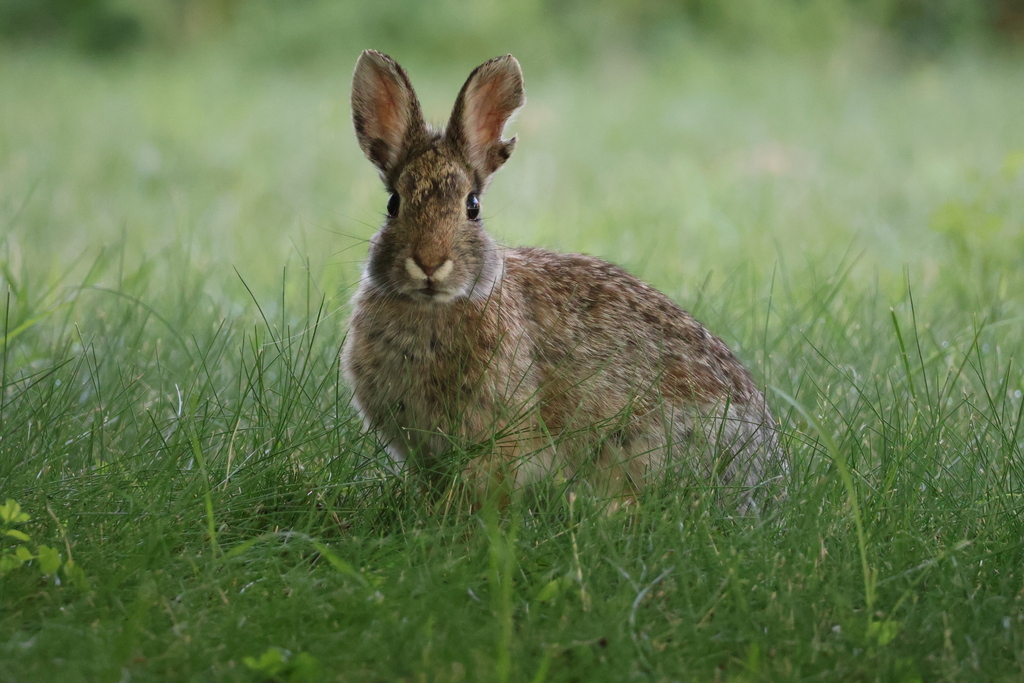
Mountain Cottontail
Photo © James Tetreau
Photo © James Tetreau — CC BY 4.0 — Source: iNaturalist photo #530570836The mountain cottontail or Nuttall's cottontail (Sylvilagus nuttallii) is a species of rabbit found in western Canada and the United States. It is a medium- to small-sized rabbit with pale brown fur, white undersides, a two-colored tail, and black-tipped, rounded ears with densely furred insides. It has notably rusty-colored legs and an orange nape. The mountain cottontail appears largely among coniferous forests in mountainous regions, including the slopes of the Rocky Mountains and the Cascade-Sierra Nevada mountain ranges, and adapts to a variety of elevations and vegetation. Its diet is made up of various grasses, shrubs, and sagebrush, as well as twigs, bark, or fungi in lesser amounts or when foliage is scarce. The mountain cottontail was first described in 1837 by naturalist John Bachman and named Lepus nuttallii; the specific name commemorates zoologist Thomas Nuttall. Marcus Ward Lyon Jr. placed the species in the genus Sylvilagus in 1904. The species is closely related to the desert cottontail, and less so to the swamp rabbit and marsh rabbit. There are three subspecies of the mountain cottontail, and limited evidence points to the three as each making up distinct species. The range of the mountain cottontail has shrunk as a result…
Great Basin National Park
White Pine County, United States
+170 birds+19 mammals
Where the Great Basin's high desert plateaus rise above 10,000 feet, ancient bristlecone pines endure on moonscape ridges of limestone and quartzite, creating one of North…
VIEW NATIONAL PARKArches National Park
Grand County, United States
+185 birds+20 mammals
Where rust-red sandstone fins rise abruptly from high desert scrubland, Arches National Park spans 548 square kilometers of one of North America's most sculptural landscapes. The…
VIEW NATIONAL PARKZion National Park
Washington County, United States
+244 birds+30 mammals
Towering sandstone cliffs in shades of crimson, rust, and cream rise abruptly from the Virgin River's winding canyon floor, their sculpted faces bearing witness to millions…
VIEW NATIONAL PARKYellowstone National Park
Park County, United States
+253 birds+43 mammals
Across nearly 11,400 square kilometres of the Rocky Mountain plateau, geothermal fury and pristine wilderness converge in one of Earth's most dynamic landscapes. Hot springs, geysers…
VIEW NATIONAL PARKBlack Canyon of the Gunnison National Park
Montrose County, United States
+169 birds+13 mammals
Where the Gunnison River has carved one of North America's steepest and most dramatic canyons, ancient metamorphic rock walls plunge nearly 2,000 feet in places, creating…
VIEW NATIONAL PARKBadlands National Park
Wall, United States
+200 birds+14 mammals
Eroded badlands rise in jagged formations across northwestern South Dakota, where the White River has carved deep canyons through layers of sedimentary rock spanning millions of…
VIEW NATIONAL PARKBryce Canyon National Park
Tropic, United States
+202 birds+20 mammals
Hoodoos rise like a forest of stone pillars from an amphitheater carved into Utah's high plateau, where the Paunsaugunt elevates the landscape to over 9,000 feet…
VIEW NATIONAL PARKGrand Canyon National Park
United States
+277 birds+35 mammals
A mile-deep chasm of rust-red rock and purple shadow cuts through the high desert plateau of northern Arizona, revealing nearly two billion years of geological history…
VIEW NATIONAL PARKWind Cave National Park
Custer County, United States
+175 birds+13 mammals
Beneath the rolling prairie of the Black Hills, a network of passages carved through limestone creates one of North America's most extensive cave systems. Wind Cave…
VIEW NATIONAL PARKMalheur National Wildlife Refuge
Harney County, United States
+309 birds+24 mammals
Across the high desert plateau of southeastern Oregon, where sagebrush scrubland stretches toward distant ridgelines under an enormous sky, lies a sanctuary shaped by water in…
VIEW WILDLIFE SANCTUARYNo community photos yet. Log in to add the first one.
No community observations of this species yet.