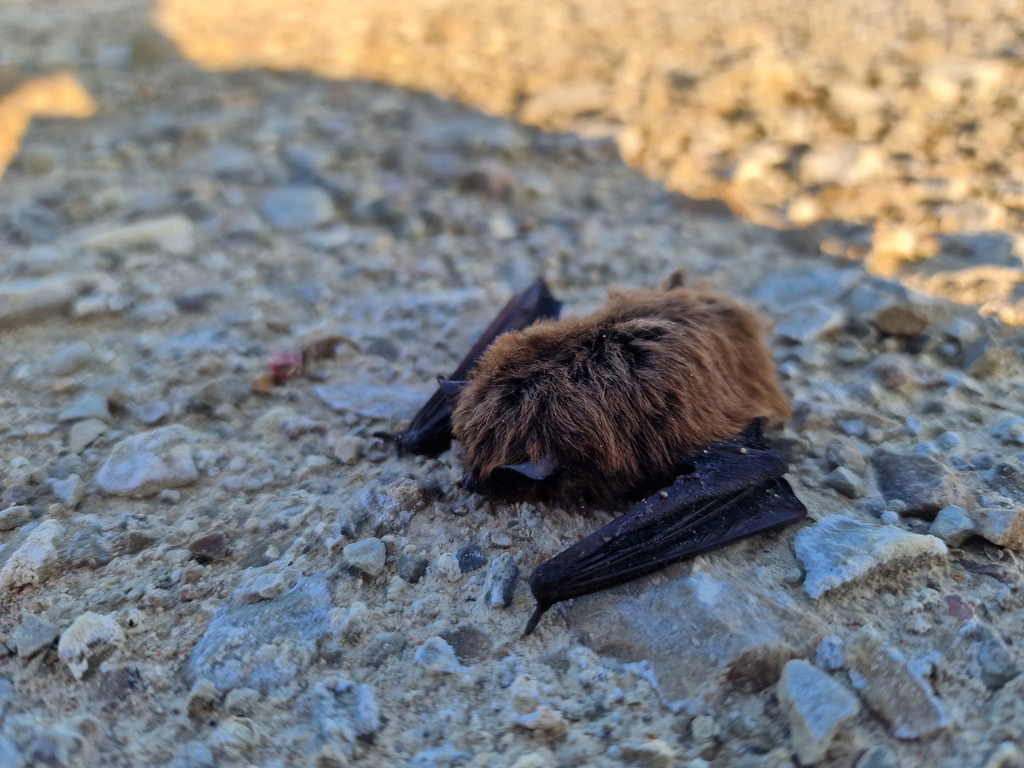
Nathusius’s Pipistrelle
Photo © Aurelijus Narbutas
Photo © Aurelijus Narbutas — CC BY 4.0 — Source: iNaturalist photo #424515544Identification
Nathusius's pipistrelle is a small bat easily confused with the common pipistrelle, though closer inspection reveals several distinguishing features. It measures 46–55 mm in head and body length, with a wingspan of 220–250 mm and weighing just 6–15.5 grams. The forearm is 32–40 mm long, and the fifth finger exceeds 43 mm. Compared to its common relative, this species is noticeably larger with broader wings, and its fur is longer and more irregularly colored. The upperparts display a medium-dark reddish-brown tone, often with paler tips, while the underparts are pale brown. The face, ears, wings, and tail are distinctly dark, providing useful field marks for identification.
Range & Habitat
This highly migratory species is widely distributed across Europe, ranging from Western Europe eastward to the Ural Mountains, Turkey, and the Caucasus. Individuals from northern and eastern populations migrate southwest to winter grounds, making their presence highly seasonal in many areas. Nathusius's pipistrelle is generally more common in Central and Eastern Europe, while in western regions it historically appeared mainly as a rare winter visitor. However, recent decades have brought significant range changes: new breeding colonies have been discovered across Western Europe, and the species is now known to breed at several sites in Britain and Ireland, where it was previously considered merely a vagrant.
The species favors parkland and light woodland habitats, with a strong preference for areas near water. It relies on hollow trees for breeding colonies, though it has adapted well to bat boxes and occasionally roosts in buildings. Threats include the loss of hollow trees and toxic timber treatments in structures, but legal protection and successful breeding in artificial roosts have helped stabilize populations in many countries.
Behaviour & Diet
Nathusius's pipistrelle is an early emerger, taking to the wing to hunt before many other bat species. It flies in characteristically straight lines with rapid, deep wingbeats, typically hunting at heights of 3 to 15 metres above the ground. Its diet consists primarily of small to medium-sized flying insects, with chironomid midges forming a particularly important food source. Mating occurs from July to early September, when males establish territories and gather harems of females. Females gather at nursery roosts in spring, where each gives birth to two young per season.
Best Time & Places to See It
Nathusius's pipistrelle is most reliably encountered in Central and Eastern Europe, where populations are most established. In Western Europe, winter months offer the best opportunity to encounter this migratory species. Recent range expansion means that Britain and Ireland now support breeding populations, making spring and summer viable seasons for observation in these regions. Look for activity over water and in open parkland or light woodland habitats, particularly during the early evening hours when this species emerges to hunt.
Photography Tips
Photographing Nathusius's pipistrelle requires specialized equipment for capturing fast-moving subjects in low light. High-speed flash and fast shutter speeds are essential to freeze the rapid wingbeats and straight-line flight pattern characteristic of this species. Its habit of hunting at modest heights (3–15 metres) and along predictable routes over water makes it more accessible than many bat species for patient photographers. Focus on distinguishing features such as the reddish-brown fur with pale tips and the darker face and ears to confirm identification in photographs.
Stenshuvuds National Park
Skåne län, Sweden
+224 birds+19 mammals
Where limestone cliffs rise sharply above the Øresund Strait, Stenshuvuds National Park commands the southeastern tip of Skåne, a landscape carved by glaciation into rolling beech…
VIEW NATIONAL PARKFärnebofjärden National Park
Gävleborgs län, Sweden
+170 birds+20 mammals
Where the Gävle River widens into a sprawling delta before meeting the Gulf of Bothnia, Färnebofjärden National Park unfolds across a landscape of exceptional ecological complexity.…
VIEW NATIONAL PARKHamburgisches Wattenmeer National Park
Hamburg, Germany
+206 birds+6 mammals
Where the North Sea exhales across the Elbe estuary, the tidal mudflats of Hamburgisches Wattenmeer National Park emerge twice daily in a landscape of extraordinary ecological…
VIEW NATIONAL PARKLower Oder Valley National Park
Schwedt/Oder, Germany
+216 birds+21 mammals
Where the Oder River winds through northeastern Brandenburg, the Lower Oder Valley National Park protects one of Central Europe's most vital wetland systems. This sprawling mosaic…
VIEW NATIONAL PARKSchleswig-Holsteinisches Wattenmeer National Park
Germany
+378 birds+49 mammals
Where the North Sea ebbs and flows across a vast expanse of exposed mud and sand, the Schleswig-Holsteinisches Wattenmeer National Park reveals one of Europe's most…
VIEW NATIONAL PARKPembrokeshire Coast National Park
Pembrokeshire, United Kingdom
+250 birds+41 mammals
Where the Cambrian coastline meets the Celtic Sea, cliff-top moorland and hidden coves define a landscape carved by 300 million years of geological drama. Pembrokeshire Coast…
VIEW NATIONAL PARKEryri National Park
Gwynedd, United Kingdom
+199 birds+36 mammals
Where granite peaks rise abruptly from the Snowdonia landscape, Eryri National Park encompasses one of Britain's most dramatic mountain terrain. The park's rugged plateaus, deep glacial…
VIEW NATIONAL PARKLake District National Park
Westmorland and Furness, United Kingdom
+209 birds+36 mammals
Where slate fells rise steeply from mirror-still waters, the Lake District unfolds as one of Britain's most ecologically intricate mountain landscapes. The park's patchwork of deep…
VIEW NATIONAL PARKSouth Downs National Park
Chichester, United Kingdom
+298 birds+45 mammals
Chalk downland ridges rise and fall across the South Downs, their open grasslands and beech hangers creating a mosaic of habitats that has shaped human settlement…
VIEW NATIONAL PARKCévennes National Park
Vebron, France
+187 birds+63 mammals
Where granite gorges slice through the limestone plateaux of southern France, the Cévennes Cœur National Park unfolds across nearly 3,500 square kilometres of one of Europe's…
VIEW NATIONAL PARKVanoise National Park
Val-Cenis, France
+107 birds+29 mammals
Where the French Alps rise in serrated ranks above the Maurienne valley, Vanoise National Park sprawls across more than 1,700 square kilometres of high-altitude wilderness—a realm…
VIEW NATIONAL PARKForêts National Park
Lucey, France
+140 birds+50 mammals
Across the rolling plateaux of central Burgundy, where limestone uplands give way to deep valleys carved by time and water, lies a landscape of profound ecological…
VIEW NATIONAL PARKCamargue Regional Nature Park
Saintes-Maries-de-la-Mer, France
+378 birds+48 mammals
Where the Rhône Delta sprawls into the Mediterranean, a landscape of stark and haunting beauty emerges—vast salt marshes punctuated by shallow lagoons, reed beds, and scrubland…
VIEW NATURAL PARKRegional Park of the Catalan Pyrenees
Olette, France
+244 birds+63 mammals
Where granite peaks thrust skyward above cloud-laden valleys, a wild tapestry of Mediterranean and alpine ecosystems interweaves across the Franco-Spanish frontier. These Pyrenean slopes harbour extraordinary…
VIEW NATURE RESERVELoch Lomond & the Trossachs National Park
Duchray, United Kingdom
+188 birds+40 mammals
Where ancient woodlands rise from glassy lochs and rugged Highland peaks pierce the lowland horizon, Scotland's most biodiverse landscape unfolds across 720 square kilometres of wild…
VIEW NATIONAL PARKKarula National Park
Võru County, Estonia
+110 birds+9 mammals
Where glacial lakes pierce a landscape of boreal forest and bogland, Karula National Park sprawls across 222 square kilometers of southeastern Estonia, a sanctuary where the…
VIEW NATIONAL PARKSoomaa National Park
Viljandi County, Estonia
+172 birds+20 mammals
Across the boglands of south-central Estonia, where water dominates more than half the landscape, lies one of northern Europe's most hydrologically dynamic national parks. The terrain…
VIEW NATIONAL PARKLahemaa National Park
Lääne-Viru County, Estonia
+237 birds+25 mammals
Where the Baltic coast meets temperate forest in northwestern Estonia, Lahemaa National Park sprawls across more than 1,300 square kilometers of deeply character-filled terrain. Coastal wetlands…
VIEW NATIONAL PARKLosiny Ostrov National Park
Balashikhinsky District, Russia
+173 birds+20 mammals
Across the forested plateaus of Moscow Oblast, where the Losinka River winds through mixed woodland and marshy clearings, lies a national park that captures the ecological…
VIEW NATIONAL PARKPort-Cros National Park
Hyères, France
+271 birds+29 mammals
Where Mediterranean granite islands rise from crystalline waters off the Provençal coast, Port-Cros National Park protects one of Europe's most intact marine and terrestrial ecosystems. The…
VIEW NATIONAL PARKNo community photos yet. Log in to add the first one.
No community observations of this species yet.