Noki
Photo © Vernon Swanepoel
Photo © Vernon Swanepoel — CC BY 4.0 — Source: Wikimedia CommonsIdentification
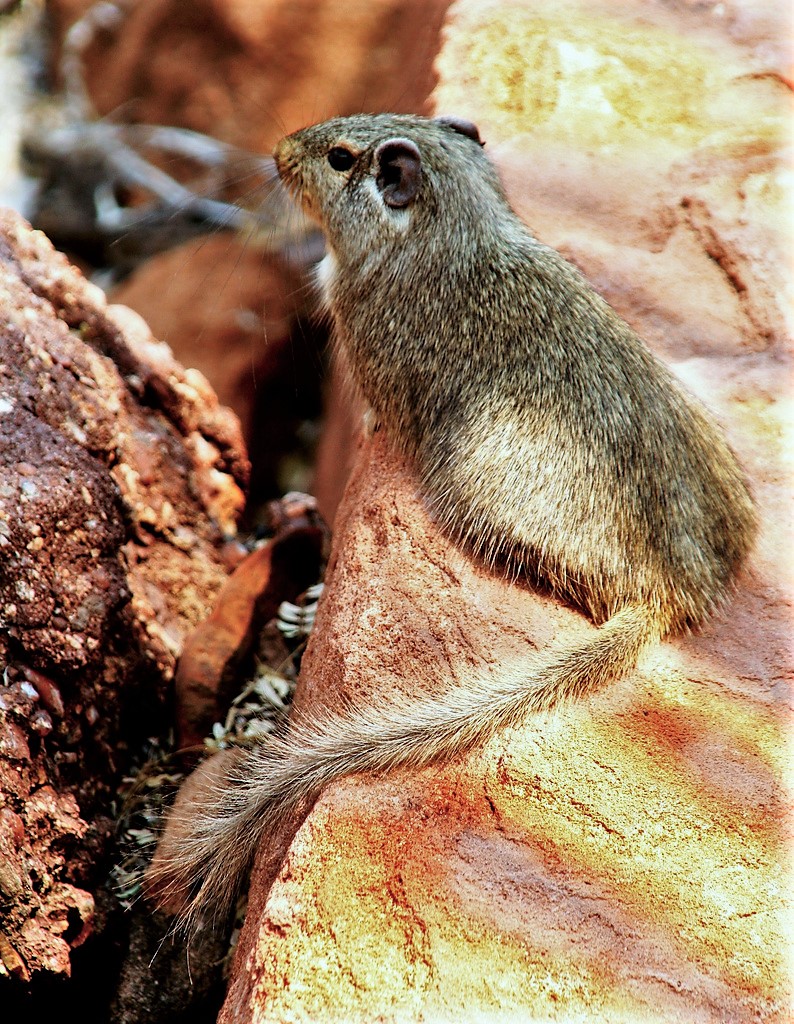
The noki, or dassie rat, is a squirrel-like rodent with several distinctive anatomical features that reflect its rock-dwelling lifestyle. Its most remarkable characteristic is a flattened skull and flexible ribs, allowing it to squeeze into impossibly narrow rock crevices for shelter. The animal's overall coloration ranges from brown to grey to nearly black, while its yellowish nose stands out prominently against its face. The tail is hairy but not bushy, and the soles of the feet are bare with characteristic pads. Notably, dassie rats lack underfur, and their cheek teeth bear two raised ridges adapted for grinding plant material using a distinctive vertical chewing motion rather than the side-to-side grinding of typical grazers.
An unusual reproductive adaptation reveals how thoroughly this species is specialized for crevice living: the teats are positioned on the sides of the torso, allowing young to nurse from the side while compressed in narrow rock shelters.
Range & Habitat
The noki is found exclusively in southern Africa, inhabiting rocky areas across Namibia, southwestern Angola, and northwestern South Africa. These rodents are entirely dependent on rock outcrops, spending most of their time on or near rocky terrain where they find refuge in cracks and crevices. They share this rocky-habitat niche with hyraxes, animals to which they bear no close evolutionary relationship—the Afrikaans name "dassie" actually means hyrax, reflecting this shared ecological preference rather than any taxonomic connection.
Behaviour & Diet
Dassie rats are diurnal animals, active during daylight hours and often observed basking in the sun on rocks. They are generalist herbivores with a clear preference for high-fiber grasses, but their diet also includes leaves, stems, flowers, fruits, and seeds. Studies confirm they refuse insects even when offered, indicating a strictly plant-based diet. These rodents use their front feet to manipulate food and sometimes rear up on their hind legs; males may bend forward into characteristic grooming postures.
Socially, dassie rats are monogamous, with male-female pairs maintaining long-term bonds and shared home ranges. Both partners defend their territory together and shelter in the same rock crevices. Breeding typically produces a single well-developed baby per year, with births timed to coincide with periods of greater food availability. Both parents participate in offspring care.
Best Time & Places to See It
To observe noki, focus on rocky outcrops in Namibia, southwestern Angola, and northwestern South Africa. These diurnal creatures are most visible during daylight hours, particularly when they are active and basking on rocks. Rocky habitat is essential—they are rarely encountered away from their crevice shelters. The species is listed as Least Concern, suggesting populations remain stable across its range.
Photography Tips
Photograph noki during bright daylight hours when they are most active and visible on rock surfaces. Their distinctive yellowish nose and varied brown-grey coloration provide good contrast against rocky backgrounds. Capture them in characteristic poses—basking in sun, using their front feet to handle food, or standing upright. Rock crevices form natural framing elements. Since they are adapted to narrow spaces, wide-angle shots showing them in their rocky habitat alongside close portraits will best convey their specialized lifestyle and anatomy.
Augrabies Falls National Park
Kai !Garib Local Municipality, South Africa
+176 birds+20 mammals
Where the Orange River cuts a dramatic scar through the Northern Cape's arid interior, Augrabies Falls National Park sprawls across nearly 1,200 square kilometers of raw,…
VIEW NATIONAL PARKSperrgebiet National Park
Barcelona, Namibia
+181 birds+18 mammals
Where the Namib's ancient gravel plains meet the Atlantic coast, one of Africa's most remote and geologically austere landscapes unfolds across more than 56,000 square kilometres.…
VIEW NATIONAL PARKDorob National Park
Henties Bay, Namibia
+230 birds+13 mammals
Where the Skeleton Coast meets the Namib Desert's inland reaches, Dorob National Park sprawls across 34,021 square kilometres of one of southern Africa's most austere and…
VIEW NATIONAL PARKNamib-Naukluft National Park
Namibia
+217 birds+33 mammals
Across nearly 94,000 square kilometers of southwestern Namibia, a landscape of extremes unfolds where towering sand dunes meet rugged mountain ranges, and ancient riverbeds carve through…
VIEW NATIONAL PARKEtosha National Park
Namibia
+356 birds+58 mammals
Across northern Namibia's stark semi-arid plateau, a vast shallow depression transforms seasonally into one of Africa's most dramatic wildlife theaters. Etosha National Park, encompassing more than…
VIEW NATIONAL PARKNo community photos yet. Log in to add the first one.
No community observations of this species yet.