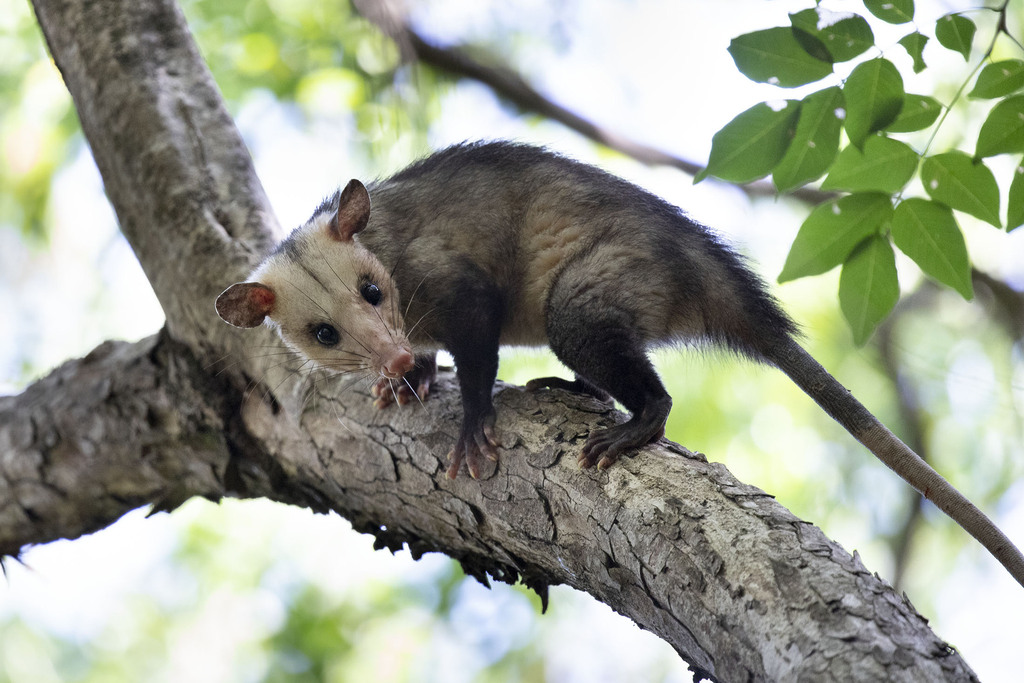
Northern Black-eared Opossum
Photo © Kristof Zyskowski
Photo © Kristof Zyskowski — CC BY 4.0 — Source: iNaturalist photo #249521936Identification
The Northern Black-eared Opossum is similar in size to a house cat, with a body length of nearly a foot and a distinctive naked tail that can reach almost two feet long. Adults weigh more than three pounds, making them one of the largest members of the Didelphidae family. Despite their pale peach-colored face and lighter extremities, these opossums are named for their characteristically large black ears. Their fur is deceptive: the visible coat consists of long black guard-hairs covering a hidden yellow under-fur. The tail, fingers, and face are notably lighter in color, and their eyes reflect a distinctive reddish hue in light.
Range & Habitat
This species ranges from northeastern Mexico through Central America and South America to Bolivia, reaching the Pacific coast of central Peru and extending into Trinidad and Tobago and the Windward Islands of the Caribbean, where locals call it the manicou. Northern Black-eared Opossums inhabit tropical and subtropical forests—both primary and secondary growth—at elevations up to 2,200 meters (7,200 feet), though they also adapt to fields and urban areas. They nest in tree hollows most commonly, but readily dig burrows or use any dark shelter when necessary, which sometimes brings them into conflict with humans.
Behaviour & Diet
These marsupials are primarily nocturnal and terrestrial, with males most active between 11 pm and 3 am. Outside the breeding season, they are solitary and non-territorial. When threatened, they employ the famous defense strategy of playing dead. Northern Black-eared Opossums are dietary generalists with remarkable adaptability. Their teeth enable them to consume insects, earthworms, small vertebrates including toads and snakes, birds, small mammals, fruits, vegetables, nectar, and carrion. In urban settings, they readily scavenge from compost and garbage, a behavior that has earned them an occasional pest reputation.
Best Time & Places to See It
Since these opossums are strictly nocturnal, nighttime wildlife watching offers the best chance of encounters. They are most active between 11 pm and 3 am. Look in forests, forest edges, and even urban gardens throughout their broad range from Mexico to Peru. Their presence is indicated by overturned trash cans and signs of ground foraging. The dry season may alter their activity patterns and home ranges, particularly in males, potentially affecting sighting opportunities.
Photography Tips
Night photography is essential for capturing this species in its active state. Use a headlamp or red light to preserve the animals' natural behavior and your own night vision. The contrast between their dark fur and pale face provides good compositional elements, and their distinctive large ears make for recognizable portraits. Patience is key—observe quietly near potential feeding sites such as forest floors and gardens. Be prepared for rapid movement; these opossums are surprisingly mobile when foraging. The reflective quality of their eyes can add character to low-light shots, though avoid direct bright flashes that may stress the animal.
Tortuguero National Park
Roxana, Costa Rica
+420 birds+23 mammals
Canals and lagoons thread through a labyrinth of lowland rainforest where the Caribbean coast of Costa Rica meets the wetland frontier. This is terrain shaped by…
VIEW NATIONAL PARKSanta Rosa National Park
Santa Elena, Costa Rica
+359 birds+30 mammals
Where Pacific-facing slopes descend from volcanic uplands toward the Guanacaste lowlands, Santa Rosa National Park unfolds across a mosaic of tropical dry forest, gallery woodland, and…
VIEW NATIONAL PARKYasuní National Park
Aguarico, Ecuador
+601 birds+43 mammals
Where the western Amazon basin converges with Ecuador's Orellana Province, lowland rainforest reaches toward the horizon in an unbroken canopy of staggering botanical density. Yasuní National…
VIEW NATIONAL PARKNatural Farallones de Cali National Park
Buenaventura, Colombia
+733 birds+27 mammals
Where the Pacific coastal plain meets the western slopes of the Andes, Farallones de Cali National Park sprawls across nearly 3,500 square kilometers of dramatic topography…
VIEW NATIONAL PARKAmacayacu National Park
Leticia, Colombia
+567 birds+25 mammals
Where the Rio Amazonas curves through the tri-border region where Colombia, Peru, and Brazil converge, Amacayacu National Park sprawls across more than 5,250 square kilometres of…
VIEW NATIONAL PARKManu National Park
Manu, Peru
+892 birds+26 mammals
Across the eastern slopes of the Peruvian Andes, tropical rainforest descends into the Amazon basin with a complexity that few terrestrial ecosystems match. Manu National Park…
VIEW NATIONAL PARKCoiba National Park
Montijo, Panama
+260 birds+10 mammals
An archipelago of volcanic and sedimentary islands rises from the Pacific waters off Panama's southwestern coast, its densest rainforest canopy unbroken for millennia. Coiba National Park…
VIEW NATIONAL PARKSoberanía National Park
Cristóbal, Panama
+495 birds+34 mammals
Rainforest and riverine woodland blanket the rolling terrain of this 714-square-kilometre national park in Colón Province, where the Caribbean watershed feeds a maze of streams and…
VIEW NATIONAL PARKDarién National Park
Tucutí, Panama
+534 birds+13 mammals
Where the spine of Central America crumbles into wetland and rainforest, Darién National Park sprawls across more than 20,000 square kilometres of some of the tropics'…
VIEW NATIONAL PARKPortobelo National Park
Portobelo, Panama
+366 birds+9 mammals
Where the Caribbean's turquoise waters meet the Darién's verdant shore, Portobelo National Park sprawls across 570 square kilometers of coastal forest, mangrove wetland, and coral-fringed islands…
VIEW NATIONAL PARKParque Internacional la Amistad
Teribe, Panama
+325 birds+11 mammals
Where the continental divide rises between the Caribbean and Pacific watersheds, a wilderness of extraordinary biological richness unfolds across the Talamanca Range and into lowland rainforest—a…
VIEW NATIONAL PARKPalo Verde National Park
Bagaces, Costa Rica
+318 birds+24 mammals
Dry forest spreads across Palo Verde's low-lying terrain in northwestern Guanacaste, where seasonal rivers and lagoons etch through deciduous woodland that sheds its canopy each winter.…
VIEW NATIONAL PARKCaño Negro National Wildlife Refuge
Caño Negro District, Costa Rica
+486 birds+16 mammals
Where the San Juan River's seasonal floodplain opens into expansive wetlands, Caño Negro Wildlife Sanctuary sprawls across one of Central America's most productive freshwater ecosystems. This…
VIEW WILDLIFE SANCTUARYBarra del Colorado National Wildlife Refuge
Tortuguero, Costa Rica
+462 birds+36 mammals
Where the Caribbean's restless waters meet the Limón Province coastline, Barra del Colorado National Wildlife Sanctuary unfolds across a landscape of extraordinary ecological complexity. This equatorial…
VIEW WILDLIFE SANCTUARYNo community photos yet. Log in to add the first one.
No community observations of this species yet.