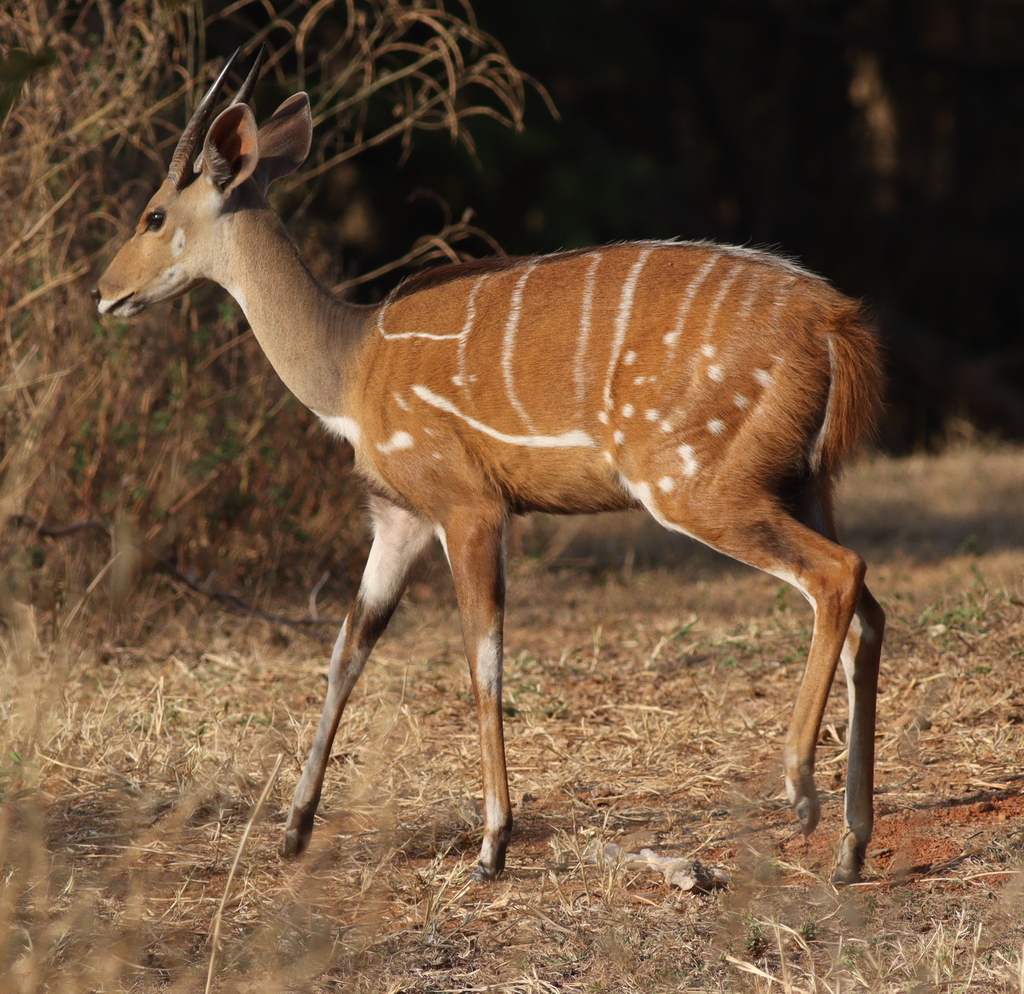
Northern Bushbuck
Photo © Jan Ebr & Ivana Ebrová
Photo © Jan Ebr & Ivana Ebrová — CC BY 4.0 — Source: iNaturalist #195594084Identification
The northern bushbuck is a medium-sized antelope characterized by a mainly red or yellow-brown coat. Males in West African populations are notably more often striped than their counterparts in East or Southern Africa, though striped individuals occur throughout the species' range. This coloration and pattern variation makes each population visually distinct, offering field observers multiple identification features across different regions.
Range & Habitat
The northern bushbuck is widespread across sub-Saharan Africa, occurring from Senegal, Gambia, Guinea, and Sierra Leone through Ghana and the Niger Basin in Nigeria, extending eastward to the Cross River. Its range continues south of the Bamenda Highlands through Cameroon, Chad, and the Central African Republic to the Nile in South Sudan and northern Uganda, with populations also present in Gabon, the Republic of the Congo, the Democratic Republic of the Congo, and northern Angola.
This species is common across its broad geographic distribution and adapts to diverse habitats including wooded savannas, forest-savanna mosaics, rainforests, montane forests, and semi-arid zones. Notably, it does not inhabit the deep rainforests of the central Congo Basin, preferring more open or transitional woodland environments.
Behaviour & Diet
While specific behavioural details are limited in available data, the northern bushbuck's success across such varied habitats suggests considerable ecological flexibility. Its presence in both semi-arid and montane forest zones indicates an adaptable species capable of thriving in multiple environmental conditions throughout its extensive range.
Best Time & Places to See It
The northern bushbuck's widespread distribution and common status across sub-Saharan Africa make it accessible to wildlife travellers throughout much of West, Central, and East Africa. Forest-savanna mosaic habitats and wooded savannas offer the best opportunities for observation, particularly in protected areas spanning from West African nations through the Congo Basin and into East African regions.
Photography Tips
The variation in coat coloration and striping patterns across geographic populations provides excellent photographic opportunities. West African males' more pronounced striping offers striking compositional possibilities compared to less-marked eastern and southern populations. The species' medium size and woodland habitat preference reward photographers with accessible subjects in forest-edge and mosaic environments, where morning and late-afternoon light can beautifully illuminate the distinctive red-brown pelage.
Bwindi Impenetrable National Park
Lake Mburo National Park
Murchison Falls National Park
Queen Elizabeth National Park
Aberdare National Park
Bwabwata National Park
Chyulu Hills National Park
Kidepo Valley National Park
Lake Manyara National Park
Nothing matches these filters.
No community photos yet. Log in to add the first one.