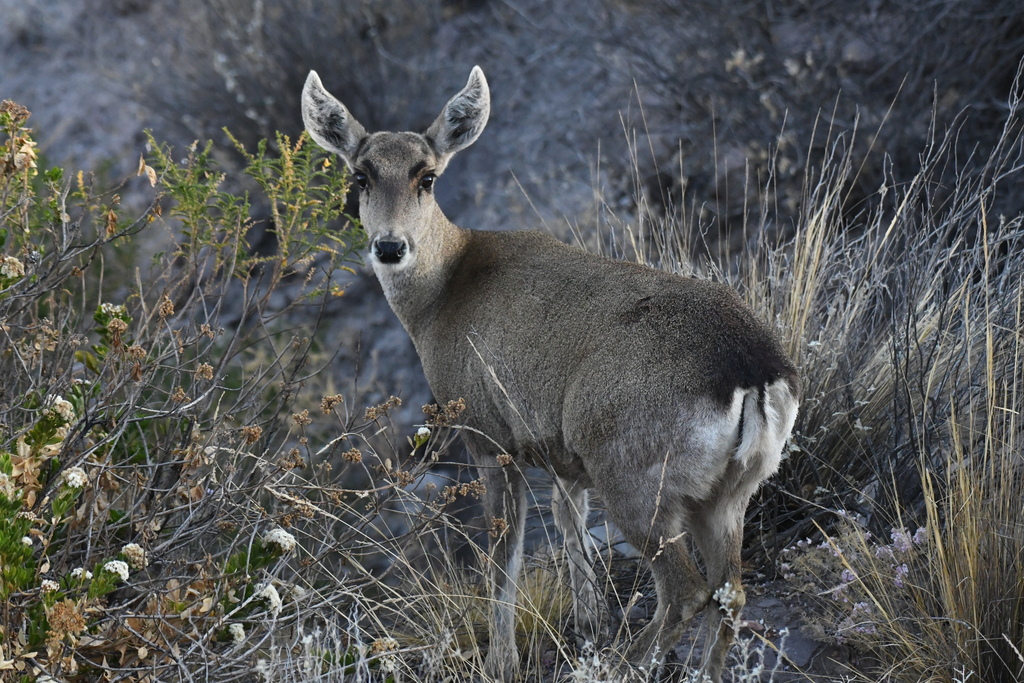
Northern Huemul
Photo © Tristan Jobin
Photo © Tristan Jobin — CC BY 4.0 — Source: iNaturalist photo #249293723The taruca (Hippocamelus antisensis), also known as the taruka, Peruvian guemal, north Andean deer, north Andean huemul, northern huemul or northern guemal, is a mid sized deer species that inhabits the high regions of the Andes mountains in South America. The common name taruca means "deer" in both the Quechua and Aymara languages. The taruca is closely related to the southern guemal (H. bisulcus), the only other member of the Hippocamelus genus. == Description == The taruca is a medium-sized deer with a heavy body. It measures 128 to 146 cm (50 to 57 in) from head to rump, with an 11 to 13 cm (4.3 to 5.1 in) tail, and stands 69 to 80 cm (27 to 31 in) tall at the shoulder. Adults weigh between 69 and 80 kg (152 and 176 lb). As with most deer, males are significantly larger than females. It has sandy brown fur over most of its body, with white patches on the underside of its head, neck, tail, and genital region, and on the inner surface of its fore-legs. While females often have a dark brown area on the forehead, facial markings are much clearer in the males. The exact patterns vary…
Huascarán National Park
Independencia, Peru
+201 birds+5 mammals
Where granite peaks pierce the Andean sky above 6,000 metres, Huascarán National Park sprawls across more than 11,500 square kilometres of Peru's Cordillera Blanca, a landscape…
VIEW NATIONAL PARKLauca National Park
Putre, Chile
+139 birds+17 mammals
Where the Andes rise toward the altiplano in Chile's far north, Lauca National Park sprawls across more than 3,000 square kilometres of some of South America's…
VIEW NATIONAL PARKLos Cardones National Park
Argentina
+193 birds+6 mammals
Where the Andes descend into northwestern Argentina, Los Cardones National Park sprawls across nearly 1,200 square kilometres of one of South America's most distinctive high-altitude desert…
VIEW NATIONAL PARKNo community photos yet. Log in to add the first one.
No community observations of this species yet.