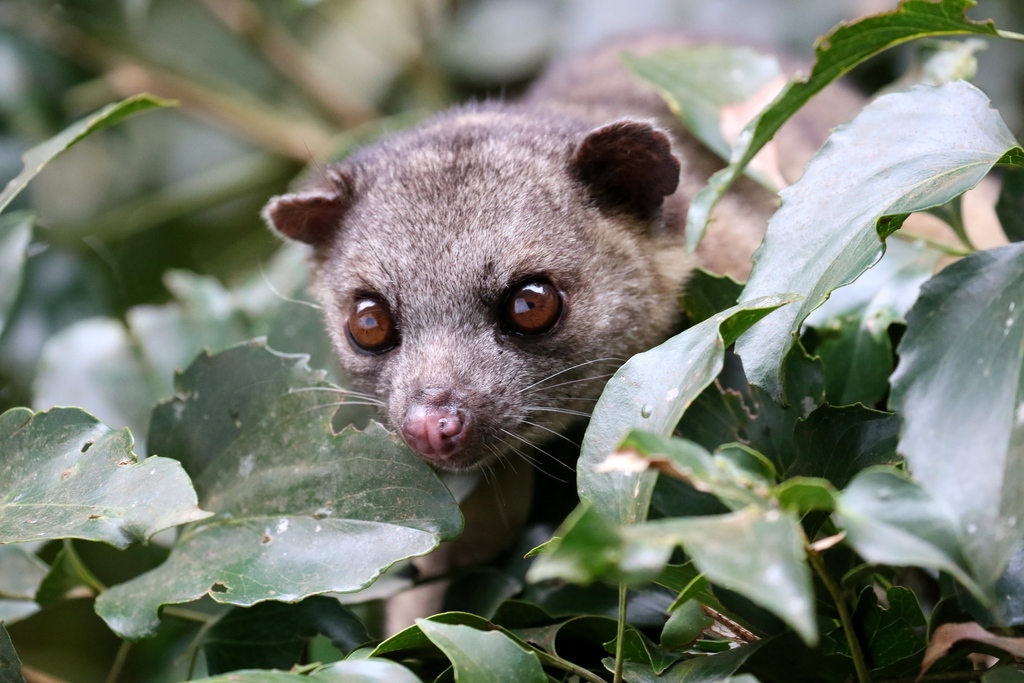
Northern Olingo
Photo © Thomas Galewski
Photo © Thomas Galewski — CC BY 4.0 — Source: iNaturalist photo #89638928The northern olingo (Bassaricyon gabbii), also known as the bushy-tailed olingo or, simply, the olingo (due to it being the most common of the species), is an arboreal (tree-dwelling) member of the raccoon family, Procyonidae, which also includes the coatimundis and kinkajou. Native to Central America, it was the first species of olingo to be scientifically described; while it is considered by some authors to be the only "true" olingo species, a review of the genus Bassaricyon had shown there to be a total of four species, two of those now being considered synonymous with the northern olingo. Its specific name honors William More Gabb (1839-1878), who found and collected the first specimen for western science. == Description == The northern olingo is a slender arboreal animal, with hind legs distinctly longer than the fore legs, and a long, bushy tail. The face is short and rounded, with relatively large eyes and short round ears. The fur is thick and colored brown or grey-brown over most of the body, becoming slightly darker along the middle of the back, while the underparts are light cream to yellowish. A band of yellowish fur runs around the throat and sides of the head…
Arenal Volcano National Park
Peñas Blancas, Costa Rica
+551 birds+21 mammals
Straddling the border between Alajuela and Guanacaste in northwestern Costa Rica, this national park rises dramatically around one of Central America's most active volcanic systems. The…
VIEW NATIONAL PARKBaru Volcano National Park
Cerro Punta, Panama
+402 birds+6 mammals
Where the land rises sharply toward the Caribbean's western spine, Baru Volcano National Park sprawls across roughly 220 square kilometres of southwestern Panama, anchored by the…
VIEW NATIONAL PARKParque Internacional la Amistad
Teribe, Panama
+325 birds+11 mammals
Where the continental divide rises between the Caribbean and Pacific watersheds, a wilderness of extraordinary biological richness unfolds across the Talamanca Range and into lowland rainforest—a…
VIEW NATIONAL PARKNo community photos yet. Log in to add the first one.
No community observations of this species yet.