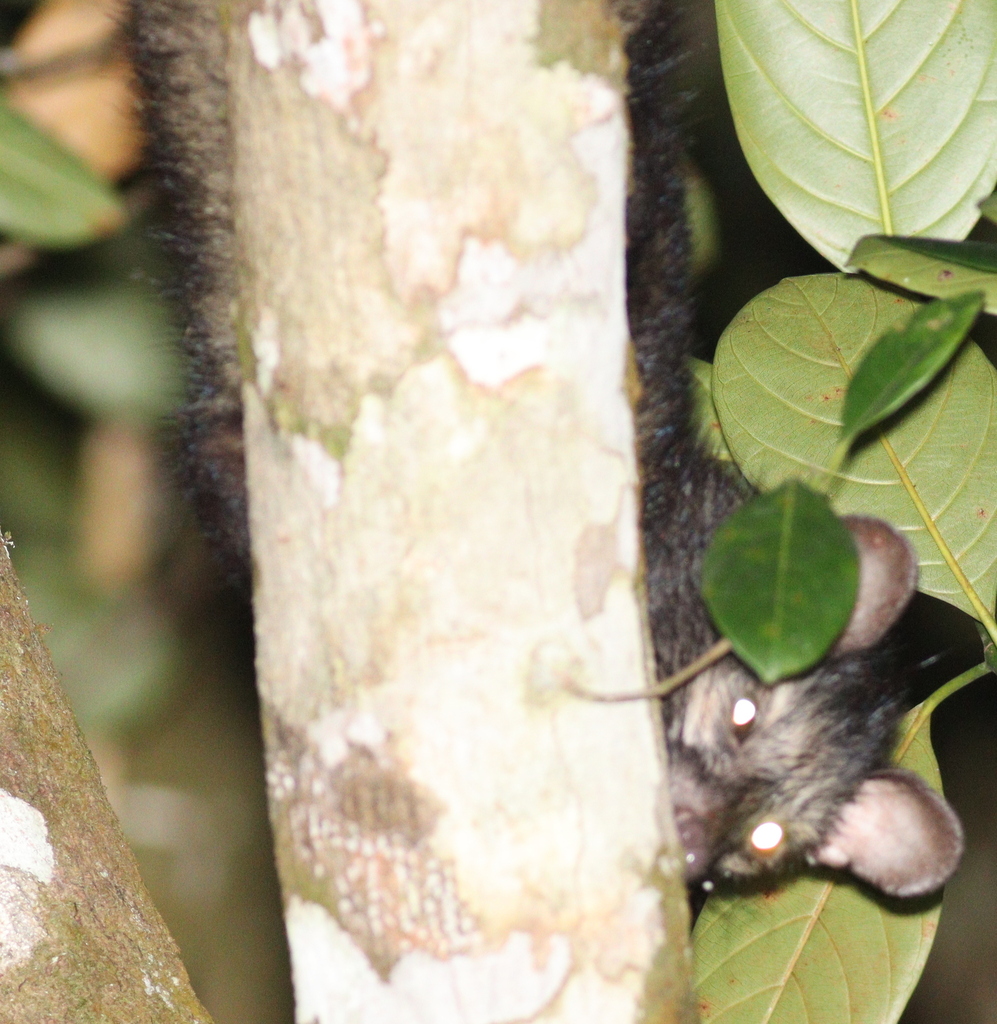
Northern Palm Civet
Photo © Jan Ebr & Ivana Ebrová
Photo © Jan Ebr & Ivana Ebrová — CC BY 4.0 — Source: iNaturalist #267314795Identification
The Northern Palm Civet is a small, stocky viverrid with a distinctly marked face and compact build. Its coarse, shaggy coat is typically greyish, with a characteristic white mask across the forehead, small white patches under each eye, and white spots on either side of the nostrils. A narrow dark line runs between the eyes, and three rows of black markings stripe the body. The muzzle, ears, lower legs, and the distal half of the tail are black. Head-to-body length averages around 53 cm with a 48 cm unringed tail, and the animal weighs between 2 and 5 kg. When threatened, it releases a distinctive and nauseating secretion from its anal scent glands as a chemical defense.
Range & Habitat
This species is widely distributed throughout South and Southeast Asia, ranging from India, Nepal, Bangladesh, Bhutan, and Sri Lanka through Myanmar, Thailand, Peninsular Malaysia, Singapore, Laos, Cambodia, and Vietnam, to China, the Philippines, Borneo, and Indonesian islands including Sumatra, Java, Bawean, and Siberut. It has also been introduced to Irian Jaya, the Lesser Sunda Islands, Maluku, and Sulawesi, though its presence in Papua New Guinea remains uncertain.
The Northern Palm Civet primarily inhabits primary forests but also occurs at lower densities in secondary and selectively logged forest, demonstrating adaptability to a broad range of habitats. This flexibility has contributed to its stable conservation status since 2008, when it was classified as Least Concern by the IUCN.
Behaviour & Diet
The Northern Palm Civet is believed to lead a solitary lifestyle except during brief mating periods. It is both terrestrial and arboreal, displaying nocturnal activity with peaks between late evening and after midnight, and additional activity from dawn until around 4:00 a.m. Moonlight affects its behavior—the animal is noticeably less active during nights with bright moonlight. The species uses scent marking extensively, dragging its perineal gland to leave chemical signals on substrates, with males and females showing different patterns of scent marking and olfactory responses.
An omnivore, the Northern Palm Civet feeds primarily on fruits including berries, pulpy fruits, chiku, mango, and rambutan, along with small mammals and insects. Through seed dispersal, it plays a vital ecological role in maintaining tropical forest ecosystems and aids in the natural regeneration of certain palm species. Despite its solitary and nocturnal nature, little is known about its reproductive behavior beyond a single documented observation of a mating pair in 2010.
Best Time & Places to See It
The Northern Palm Civet's nocturnal habits and solitary nature make it a challenging species to observe in the field. Your best opportunities occur during night-time wildlife surveys in forested areas throughout its range. The species is active from late evening through the early morning hours, with activity peaks between dusk and midnight. Nights with lower moonlight intensity offer better chances of observation, as the animal is noticeably less active during bright moonlit nights. Primary forests offer the highest densities, though secondary and logged forests also harbor populations.
Photography Tips
Photographing the Northern Palm Civet requires patience, night-vision equipment, and a thorough understanding of its nocturnal behavior. Since the species is most active after dark and less likely to be observed during bright moonlit nights, plan your photography expeditions for darker lunar phases. The animal's arboreal tendencies mean positioning yourself to capture it moving through the canopy or along branches will showcase its natural behavior. A camera trap setup near active feeding areas in fruiting trees may yield results, though the species' solitary nature and low densities make opportunistic encounters rare. Its distinctive facial mask and markings are key identification features worth highlighting when capturing images.
Khao Yai National Park
Prachantakham District, Thailand
+377 birds+46 mammals
Evergreen dipterocarp forest blankets the rolling terrain of this national park in eastern Thailand, where limestone hills rise abruptly from the forest floor and seasonal streams…
VIEW NATIONAL PARKPanna National Park
Badgadi Kalan, India
+271 birds+17 mammals
Where granite gorges slice through central India's Vindhyan plateau, a landscape of stark beauty unfolds across nearly six hundred square kilometers. The Ken River carves through…
VIEW NATIONAL PARKKaziranga National Park
Kohora, India
+422 birds+26 mammals
Dawn breaks over the floodplains of the Brahmaputra, where tall grasslands stretch endlessly beneath monsoon-heavy skies. This sprawling wilderness of northeastern Assam is a mosaic of…
VIEW NATIONAL PARKNo community photos yet. Log in to add the first one.
No community observations of this species yet.