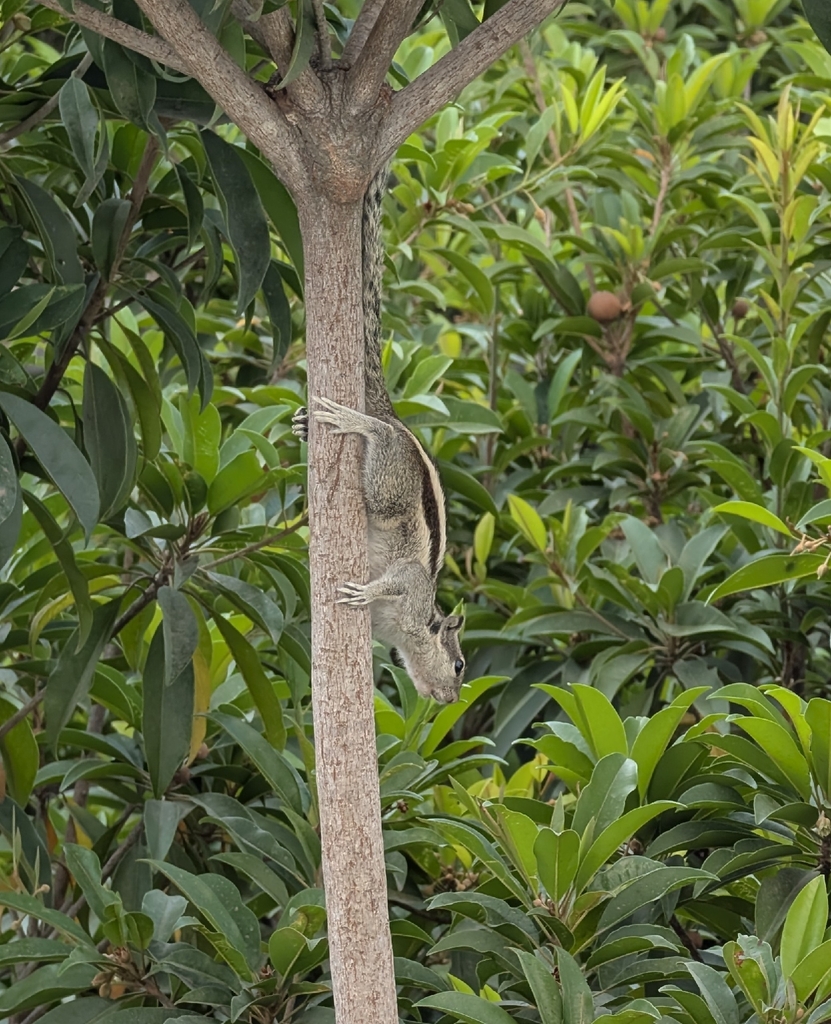
Northern Palm Squirrel
Photo © swanand kesari
Photo © swanand kesari — CC BY 4.0 — Source: iNaturalist #370867631Identification
The northern palm squirrel, also known as the five-striped palm squirrel, is a small rodent distinguished by the characteristic striped markings that give it its common name. This semi-arboreal species belongs to the family Sciuridae and is found across a wide geographical range. Two recognized subspecies exist: F. p. pennantii and F. p. argentescens, though regional colour variations and measurement differences have led some researchers to propose additional subspecies, particularly in central and eastern India.
Range & Habitat
The northern palm squirrel has an extensive distribution across South Asia, occurring in India, Nepal, Bangladesh, Pakistan, and Iran, as well as the Andaman and Nicobar Islands. The species has also been introduced to Australia and the United Arab Emirates through the exotic pet trade, with an established feral population now present in the Perth area of Western Australia. Within India, the species is particularly common in urban environments, thriving even in major cities such as Delhi and Kolkata.
This is a remarkably adaptable species, occupying diverse habitats including tropical and subtropical dry deciduous forests, montane forests at altitudes up to 4,000 metres, scrublands, plantations, grasslands, arable land, rural gardens, and urban areas. The species' southern range extends through the Western Ghats to localities including Dharwar and Mysore in Karnataka, though the precise southern boundary remains unclear.
Behaviour & Diet
As a semi-arboreal species, the northern palm squirrel is well-adapted for movement between ground and trees. While specific dietary details are not extensively documented in available sources, the squirrel's presence across such varied habitats suggests a flexible diet suited to both rural and urban environments. The species demonstrates particular success in human-modified landscapes, indicating an ability to exploit available food resources opportunistically.
Best Time & Places to See It
The northern palm squirrel's adaptability and common status throughout most of its range make it relatively accessible to wildlife enthusiasts and photographers. Urban parks and gardens in major Indian cities offer reliable viewing opportunities, with Delhi and Kolkata being particularly good locations. Rural areas featuring dry deciduous forests and plantations also provide excellent habitats for observation. In Australia's Perth region, the feral population offers a unique opportunity to observe this Asian species in an introduced range. The species' comfort in human-modified landscapes means that patient observation in parks and gardens often yields sightings.
Photography Tips
The northern palm squirrel's active, semi-arboreal nature and comfort in accessible habitats make it a rewarding photography subject. Urban and garden settings provide opportunities for close-range photography with natural or minimal background clutter. Early morning hours typically offer the best light and highest activity levels. The squirrel's small size and quick movements demand fast shutter speeds and continuous autofocus. Its striped markings are a key identifying feature, so positioning to capture these details will enhance field-guide quality images. Patient positioning near feeding areas or fruiting trees increases the likelihood of obtaining clear, well-composed shots.
Ranthambhore National Park
Sawai Madhopur, India
+294 birds+20 mammals
Granite ridges and ravines carved through the Aravalli Range frame this protected landscape in eastern Rajasthan, where deciduous forest mingles with open scrubland and seasonal water…
VIEW NATIONAL PARKKanha Tiger Reserve
Kanha Kisli F.V., India
+321 birds+23 mammals
Where sal forests give way to emerald meadows and crystalline streams carve through ancient valleys, one of India's finest wilderness reserves unfolds across the Maikal Range.…
VIEW NATIONAL PARKBandhavgarh National Park
Garhpuri, India
+285 birds+17 mammals
Where granite ridges rise dramatically above sal and bamboo forests, one of India's most pristine tiger reserves unfolds across the Vindhyan plateau. Ancient rock formations tower…
VIEW NATIONAL PARKKeoladeo National Park
Shreenagar Rural, India
+326 birds+14 mammals
Where shallow wetlands shimmer beneath vast Rajasthani skies, one of Asia's finest bird sanctuaries pulses with extraordinary life. This former maharaja's hunting reserve, now spanning 29…
VIEW NATIONAL PARKGir National Park
Asundrali, India
+258 birds+13 mammals
Dry deciduous forests cloak the rolling hills of western Gujarat where the Gir landscape rises as a final sanctuary for one of the world's rarest felids:…
VIEW NATIONAL PARKNo community photos yet. Log in to add the first one.
No community observations of this species yet.