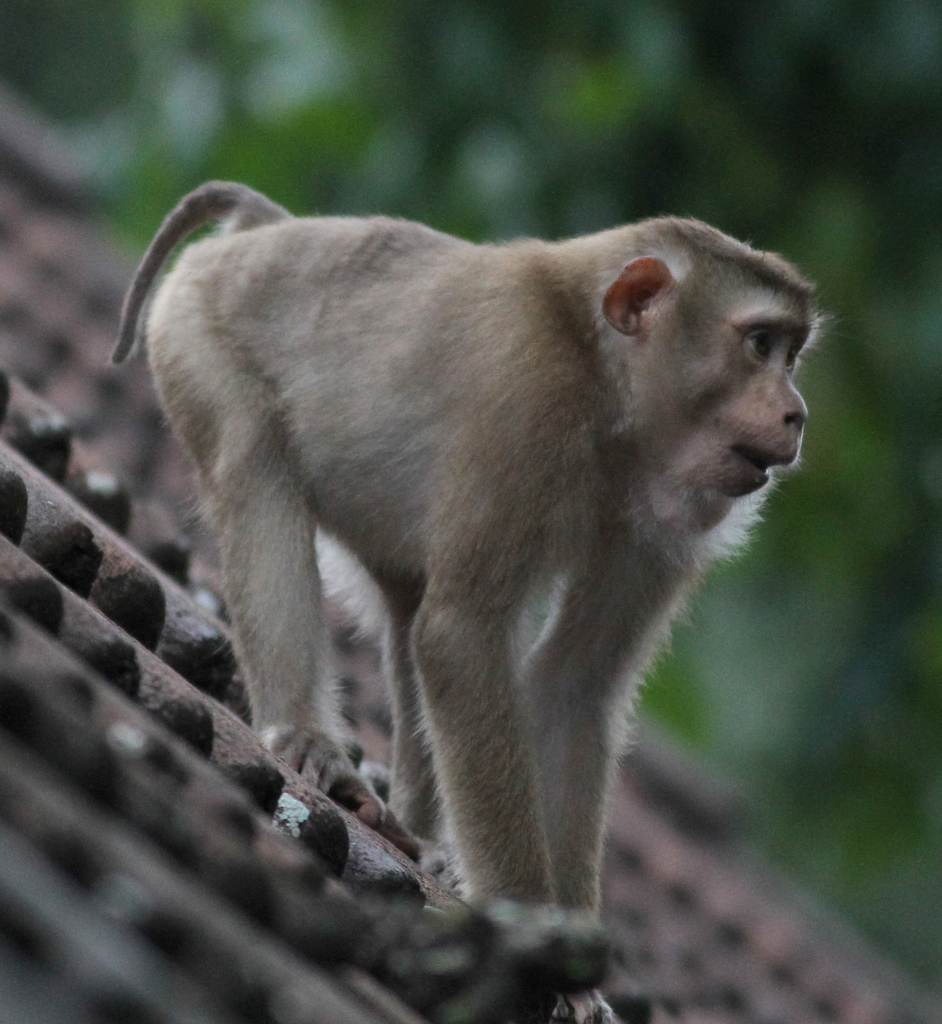
Northern Pig-tailed Macaque
Photo © Jan Ebr & Ivana Ebrová
Photo © Jan Ebr & Ivana Ebrová — CC BY 4.0 — Source: iNaturalist #69769293Identification
The northern pig-tailed macaque is a medium-sized primate distinguished by a distinctive facial crown of greyish pelage extending from the cheeks around the top of the head to beneath the chin. A brown patch occupies the centre of this crown, with white triangular markings beneath and above the eyes, while red stripes angle upwards from the outer eye corners. Their elongated muzzle is notably shorter than that of their southern cousins, and their dark, thin tail is characteristically short and skinny, typically curved at a 90-degree angle pointing backward.
Sexual dimorphism is pronounced in this species. Males weigh over eight kilograms and display defined shoulder musculature and red-coloured sexual organs, with longer tails and darker pelage contrast. Females are noticeably smaller, weighing below six kilograms, with more vibrant red sexual swelling. Both sexes possess distinctive oval-shaped thick sitting pads called ischial callosities on their hindquarters.
Range & habitat
Northern pig-tailed macaques are found across Southeast Asia and southern Asia, with populations in Bangladesh, Cambodia, China, India, Laos, Myanmar, Thailand, and Vietnam. In India, they occur south of the Brahmaputra River throughout the northeastern states including Assam, Meghalaya, Arunachal Pradesh, Nagaland, Manipur, Mizoram, and Tripura. They inhabit tropical forests and broadleaved evergreen forests, showing a preference for higher elevations and regions with diverse vegetation.
These adaptable primates are impacted by habitat loss through agricultural expansion, aquaculture development, logging, and infrastructure projects. While they avoid rubber plantations due to severely reduced habitat and restricted food access, they demonstrate resilience in degraded environments. Seasonal changes, particularly monsoonal rainfall patterns, significantly influence their distribution and activity within their home ranges, which vary considerably from 62 to 828 hectares.
Behaviour & diet
Northern pig-tailed macaques are primarily frugivorous, feeding extensively on fruit when available. However, their diet reflects remarkable adaptability—during periods of fruit scarcity, they readily consume wild vegetation, crops, human foods, and small insects and mammals. This dietary flexibility has enabled them to survive in altered and degraded habitats where preferred food sources may be limited.
These primates exhibit a matriarchal social structure where females hold primary social authority. Infants remain dependent on their mothers for the first several weeks, nursing exclusively until four weeks old and remaining closely attended. By five to eight weeks, infants begin consuming solid foods and gradually achieve independence, though they maintain proximity to their mothers during travel. Despite their behavioural adaptability, populations face significant health threats from viral pathogens including human immunodeficiency virus type 1, simian immunodeficiency virus, and coronavirus.
Best time & places to see it
The Keo Seima Wildlife Sanctuary in Cambodia supports a substantial and increasing population of nearly 4,000 individuals, making it a promising location for observing this species. The Naban River Watershed National Nature Reserve in southwestern China has also yielded significant camera-trapping data documenting the species' presence in broadleaved evergreen forests at higher elevations. In India, protected areas within the northeastern states, particularly in Assam, offer opportunities to encounter these macaques in their natural habitat.
Seasonal considerations are important for planning observations. During the dry-hot season, macaque activity becomes more spatially restricted as vegetation becomes limited, potentially concentrating animals in smaller areas. Conversely, monsoonal periods with higher rainfall support more dispersed activity patterns across larger ranges as food resources become more abundant and accessible throughout the forest.
Photography tips
The striking facial markings of northern pig-tailed macaques—particularly the distinctive crown, white eye markings, and red orbital stripes—make them compelling photography subjects. Position yourself to capture these facial features in good light, as they are key identification characteristics. Their relatively short, characteristically curved tails also provide distinctive compositional elements that distinguish them from other macaque species.
The pronounced sexual dimorphism offers rich photographic opportunities to document males and females side by side, showcasing the size difference and contrasting pelage darkness. Patience will be rewarded when photographing mothers with dependent infants, as nursing and dependent behaviours provide intimate glimpses of their matriarchal social structure. Early morning and late afternoon light will best highlight their greyish crown pelage and the subtle brown and red tones of their markings.
No community photos yet. Log in to add the first one.
No community observations of this species yet.