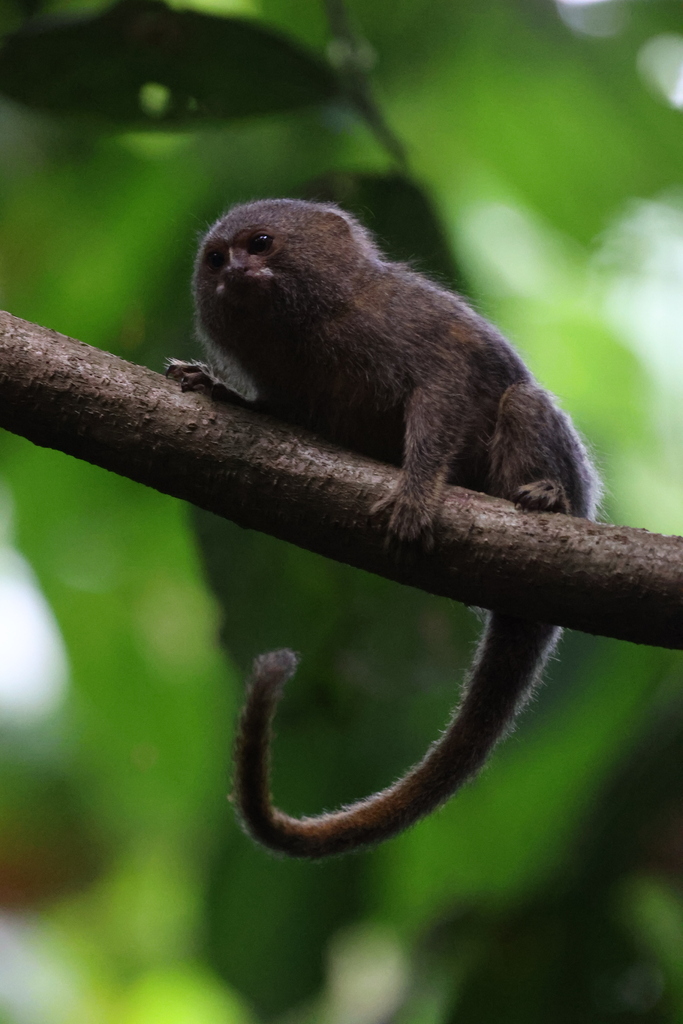
Northern Pygmy Marmoset
Photo © Tommy Andriollo
Photo © Tommy Andriollo — CC BY 4.0 — Source: iNaturalist photo #342955121The western pygmy marmoset (Cebuella pygmaea) is a marmoset species, a very small New World monkey found in the northwestern Amazon rainforest in Brazil, Colombia, Ecuador, and Peru. It was formerly regarded as conspecific with the similar eastern pygmy marmoset, which has whitish underparts. Although the western pygmy marmoset occurs further west than the eastern pygmy marmoset, the primary separators of their ranges are the Amazon River (Solimões River) and Marañón River, with the western occurring to the north of them and the eastern to the south. == Physical description == The western pygmy marmoset is the world's smallest monkey. Pygmy marmosets have only a slight degree of sexual dimorphism; in the wild the average male weighs 110 g (3.9 oz), which is slightly smaller than the average female at 122 g (4.3 oz). Fully grown western pygmy marmosets have an average body length of 13 cm (5.1 in), and a tail marked with black rings that is on average longer than their bodies at 20 cm (7.9 in). They have fluffy "brownish-gold fur with black ticking on their shoulders, backs, and heads, while their ventral fur is light yellow to white". There are very little visible physical differences between…
Yasuní National Park
Aguarico, Ecuador
+132 birds+30 mammals
Where the Napo and Curaray rivers carve through Ecuador’s vast Amazonian lowlands, one of Earth’s most biodiverse terrestrial ecosystems sprawls […]
VIEW NATIONAL PARKNatural Serranía de los Churumbelos National Park
Santa Rosa, Colombia
+145 birds+15 mammals
Where the Andes’ western cordillera surrenders to the Pacific watershed, a fortress of granite peaks and cloud-draped valleys rises across […]
VIEW NATIONAL PARKAmacayacu National Park
Leticia, Colombia
+133 birds+29 mammals
Where the Amazon’s dark waters merge with flooded forest and terra firme upland, five thousand square kilometres of pristine wilderness […]
VIEW NATIONAL PARKNo community photos yet. Log in to add the first one.
No community observations of this species yet.