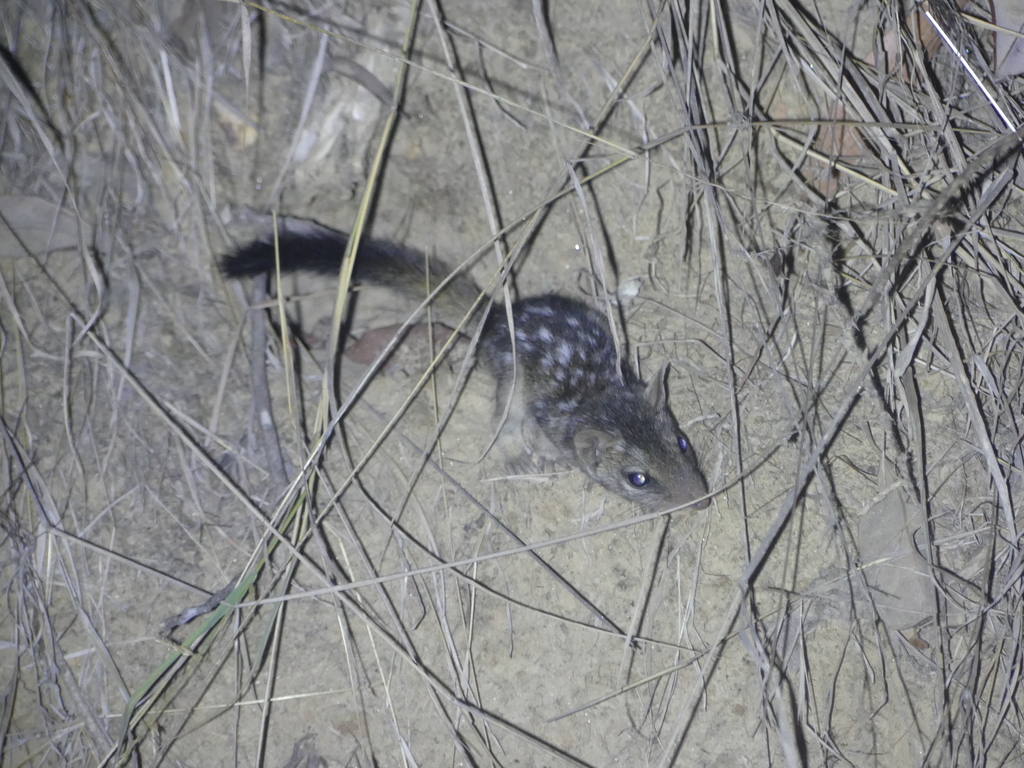
Northern Quoll
Photo © Valentin Moser
Photo © Valentin Moser — CC BY 4.0 — Source: iNaturalist #19148228The northern quoll (Dasyurus hallucatus), also known as the northern native cat, the North Australian native cat or the satanellus is a carnivorous marsupial native to Australia. == Taxonomy == The northern quoll is a member of the family Dasyuridae. There are three other quoll species found in Australia, and another two species found on the island of New Guinea, all of which are currently placed in the genus Dasyurus. The northern quoll was first described in 1842 by naturalist and author John Gould, who gave it the specific epithet hallucatus, indicating that it has a notable first digit. This species has sometimes been placed in a separate genus, Satanellus. Four distinct morphological forms of the northern quoll were recognised in the 1920s, however more recent population genomic analysis has shown that these forms do not conform to the underlying genetic differentiation shown across the species distribution. Three broad population genomic clusters are present in the species, which broadly correspond to populations in the regions of Queensland, Northern Territory and Western Australia. This population genomic structure conforms to known biogeographic barriers across northern Australia, including the Carpentarian Gap and Ord Arid Region. Finer scale population structure shows differentiation of the…
Kakadu National Park
Kakadu, Australia
+273 birds+46 mammals
Kakadu National Park is Australia’s largest national park and one of the world’s most remarkable protected areas, covering nearly 20,000 square kilometres in the tropical north…
VIEW NATIONAL PARKLitchfield National Park
Australia
+175 birds+15 mammals
Where weathered sandstone plateaus rise above the savanna woodlands of Australia's Top End, Litchfield National Park unfolds as a landscape of dramatic contrasts shaped by a…
VIEW NATIONAL PARKNo community photos yet. Log in to add the first one.
No community observations of this species yet.