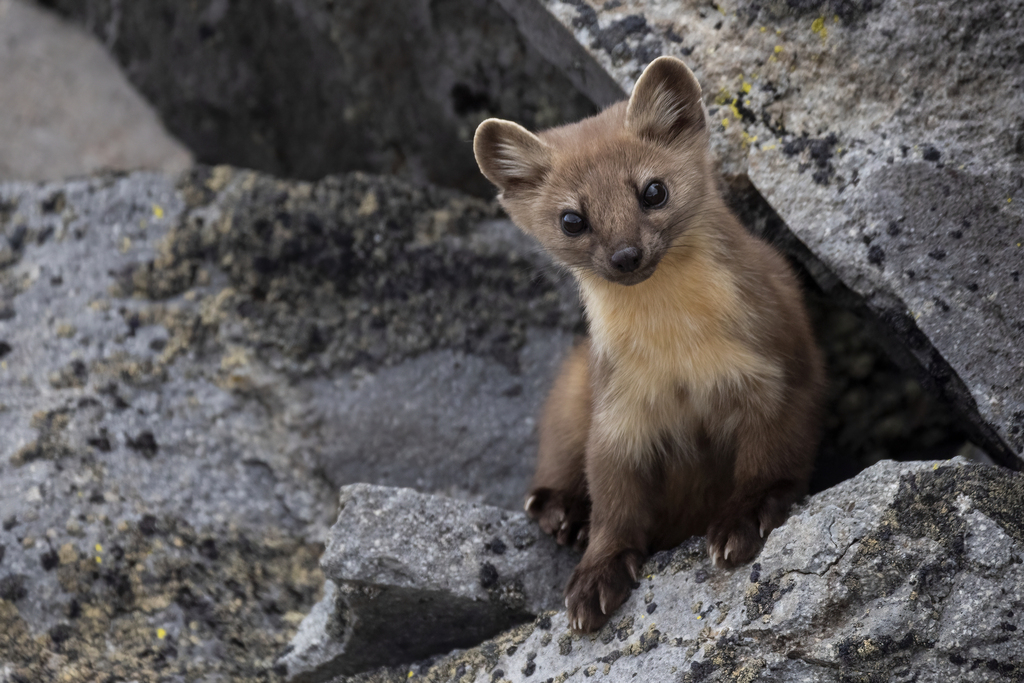
Pacific Marten
Photo © Sam Eberhard
Photo © Sam Eberhard — CC BY 4.0 — Source: iNaturalist photo #320342882Identification
The Pacific marten is a slender, agile mustelid with a distinctive appearance that sets it apart from its close relative, the American marten. It features a shorter snout and broader skull than the American marten, though these differences are subtle and best appreciated by specialists. Like other martens, it possesses the characteristic elongated body, sharp claws, and keen senses that make it a formidable hunter in forest environments. Its coloration typically ranges from golden-brown to darker tones, though exact hues vary among the seven recognized subspecies across its range.
Range & Habitat
This species inhabits a wide but fragmented range throughout western North America, from the Alexander and Haida Gwaii archipelagos in Alaska south along the Pacific coast to Humboldt County, California, and extending east to the southern Rocky Mountains and New Mexico. Pacific martens thrive in both deciduous and coniferous forests, showing particular preference for higher terrain and areas with substantial snow cover. In Oregon, they occupy the Cascade Range and coastal mountains, typically in pine-forested areas separated by unsuitable lowland habitat. A hybrid zone with American martens exists in the Columbia Mountains and certain Alaskan islands.
Behaviour & Diet
Pacific martens are active foragers that adjust their behavior seasonally and by weather conditions. During warmer months (May–December), they are primarily diurnal, but shift to largely nocturnal activity in winter. Summer activity involves more extensive traveling and hunting compared to winter, likely due to thermal stress and reduced food availability. Daily movements average around 0.6 miles, though this varies by season and habitat. These martens use different resting sites depending on temperature: above-snow locations in warm weather and subnivean (under-snow) sites during cold spells, and they can travel considerable distances—over 98 feet—beneath the snowpack to forage. Snow depth is crucial to their ecology; they associate with areas of deep snow (over 9 inches monthly) where they can easily burrow for prey, giving them a competitive advantage over fishers, which prefer shallower snow. Diet is opportunistic and influenced by seasonal availability, expanding to include fish and small mammals during drought years when snow conditions improve prey accessibility.
Best Time & Places to See It
Spring offers opportunities to observe dispersing juveniles in areas like northeastern Oregon and throughout the Pacific Northwest. The species is most active during the snow-free season from May through December, when diurnal habits make observation more feasible. Prime viewing regions include the Cascade Range and coastal mountains of Oregon, the Sierra Nevada and northeastern California ranges, the Rocky Mountains of Colorado, Utah, and New Mexico, and the forested regions of Washington and British Columbia. Grand Teton National Park and Yosemite National Park offer accessible habitats where Pacific martens have been studied, though sightings remain uncommon due to their elusive nature and preference for remote, forested terrain.
Photography Tips
Patience and persistence are essential when photographing Pacific martens, as they are active, mobile animals that cover considerable ground daily. Position yourself near forest-meadow edges, open ridgetops, and lakeshores where martens concentrate their activity. Early morning and late afternoon during the snow-free season (May–December) offer the best lighting and highest activity levels. In winter, focus on areas with deep snow where subnivean travel routes concentrate animals. A telephoto lens is advisable given their wariness and the dense forest habitat they prefer. Remote camera traps set along travel corridors can yield excellent results when conventional photography proves challenging. Record observations of habitat features—snow depth, forest composition, and topography—as these strongly influence where martens concentrate.
Alaska Maritime National Wildlife Refuge
Crater Lake National Park
Grand Teton National Park
Gwaii Haanas National Park Reserve and Haida Heritage Site
Kings Canyon National Park
Lassen Volcanic National Park
Mount Rainier National Park
Redwood National Park
Rocky Mountain National Park
Nothing matches these filters.
No community photos yet. Log in to add the first one.
No community observations of this species yet.