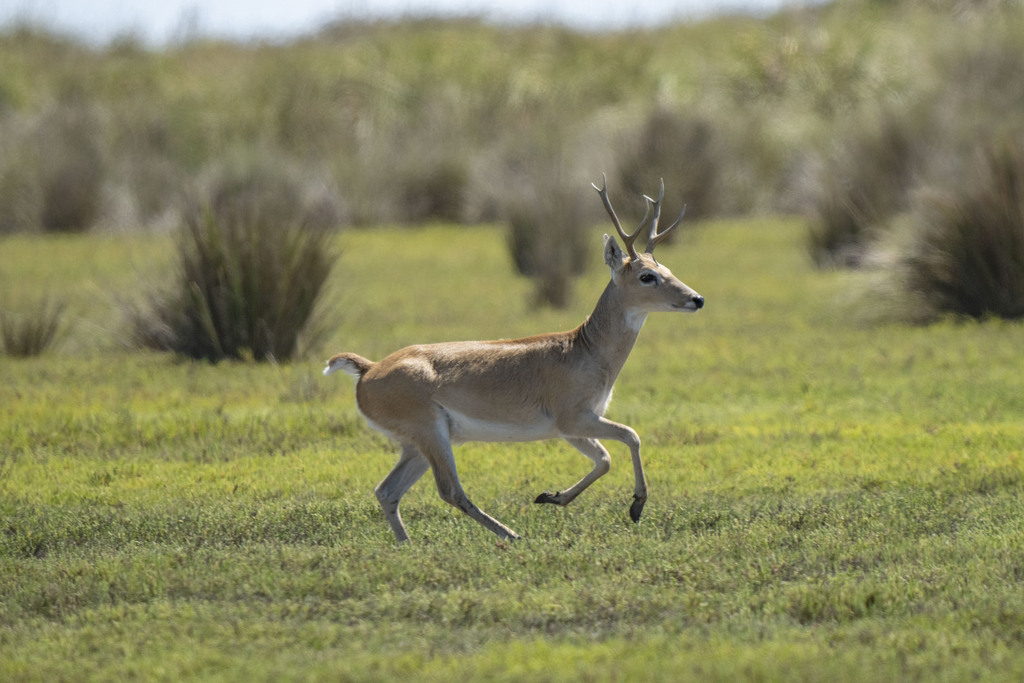
Pampas Deer
Photo © Luciano Massa
Photo © Luciano Massa — CC BY 4.0 — Source: iNaturalist photo #337727485Identification
The Pampas deer is a small South American deer with tan fur, lighter on the undersides and insides of the legs, and distinctive white spots above the lips and white patches on the throat. Shoulder height ranges from 60–65 cm in females to 65–70 cm in males, making them notably petite among deer species. Adult males typically weigh 24–34 kg, while females weigh 22–29 kg, with little sexual dimorphism between the sexes. The short, bushy tail measures 10–15 cm and reveals a white patch when raised during running, similar to white-tailed deer. Males sport small, lightweight, three-pronged antlers that shed in August or September and regrow by December. Females lack antlers but display hair whorls resembling tiny antler stubs. Males are notably distinctive for their strong scent secreted from glands in their back hooves, detectable from up to 1.5 km away.
Range & Habitat
The Pampas deer inhabits the grasslands of South America at low elevations, distributed across five recognized subspecies spanning from eastern and central Brazil south into Uruguay and Argentina. Approximately 80,000 individuals remain today, with the majority living in Brazil. They favour habitats that include water, hills, and grass tall enough to cover a standing deer, often in areas with winter drought and annual flooding cycles. Many populations inhabit the Pantanal wetlands, a region where conservation efforts are actively underway. However, human activity has substantially altered much of their original landscape.
Behaviour & Diet
Pampas deer are gregarious animals, typically found in small groups of 2–6 individuals, though larger aggregations gather in productive feeding areas. Groups are not segregated by sex, and males drift between groups rather than defending territories or mates. During the mating season—December to February in Argentina and February to April in Uruguay—males initiate courtship through submissive displays including low stretching, crouching, and soft buzzing sounds, often following females and smelling their urine. Dominance interactions involve head-raising, slow deliberate movements, horn rubbing into vegetation, and sparring rather than serious fighting; scent marking from head and facial glands plays an important role in communication. When alarmed, these deer do not immediately flee but instead stamp their feet, produce a particular trot and whistle, and deposit odor. They escape danger by bounding 100–200 meters in long flat jumps, often looking back at the disturbance, rather than engaging in sustained running.
Best Time & Places to See It
The Pantanal wetlands in Brazil represent the premier destination for observing Pampas deer, where ongoing conservation efforts support the majority of the remaining population. The mating season—December to February in Argentina and February to April in Uruguay—offers opportunities to witness courtship behaviour and male dominance displays. These deer inhabit open grasslands at low elevations where visibility is generally good, though their preference for grass tall enough to cover a standing animal means patience and careful scanning of suitable habitat are necessary. They can live up to 12 years in the wild, indicating stable populations where they may be observed.
Photography Tips
The Pampas deer's tan coloration blends naturally into grassland habitats, requiring photographers to scan carefully across suitable terrain. Early morning and late afternoon light will best showcase the lighter undersides and distinctive white throat patches and lip markings. Capture the characteristic tail-raise during movement to reveal the white patch, a defining feature. The small size of these deer—particularly females—and their tendency to remain in groups of only 2–6 individuals means wide-angle compositions often work well to include their grassland habitat. Patient observation during the mating season will reward photographers with submissive courtship displays and male dominance behaviours, including horn rubbing and sparring interactions. The strong scent glands in males' back hooves, though invisible in photographs, indicate the males' prominent role in group dynamics and scent communication.
Emas National Park
Brazil
+333 birds+23 mammals
Across the high plateaux of central Brazil, where the cerrado grasslands roll toward distant horizons under an immense sky, Emas National Park anchors one of South…
VIEW NATIONAL PARKChapada dos Veadeiros National Park
Brazil
+324 birds+6 mammals
Where granite plateaus rise above the cerrado savanna in central Brazil, Chapada dos Veadeiros National Park unfolds across 6,665 square kilometres of some of the world's…
VIEW NATIONAL PARKBrasília National Park
Plano Piloto, Brazil
+338 birds+15 mammals
Cerrado grassland and scattered woodland sweep across the central Brazilian plateau where this national park sprawls across more than a thousand square kilometres of the Federal…
VIEW NATIONAL PARKCampos del Tuyú National Park
Argentina
+169 birds+5 mammals
Subtropical forest graces the borderlands where Misiones Province meets Paraguay, a landscape shaped by the Paraná Plateau's weathered topography and the warm, humid climate of northeastern…
VIEW NATIONAL PARKNo community photos yet. Log in to add the first one.
No community observations of this species yet.