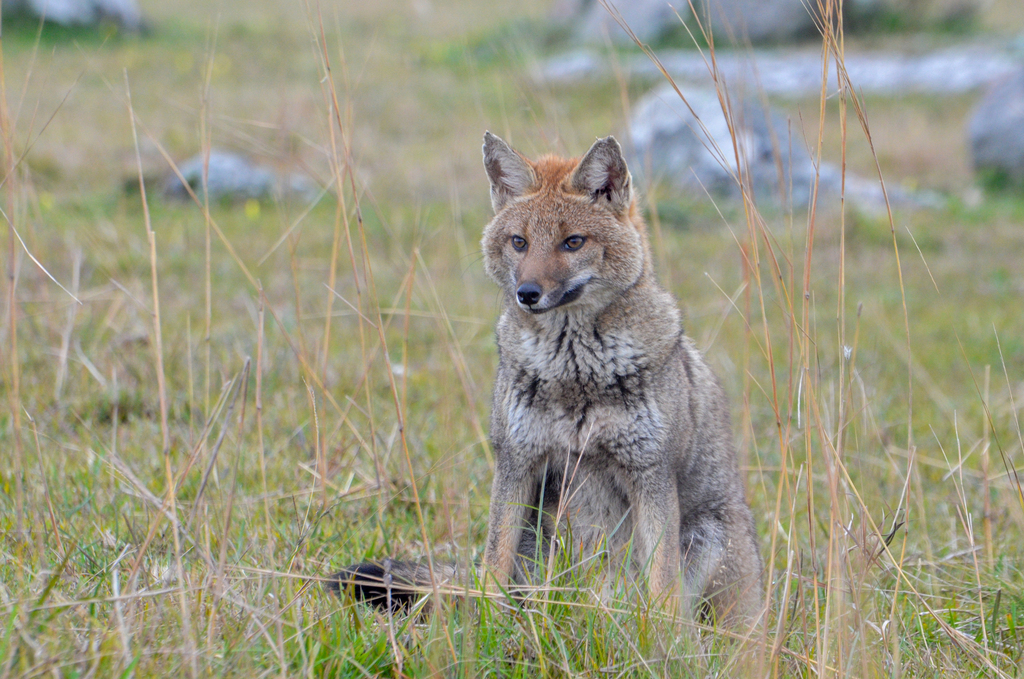
Pampas Fox
Photo © Pablo G. Fernández
Photo © Pablo G. Fernández — CC BY 4.0 — Source: iNaturalist photo #390404579Identification
The Pampas Fox (Lycalopex gymnocercus), also known as Azara's Fox, is a medium-sized South American canid with a slender build, pointed muzzle and bushy tail. Adults measure between 58 and 80 cm in body length, with an additional 25–36 cm tail, and typically weigh 4–8 kg. Its coat is predominantly grey with black grizzling, reddish legs and flanks, pale underparts and a distinctive black-tipped tail. Although commonly called a fox, it belongs to the South American genus Lycalopex rather than the true foxes (Vulpes).
Range & Habitat
The Pampas Fox is widespread across southern and central South America, occurring in Argentina, Uruguay, Paraguay, southern Brazil and eastern Bolivia. It inhabits a wide variety of open environments, including grasslands, savannas, shrublands, dry forests and agricultural landscapes, while generally avoiding dense tropical rainforest and high mountain habitats. Thanks to its remarkable adaptability, it remains one of South America's most common wild canids and is currently classified as Least Concern.
Behaviour & Diet
Primarily nocturnal and crepuscular, the Pampas Fox is usually solitary or found in pairs during the breeding season. It is a highly opportunistic omnivore, feeding on small mammals, birds, reptiles, amphibians, insects, eggs, carrion and a wide variety of fruits and other plant material. This flexible diet allows it to thrive across diverse habitats, including areas heavily modified by agriculture. Breeding takes place once a year, with females giving birth to litters of two to five pups in underground dens or natural shelters.
Best Time & Places to See It
The Pampas Fox can be seen throughout the year, although sightings are generally easier during the dry season when vegetation is shorter. Some of the best locations include Iberá National Park, El Palmar National Park and Campos del Tuyú National Park in Argentina, as well as the Pantanal and the extensive Pampas grasslands of Argentina, Uruguay and southern Brazil. Early morning, late afternoon and night drives provide the highest chances of successful observations.
Photography Tips
Photographing the Pampas Fox is most rewarding during the golden hours of sunrise and sunset, when its reddish fur contrasts beautifully against open grasslands. A telephoto lens between 300 and 600 mm is ideal for capturing detailed portraits while maintaining a respectful distance. Since the species is naturally cautious and most active during twilight or after dark, patience is essential. Including the surrounding habitat in wider compositions helps showcase the fox within its characteristic Pampas landscape, while avoiding disturbance ensures natural behaviour and more authentic images.
Serra Geral National Park
Brazil
+211 birds+2 mammals
Where basalt cliffs and sandstone escarpments rise above the subtropical forests of southern Brazil, Serra Geral National Park preserves one of the Atlantic region's most dramatic…
VIEW NATIONAL PARKEl Palmar National Park
Distrito Sexto, Argentina
+244 birds+14 mammals
Across the Paraná River floodplain in northeastern Argentina, palms rise from wetland and grassland in a landscape shaped by water and time. El Palmar National Park…
VIEW NATIONAL PARKSierra de las Quijadas National Park
Argentina
+168 birds+5 mammals
Sandstone cliffs and deeply incised canyons define this 1,137-square-kilometre expanse in San Luis Province, where the dry Chacoan landscape of central Argentina reveals an unexpected ecological…
VIEW NATIONAL PARKChaco National Park
Municipio de Presidencia de la Plaza, Argentina
+258 birds+7 mammals
Across the humid subtropical lowlands of northeastern Argentina, where the Paraná River basin feeds vast seasonal wetlands and gallery forests, Chaco National Park protects one of…
VIEW NATIONAL PARKNo community photos yet. Log in to add the first one.
No community observations of this species yet.