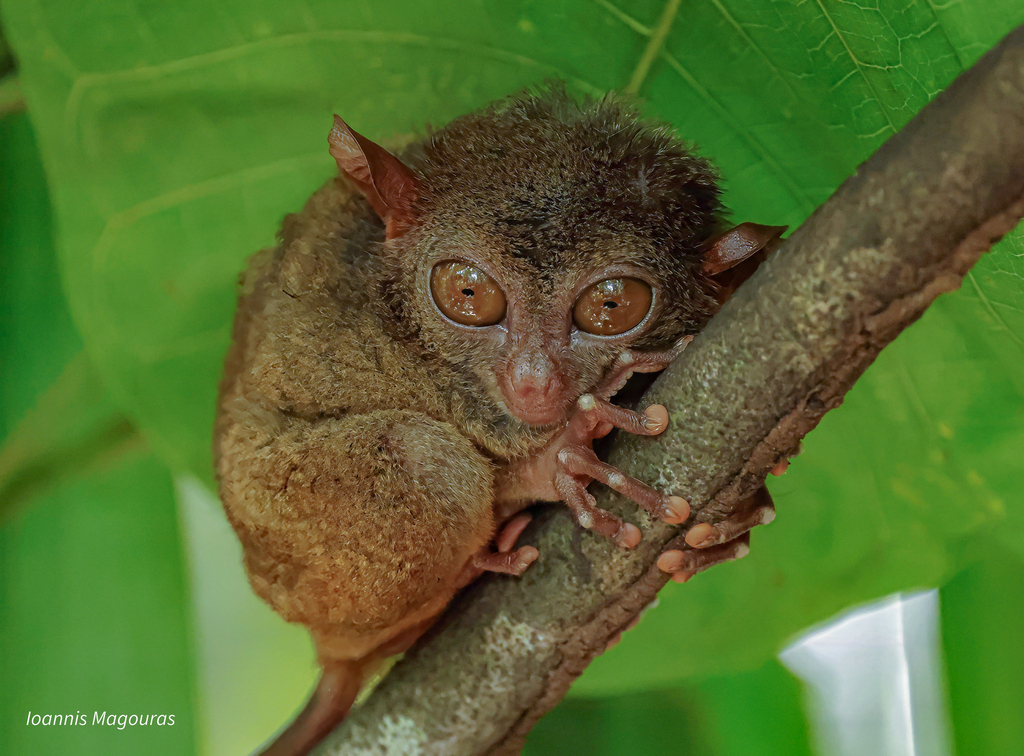
Philippine Tarsier
Photo © Ioannis Magouras
Photo © Ioannis Magouras — CC BY 4.0 — Source: iNaturalist photo #476690732Identification
The Philippine tarsier is one of the world's smallest primates, measuring just 85 to 160 mm in height—roughly the size of an adult human fist. Adults weigh between 80 and 160 grams, with females typically lighter than males. The species is instantly recognizable by its enormous, disproportionately large eyes, which have the largest eye-to-body weight ratio of all mammals. These round, forward-facing eyes cannot move in their sockets, but the tarsier compensates with a remarkable adaptation: its neck allows the head to rotate 180 degrees. Large, membranous ears that appear constantly in motion aid in detecting movement in the darkness.
The Philippine tarsier has thin, rough fur colored gray to dark brown. Its most distinctive feature is its elongated ankle bone (the "tarsus," which gives the animal its name), which enables powerful jumping. The tail is exceptionally long—roughly twice the body length—and is bald except for a tuft of hair at the tip. Long digits tipped with rounded pads allow the tarsier to cling to trees and grip almost any surface, while the second and third toes bear sharp claws specialized for grooming.
Range & Habitat
The Philippine tarsier is endemic to the Philippines, found primarily in the southeastern portion of the archipelago. Established populations occur on the islands of Bohol, Samar, Leyte, and Mindanao. The species also inhabits several smaller islands including Maripipi Island, Siargao Island, Basilan Island, and Dinagat Island. A report of tarsiers in Sarangani suggests the species may have an even wider range, though these populations may represent different subspecies.
Three subspecies are currently recognized: Carlito syrichta syrichta from Leyte and Samar; Carlito syrichta fraterculus from Bohol; and Carlito syrichta carbonarius from Mindanao. The Philippine tarsier inhabits second-growth and secondary forest environments throughout its range.
Behaviour & Diet
The Philippine tarsier is a nocturnal insectivore, hunting under cover of darkness using its exceptional night vision. Its diet consists primarily of insects, particularly crickets and grasshoppers, along with spiders, small crustaceans, and small vertebrates such as lizards and birds. When hunting, the tarsier seizes live prey and carries it to its mouth using both hands. In daylight, the tarsier's pupils can constrict to mere thin spots to protect against bright light, while in darkness they dilate to fill almost the entire eye.
The tarsier's elongated ankle bones enable it to leap at least 3 meters from tree to tree, making it an acrobatic hunter in the forest canopy. Females produce a single infant after a six-month gestation period. Newborns are born well-developed, fully furred with eyes already open, and use multiple sets of breasts on the mother as anchor points during development.
Best Time & Places to See It
Bohol is the most accessible destination for viewing Philippine tarsiers, with established eco-tourism infrastructure centered on tarsier observation. The nocturnal nature of these primates means the best viewing opportunities occur at night. Samar and Leyte offer additional possibilities for encountering the species, as do the smaller islands of Maripipi, Siargao, Basilan, and Dinagat for more adventurous travelers. Night tours through secondary forest habitats offer the highest probability of success.
The species' extremely small size and nocturnal habits make it challenging to spot without dedicated searching, particularly outside established tourism sites. Visiting during the tarsier's active night hours and enlisting experienced local guides significantly improves sighting chances.
Photography Tips
Photographing Philippine tarsiers requires specialized night-vision equipment and fast lenses to capture these diminutive creatures in low-light conditions. The tarsier's ability to rotate its head 180 degrees makes for compelling portraits highlighting its unique anatomy. Its enormous eyes are a key photographic feature; capturing the detail and reflectivity of these dominant facial features will yield striking images.
The tarsier's jumping ability and acrobatic canopy movements present both challenges and opportunities; anticipating these leaps can produce dynamic action shots. Close-focus capability is essential given the animal's tiny size. Patience and quiet presence are essential, as the tarsier is easily disturbed. Working with experienced local guides on established eco-tourism trails offers the best combination of access and ethical observation practices.