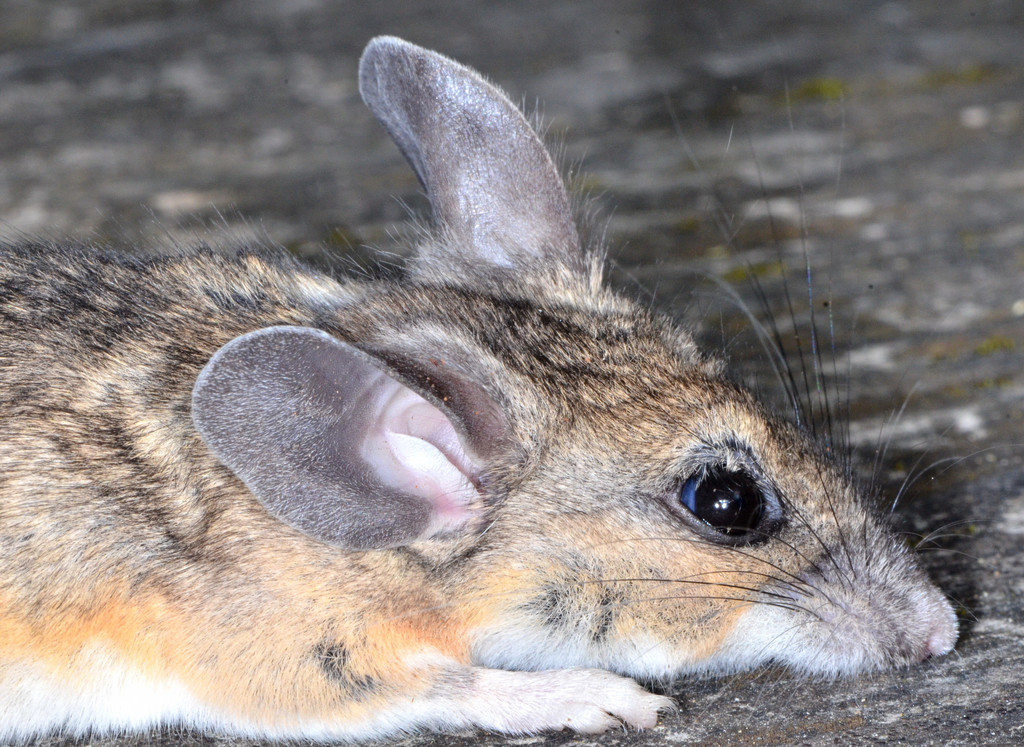
Pinyon Deermouse
Photo © Don Loarie
Photo © Don Loarie — CC BY 4.0 — Source: iNaturalist photo #83130The pinyon mouse (Peromyscus truei) is a species of rodent in the family Cricetidae. It is a species of the genus Peromyscus, a closely related group of New World mice often called "deermice". It is native to the southwestern United States and Baja California in Mexico. These medium-sized mice are often distinguished by their relatively large ears. The range of this species extends from southern Oregon and Wyoming in the north, and extends south to roughly the U.S.-Mexico border, with a disjunct population known as the Palo Duro mouse (P. t. comanche) that occupies an area in the vicinity of Palo Duro Canyon in the Texas Panhandle.[3] This isolated population is a glacial relict: during the last glacial period, Rocky Mountain juniper grew in a continuous belt from the mountains of New Mexico across the caprock escarpment to the Texas Panhandle, allowing the species to occupy the region. As the climate warmed approximately 10,000 years ago, the junipers retreated westward, leaving a gap of roughly 120 kilometers of open grassland that isolated the Palo Duro population from the main range.Schmidly, David J. (1973). "Geographic variation and systematics of Peromyscus truei". Journal of Mammalogy. 54 (1): 1–10. == Description == The…
Canyonlands National Park
Wayne County, United States
+186 birds+15 mammals
Where the Colorado River has carved an intricate labyrinth through the high desert plateau of southeastern Utah, Canyonlands National Park sprawls across nearly 3,030 square kilometres…
VIEW NATIONAL PARKPinnacles National Park
San Benito County, United States
+197 birds+33 mammals
Jagged volcanic spires thrust from chaparral-covered ridges across 222 square kilometers of central California's inner Coast Ranges, their pale stone crowns catching the afternoon light like…
VIEW NATIONAL PARKGreat Basin National Park
White Pine County, United States
+170 birds+19 mammals
Where the Great Basin's high desert plateaus rise above 10,000 feet, ancient bristlecone pines endure on moonscape ridges of limestone and quartzite, creating one of North…
VIEW NATIONAL PARKNo community photos yet. Log in to add the first one.
No community observations of this species yet.