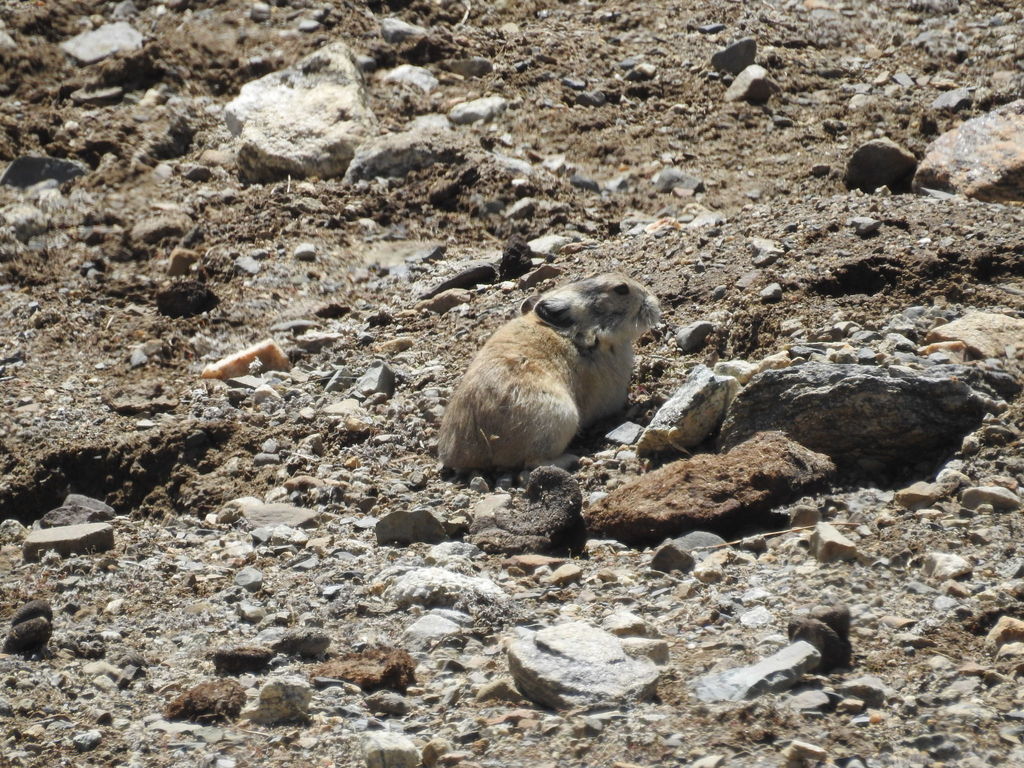
Plateau Pika
Photo © Ashwin Viswanathan
Photo © Ashwin Viswanathan — CC BY 4.0 — Source: iNaturalist #29627469Identification
The plateau pika, also known as the black-lipped pika, is a small diurnal mammal of the pika family weighing approximately 140 grams when fully grown. Its reddish-tan upperparts contrast with a whitish-yellow underside, making it relatively easy to identify in its high-altitude habitat. As a non-hibernating species adapted to extreme cold, it displays distinctive physiological features including enhanced cardiac and respiratory efficiency.
Range & Habitat
This species is found across the Tibetan Plateau and surrounding high mountains in China, India, and Nepal, inhabiting elevations between 3,100 and 5,000 meters. The plateau pika prefers high alpine deserts, steppe, and meadows, as well as tropical and subtropical montane forests at extreme altitudes. Its range centers on the vast plateau system that gives the species its common name.
Behaviour & Diet
Plateau pikas are highly social animals living in family groups of two to five adults plus offspring, sometimes forming larger units with multiple males and females. They exhibit complex social hierarchies and both monogamous and polygynandrous mating systems. Breeding occurs from April to August, with females capable of producing 2 to 5 litters of 2 to 7 young at three-week intervals, resulting in some of the fastest growth rates among lagomorphs. Both parents participate in offspring care and predator defense through alarm calls. As a keystone species, the plateau pika plays a crucial ecological role: its burrowing aerates soil and increases plant richness, while it serves as a primary food source for predators including foxes, weasels, falcons, and brown bears.
Best Time & Places to See It
The breeding season from April to August offers the best opportunity to observe plateau pikas, when family groups are most active foraging in meadows and alpine areas. The Sanjiangyuan National Nature Reserve in northern Tibet provides excellent access to protected populations. Early morning and late afternoon visits to alpine meadows yield the highest encounter rates, as these diurnal animals are most active during cooler parts of the day.
Photography Tips
Approach slowly and quietly across open terrain, as pikas are alert and will retreat to burrows if startled. Use telephoto lenses (200mm or longer) to capture behavior from a distance without disturbing family groups. The contrasting reddish-tan and whitish coloring photographs well in the clear high-altitude light, though be prepared for intense sun and reflective snow. Photograph during early morning or late afternoon for warmer, directional light that enhances the pika's colorful coat and brings out details in the alpine meadow habitat.
Sanjiangyuan National Park
Nagqu, China
+187 birds+25 mammals
Where the headwaters of three great Asian rivers emerge from a high alpine plateau, the landscape unfolds in tundra and dwarf shrubland—a world of austere beauty…
VIEW NATIONAL PARKQinghai Lake National Nature Reserve
Hainan Tibetan Autonomous Prefecture, China
+243 birds+11 mammals
At 3,200 metres above sea level on the Tibetan plateau, where winter temperatures plunge far below freezing and snow blankets the landscape for half the year,…
VIEW NATURE RESERVENo community photos yet. Log in to add the first one.
No community observations of this species yet.