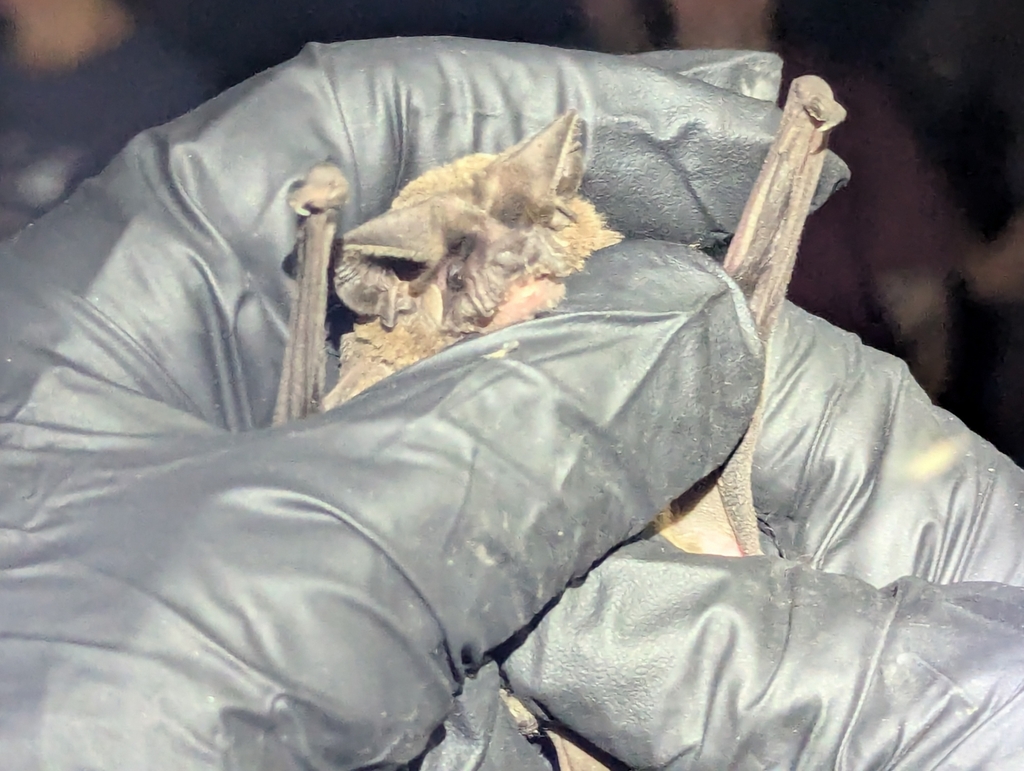
Pocketed Free-tailed Bat
Photo © Rachel Stringham
Photo © Rachel Stringham — CC BY 4.0 — Source: iNaturalist #316207388Identification
The pocketed free-tailed bat is a medium-sized insectivore with a distinctive appearance shaped by several unique anatomical features. Measuring approximately 112 mm in body length with a 46 mm tail, it weighs between 10–14 grams. The species takes its name from a characteristic skin fold that stretches from the inner thigh to the middle of the tibia, creating a shallow pocket on the underside of the interfemoral membrane near the knee—a feature that sets it apart from related species.
Visually striking, the pocketed free-tailed bat has a large, broad head with grooved lips and many stiff facial hairs bearing distinctive spoon-like tips. Its thick, leathery ears are joined at the midline and feature a prominent tragus, measuring around 23 mm. The forearms span approximately 46 mm, while the feet are notably small at about 10 mm. Though it shares similarities with the Brazilian free-tailed bat, this species is noticeably larger and can be reliably distinguished by its morphological characteristics, particularly the diagnostic femoral pocket.
Range & Habitat
The pocketed free-tailed bat inhabits Mexico and the southwestern United States, with populations documented in Arizona, California, New Mexico, and Texas. This distribution reflects the species' preference for arid and semi-arid regions of North America and Mexico. The species is classified as "least concern" by the IUCN and "apparently secure" by Natureserve, indicating stable population status across its range.
These bats are flexible in their roosting preferences, sheltering in caves, crevices, mines, tunnels, and man-made structures. Colony sizes remain modest, typically comprising fewer than 100 individuals. During the dry season, they rely on open-access water sources for drinking, making proximity to reliable water essential to their survival in arid landscapes.
Behaviour & Diet
The pocketed free-tailed bat is strictly insectivorous, consuming a diverse array of flying insects including moths and butterflies (Lepidoptera), wasps and bees (Hymenoptera), plant lice (Homoptera), beetles (Coleoptera), true bugs (Hemiptera), grasshoppers (Orthoptera), flies (Diptera), and lacewings (Neuroptera). Seasonal dietary shifts are pronounced: in June and July, moths and butterflies dominate their diet by volume, while September and March diets consist predominantly of true bugs. Compared to the larger Brazilian free-tailed bat, the pocketed free-tailed bat exhibits more limited flight maneuverability, which affects its ability to pursue certain prey such as beetles.
The species exhibits delayed fertilization, a reproductive strategy shared with some other bat species. Mating occurs in spring just prior to ovulation, with young born in early July after a gestation period of 70–90 days. Newborns weigh 3–4 grams, approximately 22% of adult weight, and achieve flight capability within 1–1.5 months.
Best Time & Places to See It
June through September offers optimal viewing opportunities, particularly during the warmer months when insect activity peaks and bat foraging becomes most intense. Target known roost sites in your region, including caves, mines, and tunnels with documented populations. Dawn and dusk provide the best observation windows, as these are peak activity periods for emergence and feeding.
In the United States, focus your search in Arizona, California, New Mexico, and Texas, particularly in arid and semi-arid habitats. Mexican locations are also productive but require advance research to identify accessible roosts. Early evening emergence from roosts offers the most reliable sightings, when large numbers leave to forage. Water sources in dry regions can also attract these bats during the dry season.
Photography Tips
Photographing this small, fast-moving bat requires patience and appropriate equipment. Use a fast shutter speed (at least 1/1000th second) to freeze wing motion during flight. Position yourself near known roosts during evening emergence, when light levels are still manageable and bat activity is predictable. Focus on silhouettes against twilight skies for dramatic compositions.
For detailed close-ups of identifying features—particularly the diagnostic femoral pocket, grooved lips, and spoon-tipped facial hairs—request permission to photograph captive individuals at research institutions when possible. A macro lens and ring flash will reveal the remarkable detail of the facial structure and ear morphology. Avoid flash near active roosts, as it may disturb colonies.
No community photos yet. Log in to add the first one.
No community observations of this species yet.