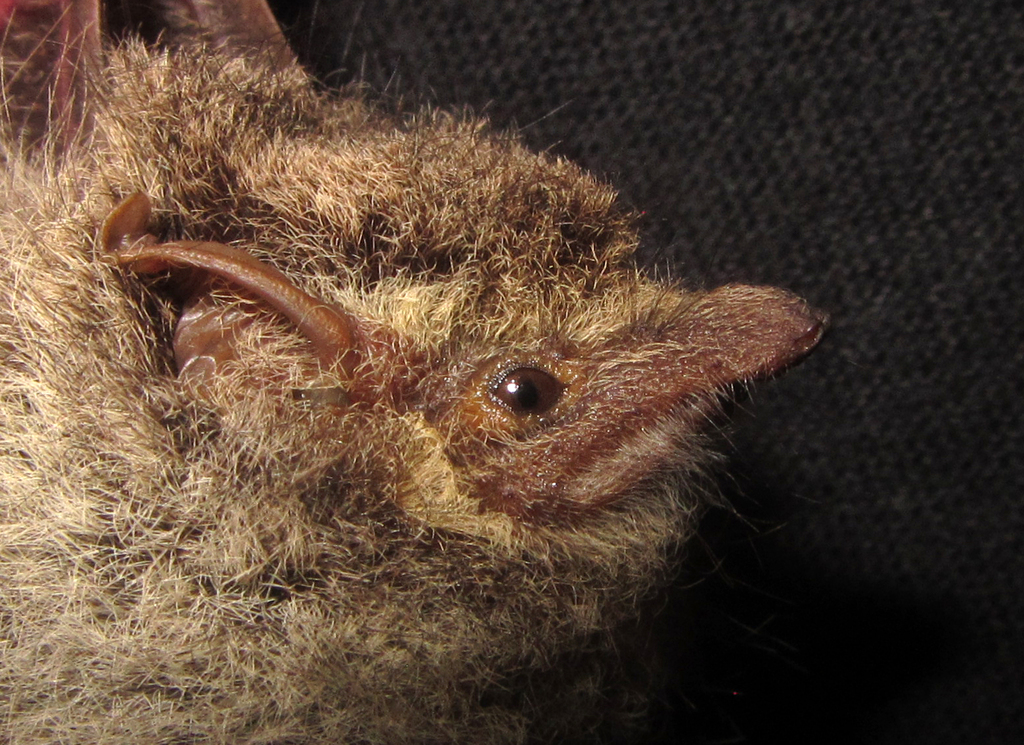
Proboscis Bat
Photo © Guilherme Siniciato Terra Garbino
Photo © Guilherme Siniciato Terra Garbino — CC BY 4.0 — Source: iNaturalist photo #243925706Identification
The proboscis bat is one of the world's tiniest bats, measuring only around 6 centimetres in length and weighing just 4 grams—roughly the mass of a penny. Males average 56 millimetres long, while females are slightly larger at 59 millimetres, with a short tail of about 16 millimetres. As the sole species in its genus Rhynchonycteris, it belongs to the family Emballonuridae, the sac-winged or sheath-tailed bats, and is distinguished by its characteristically elongated nose that gives the species its common name.
Range & Habitat
The proboscis bat is found across a wide swathe of the neotropics, from southern Mexico and Belize through Central America and into South America, including Venezuela, Ecuador, Peru, Bolivia, Brazil, and the island of Trinidad. The species is strictly a lowland dweller, seldom occurring above 300 metres in elevation. It shows a strong affinity for aquatic environments, typically inhabiting riparian forests, wetlands, swamps, and pastures—always remaining close to water sources that are essential to its ecology.
Behaviour & Diet
Proboscis bats are highly social and nocturnal, living in small, tight-knit colonies typically numbering between five and ten individuals, though rarely exceeding forty. They are famous for their distinctive daytime sleeping posture: lined up nose to tail in a perfectly straight row along a branch or wooden beam, creating an unusual and arresting sight. Each colony maintains a regular feeding territory centred on a small patch of water, where they hunt insects using echolocation, targeting midges, mosquitoes, beetles, and caddisflies. The species has no defined breeding season and instead maintains stable year-round harems, with each female producing a single young that is weaned at two to four months old, after which both sexes disperse.
Best Time & Places to See It
Proboscis bats are nocturnal and active year-round, so they may be encountered on any night, though observation requires patience and knowledge of their roosting sites. The best strategy is to locate their daytime roosts along branches overhanging water in riparian zones and wetlands. Look for their distinctive linear formations on wooden structures near water in lowland areas of Central America and northern South America. Local guides familiar with regional wetlands and river systems will greatly increase your chances of finding them.
Photography Tips
Photographing proboscis bats presents considerable challenges due to their tiny size, nocturnal habits, and preference for roosting in linear formations. Daytime photography of their roosting formations offers the best opportunity, requiring macro or telephoto lenses with excellent focusing capability and high shutter speeds to freeze any movement. Night photography demands specialized equipment including infrared illumination or high-sensitivity sensors, combined with fast lenses. A tripod is essential, and working with a local guide to locate active colonies will be crucial to successful photography.
Corcovado National Park
Puerto Jiménez, Costa Rica
+444 birds+48 mammals
Where the Osa Peninsula juts into the Pacific, rainforest descends almost to the tide line, and Corcovado National Park protects one of Central America's most intact…
VIEW NATIONAL PARKManuel Antonio National Park
Quepos, Costa Rica
+426 birds+22 mammals
Where tropical rainforest descends steeply to a rocky Pacific coastline, Manuel Antonio National Park distills Central American biodiversity into one of Costa Rica's most compressed and…
VIEW NATIONAL PARKArenal Volcano National Park
Peñas Blancas, Costa Rica
+551 birds+21 mammals
Straddling the border between Alajuela and Guanacaste in northwestern Costa Rica, this national park rises dramatically around one of Central America's most active volcanic systems. The…
VIEW NATIONAL PARKTortuguero National Park
Roxana, Costa Rica
+420 birds+23 mammals
Canals and lagoons thread through a labyrinth of lowland rainforest where the Caribbean coast of Costa Rica meets the wetland frontier. This is terrain shaped by…
VIEW NATIONAL PARKPiedras Blancas National Park
Golfito, Costa Rica
+386 birds+24 mammals
Where the Golfo Dulce meets the southwestern Pacific coast of Costa Rica, Piedras Blancas National Park protects a dramatic transition zone where lowland rainforest descends toward…
VIEW NATIONAL PARKYasuní National Park
Aguarico, Ecuador
+601 birds+43 mammals
Where the western Amazon basin converges with Ecuador's Orellana Province, lowland rainforest reaches toward the horizon in an unbroken canopy of staggering botanical density. Yasuní National…
VIEW NATIONAL PARKNatural Sierra de la Macarena National Park
Vista Hermosa, Colombia
+566 birds+15 mammals
Across nearly 20,000 square kilometres of Colombia's Meta Department, the terrain rises from lowland savanna into Andean foothills through a mosaic of gallery forests, palm-fringed wetlands,…
VIEW NATIONAL PARKAmacayacu National Park
Leticia, Colombia
+567 birds+25 mammals
Where the Rio Amazonas curves through the tri-border region where Colombia, Peru, and Brazil converge, Amacayacu National Park sprawls across more than 5,250 square kilometres of…
VIEW NATIONAL PARKPantanal Matogrossense National Park
Brazil
+322 birds+17 mammals
Where the flooded forests of central Brazil meet vast seasonally inundated grasslands, Pantanal Matogrossense National Park sprawls across nearly 2,900 square kilometers of one of the…
VIEW NATIONAL PARKAnavilhanas National Park
Brazil
+468 birds+8 mammals
Across the Rio Negro in central Amazonas, an archipelago of over a thousand islands rises from the world's largest rainforest river system, creating a labyrinth of…
VIEW NATIONAL PARKManu National Park
Manu, Peru
+892 birds+26 mammals
Across the eastern slopes of the Peruvian Andes, tropical rainforest descends into the Amazon basin with a complexity that few terrestrial ecosystems match. Manu National Park…
VIEW NATIONAL PARKSoberanía National Park
Cristóbal, Panama
+495 birds+34 mammals
Rainforest and riverine woodland blanket the rolling terrain of this 714-square-kilometre national park in Colón Province, where the Caribbean watershed feeds a maze of streams and…
VIEW NATIONAL PARKDarién National Park
Tucutí, Panama
+534 birds+13 mammals
Where the spine of Central America crumbles into wetland and rainforest, Darién National Park sprawls across more than 20,000 square kilometres of some of the tropics'…
VIEW NATIONAL PARKPortobelo National Park
Portobelo, Panama
+366 birds+9 mammals
Where the Caribbean's turquoise waters meet the Darién's verdant shore, Portobelo National Park sprawls across 570 square kilometers of coastal forest, mangrove wetland, and coral-fringed islands…
VIEW NATIONAL PARKMontes Azules
Candelaria, Mexico
+395 birds+47 mammals
Where jungle-clad limestone plateaus plunge into canyon systems carved by the Usumacinta River, Mexico's most pristine rainforest reserve unfolds across the Lacandón region of Chiapas. Montes…
VIEW BIOSPHERE RESERVELaguna del Tigre National Park
Petén, Guatemala
+399 birds+29 mammals
Where the Petén lowlands dissolve into wetland and forest, Laguna del Tigre National Park protects one of Guatemala's most ecologically vital landscapes. This sprawling reserve encompasses…
VIEW NATIONAL PARKPalo Verde National Park
Bagaces, Costa Rica
+318 birds+24 mammals
Dry forest spreads across Palo Verde's low-lying terrain in northwestern Guanacaste, where seasonal rivers and lagoons etch through deciduous woodland that sheds its canopy each winter.…
VIEW NATIONAL PARKCahuita National Park
Talamanca, Costa Rica
+359 birds+15 mammals
Where the Caribbean shoreline dissolves into mangrove creeks and coral gardens, Cahuita's mosaic of habitats unfolds across the Limón coast. The park's signature feature—a living coral…
VIEW NATIONAL PARKTapantí Macizo de la Muerte National Park
Orosi, Costa Rica
+503 birds+18 mammals
Where montane cloud forest rises steeply from the Orosi Valley, Tapantí Macizo de la Muerte National Park enfolds a landscape of perpetual moisture and emerald complexity.…
VIEW NATIONAL PARKMarino Las Baulas National Park
Santa Cruz, Costa Rica
+246 birds+9 mammals
Where the Pacific meets a mosaic of dry forest and mangrove estuary, this coastal national park protects one of Central America's most dynamic wildlife theatres. The…
VIEW NATIONAL PARKCaño Negro National Wildlife Refuge
Caño Negro District, Costa Rica
+486 birds+16 mammals
Where the San Juan River's seasonal floodplain opens into expansive wetlands, Caño Negro Wildlife Sanctuary sprawls across one of Central America's most productive freshwater ecosystems. This…
VIEW WILDLIFE SANCTUARYGandoca-Manzanillo National Wildlife Refuge
Manzanillo, Costa Rica
+394 birds+18 mammals
Where the Caribbean coastal plain surrenders to water-logged forest and mangrove tangles, Gandoca-Manzanillo Wildlife Sanctuary shelters one of Costa Rica's most biodiverse lowland wetland ecosystems. The…
VIEW WILDLIFE SANCTUARYBarra del Colorado National Wildlife Refuge
Tortuguero, Costa Rica
+462 birds+36 mammals
Where the Caribbean's restless waters meet the Limón Province coastline, Barra del Colorado National Wildlife Sanctuary unfolds across a landscape of extraordinary ecological complexity. This equatorial…
VIEW WILDLIFE SANCTUARYNo community photos yet. Log in to add the first one.
No community observations of this species yet.