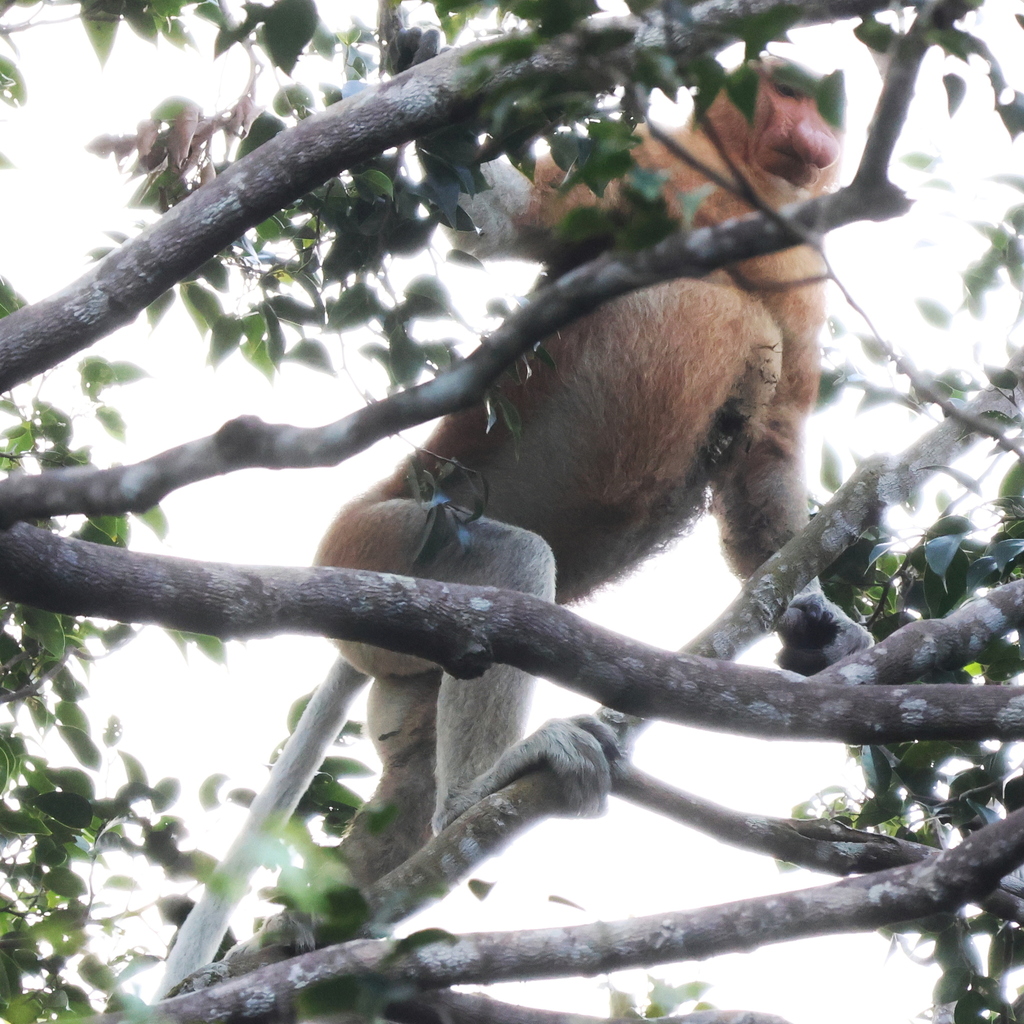
Proboscis Monkey
Photo © Huey
Photo © Huey — CC BY 4.0 — Source: iNaturalist #318539634The proboscis monkey or long-nosed monkey (Nasalis larvatus) is an arboreal Old World monkey with an unusually large nose (or proboscis), a reddish-brown skin color and a long tail. It is endemic to the Southeast Asian island of Borneo and is found mostly in mangrove forests and on the coastal areas of the island. This species co-exists with the Bornean orangutan and monkeys such as the silvery lutung. It belongs in the monotypic genus Nasalis. == Taxonomy == The proboscis monkey belongs to the subfamily Colobinae of the Old World monkeys. The two subspecies are: N. l. larvatus (Wurmb, 1787), which occupies the whole range of the species excluding northeast Kalimantan N. l. orientalis (Chasen, 1940), restricted to north-east Kalimantan However, the difference between the subspecies is small, and not all authorities recognise N. l. orientalis. The genus name Nasalis comes from the Latin word nasus meaning "nose". This animal was made known to Westerners by Baron Friedrich von Wurmb in 1781, he later sent specimens of it to Stamford Raffles in Europe. == Description == The proboscis monkey is a large species, being one of the largest monkey species native to Asia. Only the Tibetan macaque and a few…
Bako National Park
Kuching, Malaysia
+210 birds+17 mammals
Weathered sandstone cliffs rise dramatically from the South China Sea, their ochre faces sculpted by millennia of wind and tide into a landscape of extraordinary geological…
VIEW NATIONAL PARKKuching Wetlands National Park
Kuching, Malaysia
+103 birds+4 mammals
Where brackish waters meet mangrove stilts and freshwater swamps blend into coastal mudflats, one of Southeast Asia's most dynamic wetland ecosystems unfolds across Sarawak's northwestern coast.…
VIEW NATIONAL PARKNo community photos yet. Log in to add the first one.