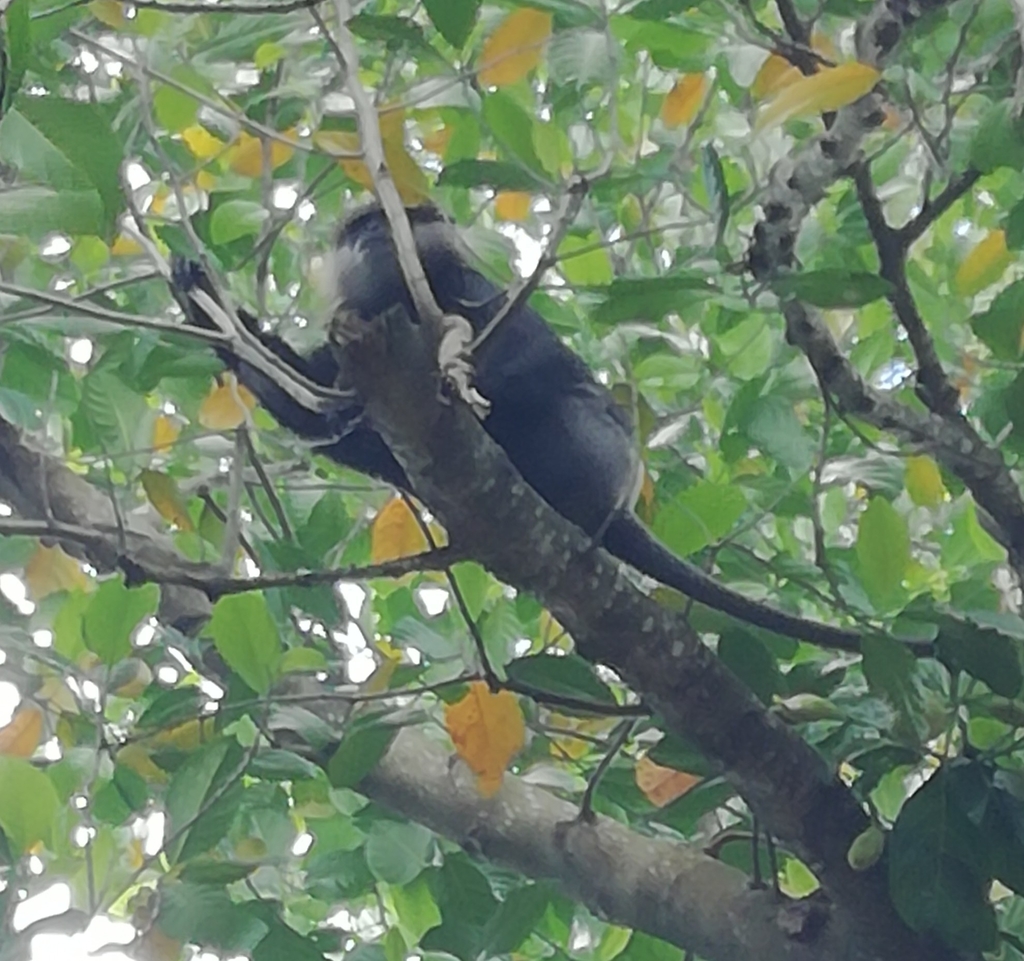
Purple-faced Langur
Photo © savija
Photo © savija — CC0 1.0 — Source: iNaturalist #102298499Identification
The purple-faced langur is a long-tailed arboreal primate endemic to Sri Lanka, distinguished by its striking facial markings and variable plumage. Males are larger than females, measuring 50–67 cm in head-body length with tails of 67–85 cm, while females are slightly smaller at 44–60 cm with 59–82 cm tails. Adults typically weigh around 7 kg, though weights vary among subspecies. The species' most recognizable features are its dark purplish-black face with white sideburns and a paler lower face, contrasting with a predominantly brown or grayish pelage. Whitish or gray "trousers" on the hindquarters, white or whitish-gray rump patches, and black-and-white tail coloration complete the distinctive appearance. The crown hair is directed backwards rather than radiating, and the species lacks the crest found in related langurs.
Range & Habitat
The purple-faced langur is found exclusively in Sri Lanka, inhabiting closed-canopy forests in the mountains and southwestern "wet zone"—areas characterized by high temperatures, high humidity, and seasonal monsoon rains. Specific locations where it can still be observed include Sinharaja, Kitulgala, Kandalama, Mihintale, Horton Plains National Park, and rainforests near Galle. Once widespread across the wet zone including suburban Colombo, the species has suffered catastrophic habitat loss; forest coverage has plummeted from 80% in 1980 to below 3% today. Four subspecies are recognized, each adapted to different elevations and regions, with the western purple-faced langur being among the 25 most endangered primates globally.
Behaviour & Diet
Purple-faced langurs are notably shy and live in small, widely scattered groups, typically containing only one adult male. The species is primarily folivorous, feeding on leaves, supplemented by fruits and flowers. Their secretive nature and arboreal habits make them challenging to observe despite their historical prevalence in the region. Rapid urbanization and human encroachment have drastically altered their behavior and distribution, fragmenting populations across remaining forest patches.
Best Time & Places to See It
Your best opportunities to encounter purple-faced langurs are in protected forest areas: Sinharaja rainforest, Horton Plains National Park, and forests near Kitulgala, Kandalama, Mihintale, and Galle. Visit during the wet season for optimal forest conditions, though the species' shy demeanor and small, dispersed populations mean sightings are never guaranteed. Early morning excursions when the monkeys are most active improve your chances of observation.
Photography Tips
The purple-faced langur's contrasting facial markings and variable coat coloration offer compelling photographic subjects. Frame shots to emphasize the distinctive dark face with white sideburns and the pale lower facial region. The species' long tail provides excellent compositional elements. Shoot in diffused morning or late afternoon light to capture details of the mixed black-and-white tail and the subtle variations in the grayish-brown pelage. A telephoto lens is essential, as these are arboreal, distant subjects. Exercise patience and move slowly through forest habitats to avoid alarming these inherently wary animals.
No community photos yet. Log in to add the first one.
No community observations of this species yet.