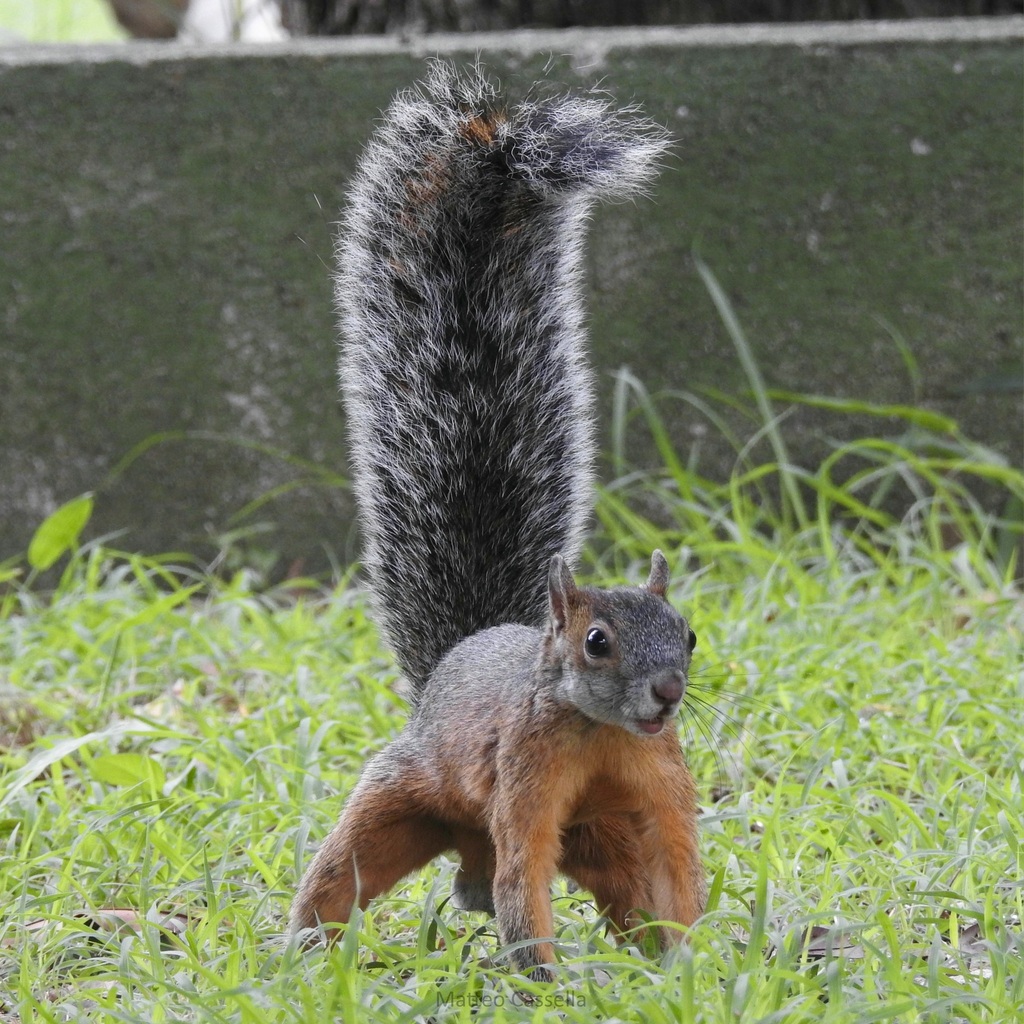
Red-bellied Squirrel
Photo © Matteo Cassella
Photo © Matteo Cassella — CC BY-SA 4.0 — Source: iNaturalist #330270156Identification
The red-bellied squirrel is a medium-sized tree squirrel with striking color variation across its range. Dorsal fur ranges from pale to dark gray, often marked with patches of color on the neck, shoulders, back, and sides. The distinctive feature is its ventral fur, which ranges from white to orange to deep chestnut, with the tail typically matching the belly coloration. Two subspecies are recognized: S. a. aureogaster from eastern Mexico displays orange to chestnut underparts with a white tail accented in black or chestnut, while S. a. nigrescens from Mexico's Pacific coast shows white to chestnut ventral fur with larger ear patches and a gray to chestnut tail. Melanism is common throughout the species, and introduced populations in Florida often display entirely black fur.
Range & Habitat
Native to Mexico and southern Guatemala, the red-bellied squirrel inhabits both lowland and highland forest environments. The species consists of two recognized subspecies distributed across different regions of Mexico. In 1938, this species was introduced to the Florida Keys, where it has become established as an invasive population. The squirrels are highly arboreal, spending most of their time in the forest canopy at heights of 10–20 metres above ground, though they will forage at varying elevations and occasionally descend to the ground.
Behaviour & Diet
Red-bellied squirrels are solitary, daytime-active creatures that are remarkably agile, making precise long jumps between trees. They are extremely shy around humans and typically remain silent except when frightened or mating, producing distinct calls including low and high-pitched barks and rapid squeaks. They frequently feed while hanging from branches by their hind limbs. Their diet varies by habitat: in lowland areas they favor fruits and seeds including mangos, figs, and coconut, while highland populations focus on acorns and pinecones. They also consume fungi, insects, and nestlings. During seasonal food scarcity, they clip branches to access the nutritious phloem.
Best Time & Places to See It
In their native range, red-bellied squirrels are best observed in forested habitats during daylight hours, particularly in the early morning after sunrise and late afternoon before sunset when they are most active. They are best located by watching the canopy at heights of 10–20 metres. In the introduced Florida Keys population, they remain predominantly arboreal except during foraging or mating periods, making tree-canopy observation the most productive approach. Patient, quiet observation is essential given their shyness toward humans.
Photography Tips
Patience and stealth are essential when photographing this shy species. Position yourself early in the morning or late afternoon when squirrels are most active, and remain still and quiet to avoid startling them. Focus on the forest canopy at mid to upper levels where they spend most of their time. Backlighting can beautifully highlight their distinctive belly coloration and tail patterns. During mating season, look for chasing behavior accompanied by vocalizations, which offers dynamic shooting opportunities. Their agility and precise arboreal movements provide excellent action photography opportunities for photographers with fast shutter speeds.
Parque Nacional Cerro de la Estrella
Mexico
+126 birds+4 mammals
Where volcanic peaks rise sharply above Mexico City's sprawling metropolis, Parque Nacional Cerro de la Estrella offers a rare glimpse of high-altitude terrain within one of…
VIEW NATIONAL PARKParque Nacional Benito Juárez
San Andrés Huayápam, Mexico
+128 birds+4 mammals
High in the Sierra Madre del Sur of Oaxaca, where cloud forest mingles with pine woodland and the terrain climbs steeply through ravines carved by mountain…
VIEW NATIONAL PARKParque Nacional Grutas de Cacahuamilpa
Pilcaya, Mexico
+97 birds+12 mammals
Where limestone ridges rise abruptly from the tropical deciduous forests of central Guerrero, the Grutas de Cacahuamilpa National Park shelters one of Mexico's most extensive cave…
VIEW NATIONAL PARKNo community photos yet. Log in to add the first one.
No community observations of this species yet.