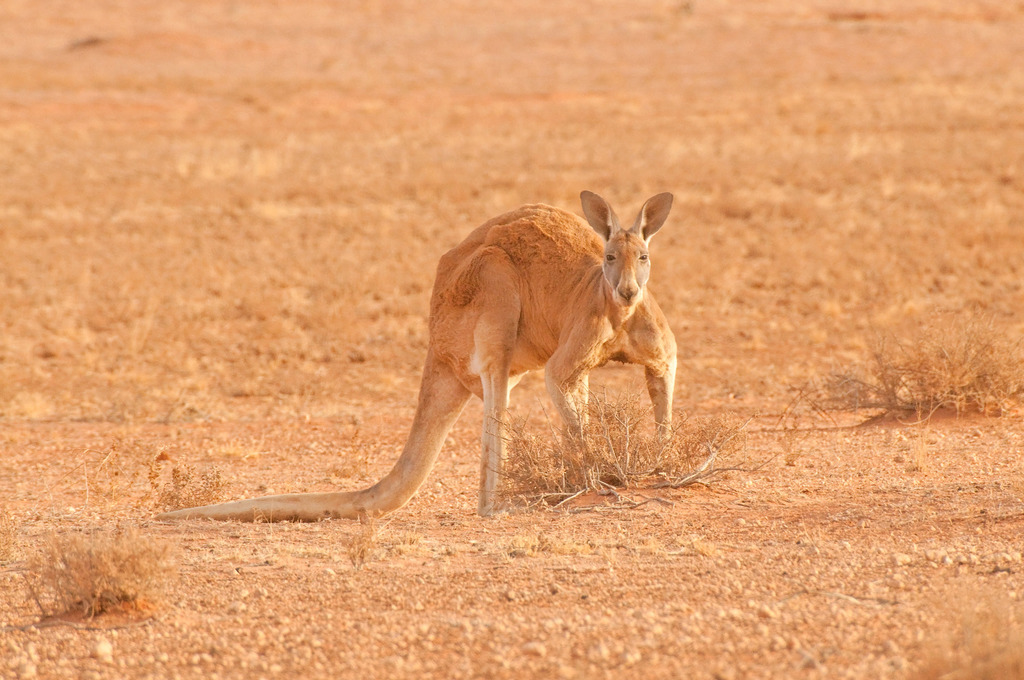
Red Kangaroo
Photo © Rolf Lawrenz
Photo © Rolf Lawrenz — CC BY 4.0 — Source: iNaturalist photo #26434743Identification
The red kangaroo is Australia's largest terrestrial mammal and the world's largest living marsupial. Males are unmistakable "Big Reds"—massive animals with short, red-brown fur fading to pale buff on the underside and limbs. Females are considerably smaller and distinctly different in colour, displaying blue-grey fur with a brown tinge and pale grey below, though arid-zone females may resemble males. Both sexes share the species' characteristic features: long, pointed ears, a square-shaped muzzle, powerful hind limbs built for leaping, small clawed forelimbs, and a strong tail used as a tripod when standing upright.
Males typically measure 1.3–1.6 m in head-and-body length with tails adding another 1.2 m, weighing 55–90 kg. Large mature males can exceed 1.8 m tall, with the largest recorded specimen reaching 2.1 m and weighing 91 kg. Females are substantially smaller at 85–105 cm in body length and 18–40 kg in weight. The red kangaroo maintains exceptional internal temperature regulation around 36°C through insulating fur, behavioural adaptations, and a remarkable ability to enter torpor during harsh conditions.
Range & Habitat
The red kangaroo is found across mainland Australia except in more fertile regions—southern Western Australia, eastern and southeastern coasts, and northern rainforests. Its range encompasses scrubland, grassland, and desert habitats, typically in open country with scattered trees for shade. These kangaroos are superbly adapted to arid environments, with kidneys that efficiently concentrate urine and the ability to extract moisture from vegetation, allowing them to survive extended periods without drinking.
Behaviour & Diet
Red kangaroos are mostly crepuscular and nocturnal, spending daylight hours resting in the shade and becoming active during cooler periods. They are primarily sedentary, maintaining relatively well-defined home ranges, though environmental stress can trigger long-distance movements. Large congregations of up to 1,500 individuals may gather in areas with abundant forage. Grazing dominates their daily activities, and they seek shelter among small saltbushes or mulga rather than rocky outcrops.
These kangaroos are specialist grazers, with green vegetation—particularly fresh grasses and forbs—comprising the bulk of their diet. Studies of Central Australian populations show green grass makes up 75–95% of intake, with specific species like Eragrostis setifolia dominating. During dry seasons, they actively search for green plants by staying near watercourses and open grassland. When preferred foods become scarce, they will browse shrubs and eat certain chenopods, demonstrating dietary flexibility essential for survival in variable arid landscapes.
Best Time & Places to See It
Red kangaroos are most active during dawn, dusk, and night, making early morning and late evening the prime viewing windows. Central and western Australian scrublands, grasslands, and semi-arid regions offer the best opportunities. Look for them in open habitats with scattered trees, particularly near watercourses during dry periods when kangaroos concentrate around remaining water sources and green vegetation.
Photography Tips
Early morning and late afternoon light provides exceptional photography conditions, illuminating the distinctive red and buff colouring of males against the arid landscape. Position yourself in open grassland where kangaroos graze, and maintain a respectful distance. The characteristic upright posture—with the tail forming a tripod—creates striking compositional opportunities. Capture their powerful hind limbs and distinctive ear shape in detail. Female blue-grey colouration offers striking colour contrast against dry golden grasses. Their remarkable leaping ability—covering 8–9 m in a single bound and reaching heights of 1.8–3 m—presents dynamic action shots, particularly in early morning or late evening when light is optimal.
Ikara-Flinders Ranges National Park
Australia
+149 birds+10 mammals
Where ancient quartzite ridges rise across the semi-arid heart of South Australia, Ikara-Flinders Ranges National Park unfolds across nearly two thousand square kilometres of one of…
VIEW NATIONAL PARKVulkathunha-Gammon Ranges National Park
Australia
+97 birds+8 mammals
Granite ridges and quartzite peaks rise abruptly from the red earth of South Australia's mid-north, their steep slopes carved into gorges where seasonal waterfalls cascade through…
VIEW NATIONAL PARKMungo National Park
Australia
+135 birds+7 mammals
Across the semi-arid inland plains of New South Wales, where sparse shrubland and scattered grassland stretch beneath enormous skies, lies a landscape shaped by ancient geological…
VIEW NATIONAL PARKMurray-Sunset National Park
Australia
+205 birds+2 mammals
Across the semi-arid borderlands of northwestern Victoria, where the Murray River defines the state's edge, sprawls a landscape of remarkable resilience and subtle beauty. Murray-Sunset National…
VIEW NATIONAL PARKCape Range National Park
Australia
+159 birds+15 mammals
Where arid limestone ridges plunge toward turquoise waters, Cape Range National Park frames one of Australia's most dramatic desert-ocean interfaces. The park's spine—a stark, weathered range…
VIEW NATIONAL PARKNo community photos yet. Log in to add the first one.
No community observations of this species yet.