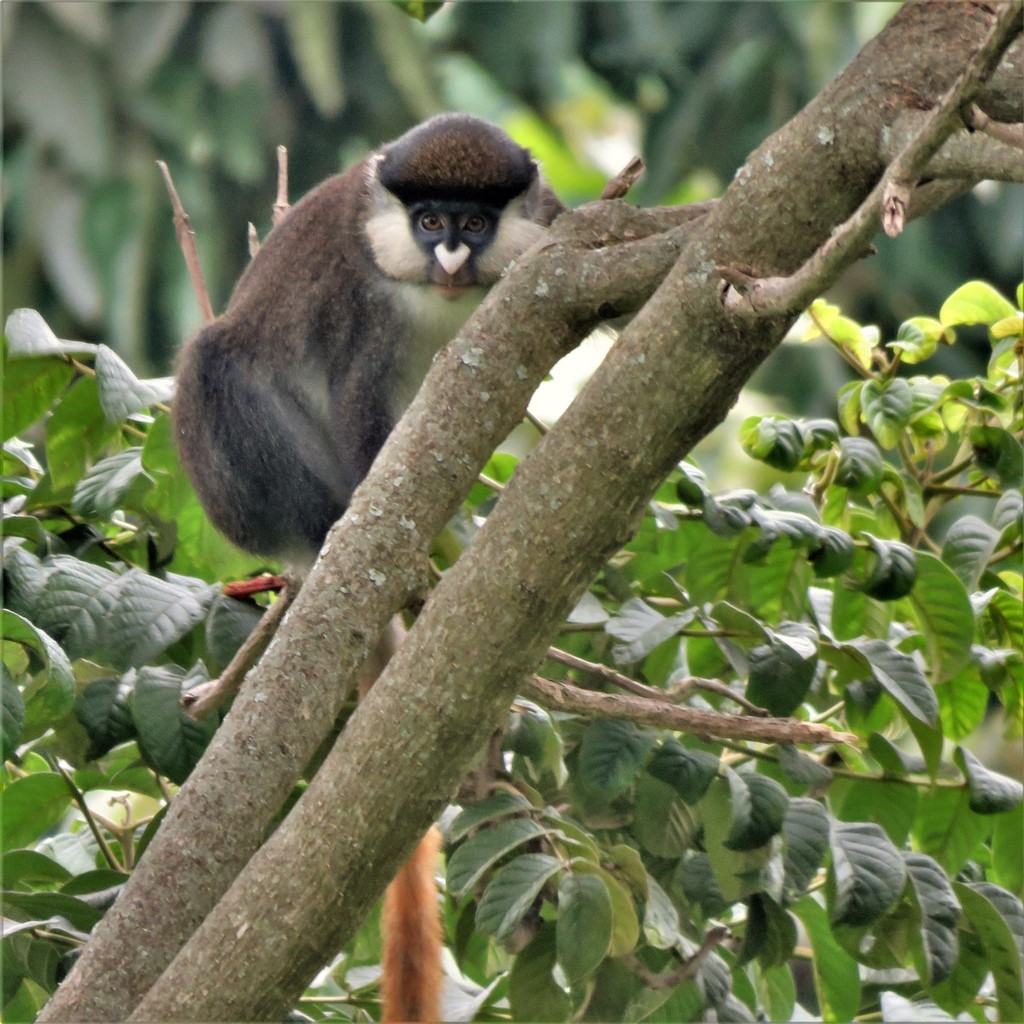
Red-tailed Monkey
Photo © Annika Lindqvist
Photo © Annika Lindqvist — CC BY 4.0 — Source: iNaturalist #31139417Identification
The red-tailed monkey is instantly recognizable by the striking red coloration on the underside of its tail, which intensifies from base to tip. Named after this distinctive feature, the species is also called the black-cheeked white-nosed monkey, red-tailed guenon, or Schmidt's guenon. These primates have characteristic black or dark grey body fur contrasting with a white nose and notably large, elastic cheeks used for storing food. Males are larger than females, with body length ranging from 12 to 24 inches (not including the tail), while their impressive tails can reach up to 35 inches—sometimes twice the body length. Males weigh 7 to 10 pounds; females slightly less at 6 to 8 pounds. The tail serves a crucial role in balance and movement through their arboreal habitat.
Range & Habitat
Red-tailed monkeys are found across East and Central Africa, inhabiting Angola, Central African Republic, Democratic Republic of the Congo, Kenya, Rwanda, South Sudan, Tanzania, Uganda, Zambia, and possibly Burundi. Five recognized subspecies occupy different ranges, with C. a. schmidti having the widest distribution stretching from Congo through Kenya, Tanzania, and Uganda, while C. a. atrinasus is restricted to a small area around Zovo, Angola. These primates are primarily arboreal inhabitants of tropical forests but spend considerable time on the forest floor foraging. They have adapted well to various habitats and environmental conditions, though the species is gradually becoming endangered due to deforestation and hunting pressure.
Behaviour & Diet
Red-tailed monkeys are highly social, forming groups of 7 to 30 individuals typically consisting of one dominant male, females, and juveniles. Mature males leave their natal groups to form bachelor groups or compete to become dominant males elsewhere. Females practice allomaternal care, collectively raising young. These primates are primarily frugivorous but omnivorous by necessity, consuming leaves, flowers, and insects when fruit becomes scarce. Their expandable cheek pouches allow them to forage in one area and carry food to safer locations for consumption. They are diurnal, most active in early morning and evening hours, and function as important seed dispersers throughout their range.
Best Time & Places to See It
Red-tailed monkeys are most active during early morning and evening hours, making these the optimal times for observation. Their primarily arboreal lifestyle means looking upward into the tropical forest canopy offers the best viewing opportunities, though they regularly come to the ground to forage. Travelers visiting East and Central African tropical forests, particularly in Kenya, Tanzania, Uganda, and Congo regions, have the best chances of encountering these social groups. During periods of fruit abundance, multiple social groups may congregate together, increasing the likelihood of sightings.
Photography Tips
The red-tailed monkey's striking tail underside is your primary photographic subject—position yourself to capture the vibrant red coloration against the forest backdrop. Early morning and evening light works best for highlighting their distinctive features: the white nose, dark fur, and expressive faces. When monkeys display threat behaviors—staring with raised eyebrows to reveal white eyelids or head-bobbing—these dynamic moments make compelling images. Use a telephoto lens to capture their acrobatic movements through the canopy while maintaining safe distance. Patience is essential; wait for groups to settle in feeding areas where their large, elastic cheeks stuffed with food provide excellent character-filled shots. The long tail, often held high for balance, frequently frames beautiful compositional opportunities in the trees.
Bwindi Impenetrable National Park
Kanyashogi, Uganda
+603 birds+26 mammals
Steep ridges cloaked in montane forest rise from Uganda's southwestern borderlands, where the landscape grows so dense and tangled that early explorers named it impenetrable. At…
VIEW NATIONAL PARKQueen Elizabeth National Park
Uganda
+672 birds+30 mammals
Across the southwestern escarpment of Uganda, where the Western Rift Valley descends through ancient volcanic terrain, Queen Elizabeth National Park sprawls across more than 8,300 square…
VIEW NATIONAL PARKNo community photos yet. Log in to add the first one.
No community observations of this species yet.