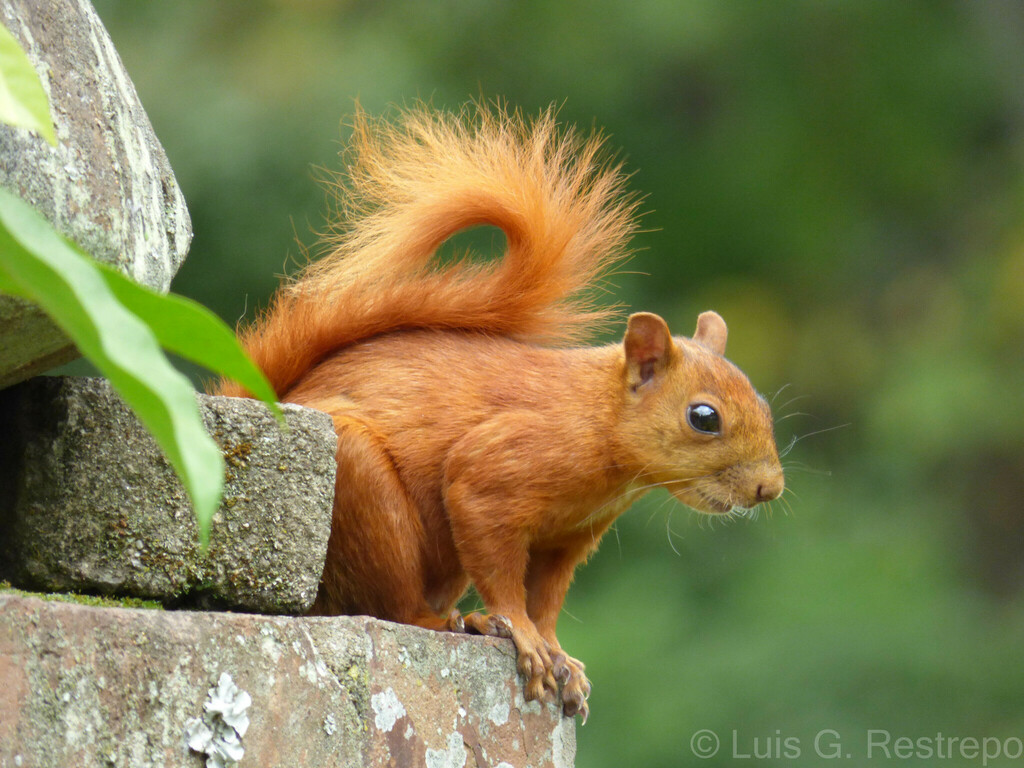
Red-tailed Squirrel
Photo © Luis G Restrepo
Photo © Luis G Restrepo — CC BY 4.0 — Source: iNaturalist photo #444266460Identification
The red-tailed squirrel is a highly variable tree squirrel with a remarkable diversity of coat colours across its range. Coat patterns include combinations of brown, orange, red, and sometimes blackish markings, with considerable individual and regional variation. Most individuals display distinctive orange or reddish fur on the throat, chest, and belly, though some populations show white or white-spotted undersides instead. A characteristic feature of most populations is a patch of lighter-coloured (generally orange) fur on the head behind the ears, though this is absent in some subspecies. The tail typically displays red-tipped hairs, and in some subspecies shows striking tricoloured patterns with dark bases, reddish middles, and black ends.
The red-tailed squirrel is most closely related to Sciurus pucheranii. It is somewhat larger than this similar species, though size overlap occurs except in the eastern Andes of Colombia where S. granatensis is always noticeably larger. Note that the species was reclassified to the genus Notosciurus in 2015, though the IUCN continues to recognize it under the genus Sciurus.
Range & Habitat
This species is distributed from southern Central America to northern South America, with populations found in Costa Rica, Panama, Colombia, Ecuador, Venezuela, and Trinidad and Tobago. It also occurs on the Caribbean island of Margarita. A small invasive population exists in Cuba, descended from animals that escaped the Havana Zoo.
The red-tailed squirrel inhabits many types of forests across a wide elevation range from sea level to 3,000 metres (9,843 feet). It is adaptable to human-modified landscapes and can be found in picnic grounds and other accessible areas, making it relatively easy for travellers to encounter.
Behaviour & Diet
The source material provided does not include specific information about the behaviour and diet of the red-tailed squirrel. Travellers seeking detailed information about its feeding habits, social structure, and activity patterns are encouraged to consult additional field guides and scientific literature.
Best Time & Places to See It
The red-tailed squirrel's wide elevational range and adaptability to various forest types make it a reasonably accessible species throughout its range. Its presence in picnic grounds and human-frequented areas increases the likelihood of encounters. The species is distributed across Costa Rica, Panama, Colombia, Ecuador, Venezuela, and the Caribbean islands of Trinidad, Tobago, and Margarita, offering multiple opportunities for observation across Central and South America.
Photography Tips
The extreme variability in coat coloration across the species' range means that photographing different populations provides opportunities to document remarkable colour variation. Focus on capturing the distinctive orange or lighter-coloured patches behind the ears (present in most subspecies) and the characteristic red-tipped tail hairs. The tricoloured tail patterns seen in some populations are particularly striking photographic subjects. Given the species' presence in picnic grounds and accessible forest areas, patient observation from these locations may yield good photographic opportunities without requiring extensive backcountry travel.
Corcovado National Park
Puerto Jiménez, Costa Rica
+444 birds+48 mammals
Where the Osa Peninsula juts into the Pacific, rainforest descends almost to the tide line, and Corcovado National Park protects one of Central America's most intact…
VIEW NATIONAL PARKArenal Volcano National Park
Peñas Blancas, Costa Rica
+551 birds+21 mammals
Straddling the border between Alajuela and Guanacaste in northwestern Costa Rica, this national park rises dramatically around one of Central America's most active volcanic systems. The…
VIEW NATIONAL PARKChirripó National Park
Rivas, Costa Rica
+274 birds+6 mammals
Where the volcanic spine of Costa Rica's Central Cordillera reaches its apex, Chirripó National Park encompasses a landscape that shifts dramatically with elevation, from montane cloud…
VIEW NATIONAL PARKBraulio Carrillo National Park
Las Horquetas, Costa Rica
+547 birds+18 mammals
Where the Caribbean slope descends from the central volcanic cordillera toward the humid lowlands of Heredia, Braulio Carrillo National Park preserves one of Costa Rica's most…
VIEW NATIONAL PARKPiedras Blancas National Park
Golfito, Costa Rica
+386 birds+24 mammals
Where the Golfo Dulce meets the southwestern Pacific coast of Costa Rica, Piedras Blancas National Park protects a dramatic transition zone where lowland rainforest descends toward…
VIEW NATIONAL PARKVolcán Poás National Park
Toro Amarillo, Costa Rica
+237 birds+4 mammals
Where volcanic slopes rise sharply from the Central Valley floor, Volcán Poás National Park protects one of Costa Rica's most active and accessible volcanic systems. The…
VIEW NATIONAL PARKAntisana National Park
Quijos, Ecuador
+432 birds+21 mammals
Where the eastern Andean slopes descend into the Amazon basin, Antisana National Park sprawls across roughly 2,500 square kilometers of some of South America's most dramatic…
VIEW NATIONAL PARKNatural Utría National Park
Alto Baudó (Pie de Pató), Colombia
+372 birds+11 mammals
Where the Chocó's coastal mountains plunge toward the Pacific, Utría National Park preserves one of Colombia's most biodiverse and least-visited wilderness expanses. Sprawling across 1,287 square…
VIEW NATIONAL PARKNatural Farallones de Cali National Park
Buenaventura, Colombia
+733 birds+27 mammals
Where the Pacific coastal plain meets the western slopes of the Andes, Farallones de Cali National Park sprawls across nearly 3,500 square kilometers of dramatic topography…
VIEW NATIONAL PARKBaru Volcano National Park
Cerro Punta, Panama
+402 birds+6 mammals
Where the land rises sharply toward the Caribbean's western spine, Baru Volcano National Park sprawls across roughly 220 square kilometres of southwestern Panama, anchored by the…
VIEW NATIONAL PARKSoberanía National Park
Cristóbal, Panama
+495 birds+34 mammals
Rainforest and riverine woodland blanket the rolling terrain of this 714-square-kilometre national park in Colón Province, where the Caribbean watershed feeds a maze of streams and…
VIEW NATIONAL PARKChagres National Park
Caimitillo, Panama
+486 birds+19 mammals
Where the Chagres River carves through the humid tropics of central Panama, a vast montane and lowland forest sprawls across more than 2,300 square kilometers, anchoring…
VIEW NATIONAL PARKPortobelo National Park
Portobelo, Panama
+366 birds+9 mammals
Where the Caribbean's turquoise waters meet the Darién's verdant shore, Portobelo National Park sprawls across 570 square kilometers of coastal forest, mangrove wetland, and coral-fringed islands…
VIEW NATIONAL PARKParque Internacional la Amistad
Teribe, Panama
+325 birds+11 mammals
Where the continental divide rises between the Caribbean and Pacific watersheds, a wilderness of extraordinary biological richness unfolds across the Talamanca Range and into lowland rainforest—a…
VIEW NATIONAL PARKCarara National Park
Tárcoles, Costa Rica
+397 birds+19 mammals
Where the Pacific coastal plain meets transitional forest, Carara National Park straddles one of Central America's most dynamic ecological boundaries. The park's landscape encompasses lowland deciduous…
VIEW NATIONAL PARKLos Quetzales National Park
Copey, Costa Rica
+232 birds+3 mammals
Cloud forest sweeps across the upper slopes of the Central Valley watershed, where elevation and persistent moisture forge an ecosystem unlike any other in Costa Rica.…
VIEW NATIONAL PARKCahuita National Park
Talamanca, Costa Rica
+359 birds+15 mammals
Where the Caribbean shoreline dissolves into mangrove creeks and coral gardens, Cahuita's mosaic of habitats unfolds across the Limón coast. The park's signature feature—a living coral…
VIEW NATIONAL PARKTapantí Macizo de la Muerte National Park
Orosi, Costa Rica
+503 birds+18 mammals
Where montane cloud forest rises steeply from the Orosi Valley, Tapantí Macizo de la Muerte National Park enfolds a landscape of perpetual moisture and emerald complexity.…
VIEW NATIONAL PARKLa Amistad International Park
Crorina, Costa Rica
+532 birds+20 mammals
Where the Caribbean slopes of Costa Rica's Talamanca Mountains rise steeply inland from Limón, the boundary between two nations dissolves into an unbroken expanse of rainforest.…
VIEW NATIONAL PARKVolcán Tenorio National Park
Guatuso, Costa Rica
+480 birds+12 mammals
Where volcanic slopes rise through Costa Rica's northwestern borderlands, Volcán Tenorio National Park sprawls across terrain shaped by ancient lava flows and mineral-rich springs. The park's…
VIEW NATIONAL PARKGandoca-Manzanillo National Wildlife Refuge
Manzanillo, Costa Rica
+394 birds+18 mammals
Where the Caribbean coastal plain surrenders to water-logged forest and mangrove tangles, Gandoca-Manzanillo Wildlife Sanctuary shelters one of Costa Rica's most biodiverse lowland wetland ecosystems. The…
VIEW WILDLIFE SANCTUARYNo community photos yet. Log in to add the first one.
No community observations of this species yet.