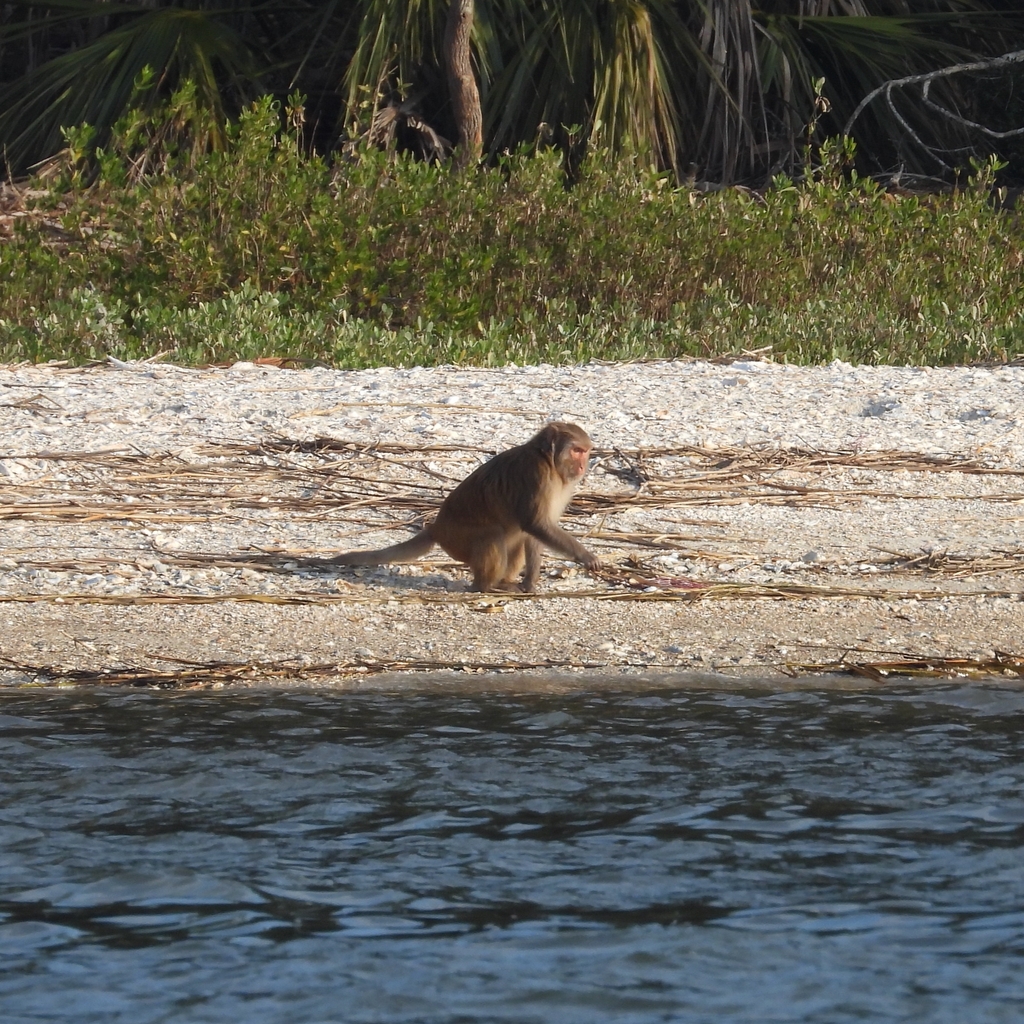
Rhesus Macaque
Photo © Peter Burka
Photo © Peter Burka — CC BY-SA 4.0 — Source: iNaturalist #327728567Identification
The rhesus macaque is a robust Old World monkey easily recognized by its brown or grey fur and distinctive bare pink face. Adult males average 53 cm (21 in) in length and weigh about 7.7 kg (17 lb), while females are noticeably smaller at 47 cm (19 in) and 5.3 kg (12 lb). The tail is relatively short, measuring 20.7–22.9 cm (8.1–9.0 in). These primates possess a wide rib cage and characteristic bilophodont molars adapted for their omnivorous diet.
Range & Habitat
The rhesus macaque has the widest geographic range of any non-human primate, native to South, Central, and Southeast Asia including India, Bangladesh, Pakistan, Nepal, Myanmar, Thailand, Afghanistan, Vietnam, and southern China. These highly adaptable monkeys occupy diverse habitats ranging from grasslands and woodlands to mountainous regions at elevations up to 2,500 m (8,200 ft). They are strong swimmers capable of crossing rivers and increasingly inhabit human-dominated landscapes, including agricultural areas and cities, where they readily adapt to human presence.
Behaviour & Diet
Rhesus macaques are diurnal and highly social, living in matrilineal troops of 20–200 individuals. They are mostly herbivorous, feeding primarily on fruit, seeds, roots, buds, and bark. In urban areas, they supplement their diet with human food and trash. These intelligent primates communicate through a sophisticated repertoire of facial expressions, vocalizations, body postures, and gestures, enabling complex social interactions within their hierarchical family groups.
Best Time & Places to See It
Rhesus macaques can be encountered throughout their broad Asian range, though they are particularly common in India, Nepal, Thailand, and southern China. Their tendency to move into agricultural areas and urban centers means they are often visible near villages, temples, and city parks where they have become habituated to human presence. Early morning and late afternoon typically offer the best viewing opportunities, when troops are most active in foraging.
Photography Tips
The striking contrast between the rhesus macaque's dark fur and bare pink face makes for compelling portraits, particularly in strong morning or late afternoon light. Their frequent facial expressions and social interactions within troops provide abundant behavioral photography opportunities. Use a telephoto lens (200–400 mm) to maintain a safe distance while capturing detailed shots of individual expressions and group dynamics. Be patient near fruiting trees or water sources where troops congregate, and exercise caution as habituated urban populations may be aggressive if approached too closely.
Kanha Tiger Reserve
Bandhavgarh National Park
Banke National Park
Bardiya National Park
Chitwan National Park
Giant Panda National Park
Gir National Park
Kaziranga National Park
Keoladeo National Park
Nothing matches these filters.
No community photos yet. Log in to add the first one.
No community observations of this species yet.