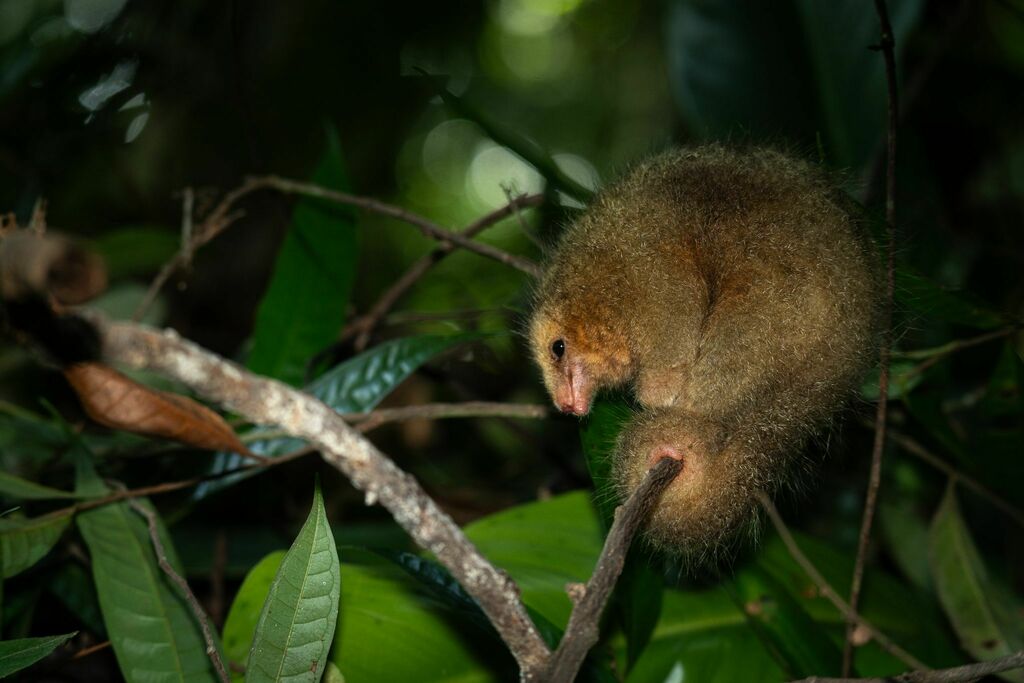
Rio Negro Silky Anteater
Photo © Sylvain Eichhorn
Photo © Sylvain Eichhorn — CC BY 4.0 — Source: iNaturalist #224418064Identification
The Rio Negro silky anteater is the smallest living anteater species, weighing just 175–400 grams with a body length of 36–45 cm plus a 17–24 cm tail. Its most distinctive features are dense, soft fur ranging from grey to yellowish with a silvery sheen, often marked with darker streaks. The underparts and limbs tend to be paler. Look for characteristic red foot soles and black eyes. Its name derives from the two prominent claws on the second and third toes of each forefoot, with the third toe being notably enlarged—these claws can nearly encircle branches as the animal clings. The partially prehensile tail and proportionately shorter face distinguish it from larger anteater relatives.
Range & Habitat
This species occurs in western Brazil, eastern Ecuador, eastern Colombia, and Peru, representing one of several recently recognized Cyclopes species across the neotropics. Silky anteaters inhabit tropical evergreen forests, semi-deciduous forests, and mangrove forests from sea level to 1,500 metres elevation. They are strictly arboreal and require continuous forest canopy where they can move between trees without descending to the ground. Population densities can reach 0.77 individuals per hectare in suitable lowland rainforest habitat.
Behaviour & Diet
Completely nocturnal and solitary, the Rio Negro silky anteater is a slow-moving canopy dweller that spends its days curled into a ball, often within silk cotton trees (Ceiba species) where its coloration provides excellent camouflage. It feeds voraciously on ants—consuming 700 to 5,000 daily—along with wasps, wasp pupae, termites, and small beetles, attacking wasp nests at night when insects are sluggish. Females have smaller home ranges than males. Breeding produces a single young up to twice annually; young are born fully furred with adult coloration and are left in tree-hole nests lined with dead leaves for approximately eight hours each night while the mother forages.
Best Time & Places to See It
The Rio Negro silky anteater remains one of the forest's most elusive mammals despite reasonable population densities. Nocturnal activity makes sightings challenging, though patient observers may encounter foraging individuals at night, particularly in continuous-canopy lowland rainforest with abundant Ceiba trees. Early morning and dusk searches near suspected feeding sites offer the best chances. This species has recently been recognized as distinct from other silky anteaters, so consult local guides familiar with Amazonian fauna in Ecuador, Peru, Colombia, and western Brazil.
Photography Tips
Photographing this cryptic nocturnal species demands specialized equipment: high-ISO capability, fast lenses, and preferably infrared or red-light headlamps to minimize disturbance. The animal's small size and slow movements make handheld shots difficult; a stable platform or tripod is recommended. Its silvery fur photographs best with diffused lighting that captures the characteristic sheen without harsh shadows. The red foot soles and black eyes provide striking detail worth isolating. Patience is essential—locate foraging individuals at night and allow the animal to become accustomed to your presence before attempting photography, keeping movements deliberate and slow.
No community photos yet. Log in to add the first one.
No community observations of this species yet.