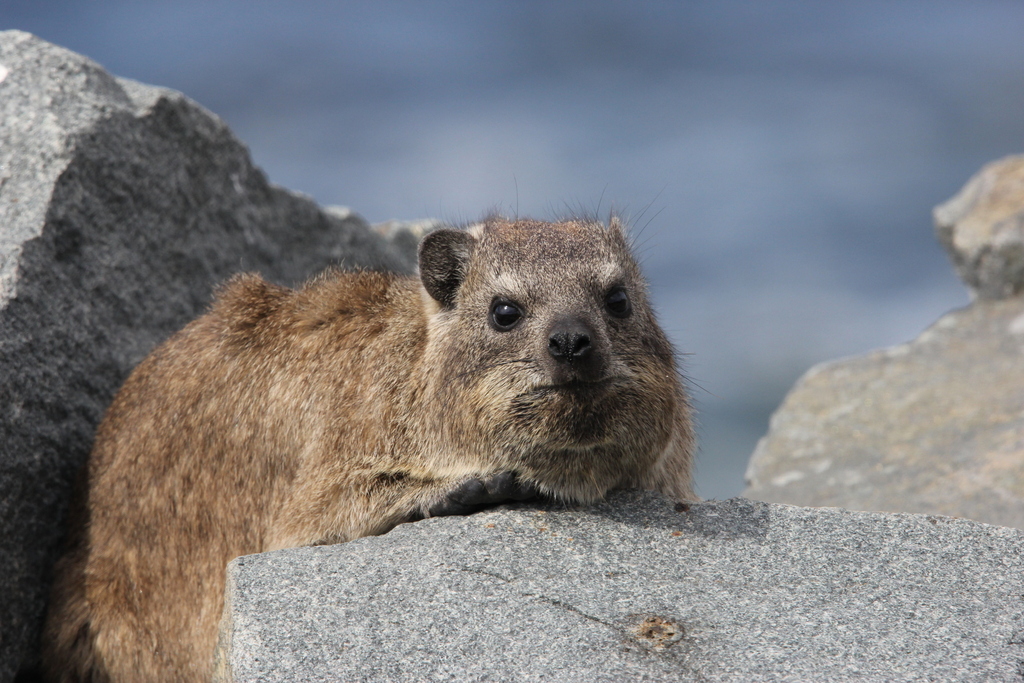
Rock Hyrax
Photo © Svyatoslav Knyazev
Photo © Svyatoslav Knyazev — CC BY 4.0 — Source: iNaturalist photo #624574973Identification
Rock hyraxes are squat, heavily built mammals weighing 4–5 kg and measuring around 50 cm in length. Their thick fur is grey-brown, though coloration varies regionally from dark brown in wetter habitats to light grey in desert-dwelling populations. They have a pointed head, short neck, and rounded ears adorned with long black whiskers. Most distinctive are their prominent, long, pointed upper incisors that resemble tusks—a surprising feature shared with their distant relatives, elephants.
A unique characteristic of hyraxes is the dorsal gland, a scent-producing organ used for territorial marking and social communication, most visible in dominant males. Their feet are specially adapted for climbing: the fore feet are plantigrade (flat-footed) while the hind feet are semi-digitigrade, with large, soft pads kept moist by sweat-like secretions that provide excellent grip on rock surfaces.
Range & Habitat
Rock hyraxes are found across sub-Saharan Africa in disjunct populations, absent only from the Congo Basin and Madagascar. Their range extends northward to southern Algeria, Libya, and Egypt, and reaches the Middle East with populations in Israel, Jordan, Lebanon, and the Arabian Peninsula. They inhabit areas from sea level up to 4,200 m elevation, making them the only extant terrestrial afrotherians in the Middle East.
These animals require habitats with rock crevices that provide essential refuge from predators. Rock hyraxes have been introduced to Jebel Hafeet on the Oman-United Arab Emirates border. Pelage color varies by subspecies and region: the Cape rock hyrax displays black dorsal patches, the Kaokoveld form has cream patches, and the red-headed variety sports orange markings. A notably larger, long-haired population inhabits the alpine moraines of Mount Kenya.
Behaviour & Diet
Rock hyraxes are highly social, living in groups of 10–80 animals that forage together and employ a sophisticated sentry system—individuals take turns watching from prominent lookouts while others feed, sounding alarm calls to alert the group to approaching predators. The dominant male defends the group and marks territory using his dorsal gland. These animals are crepuscular, most active during morning and evening hours, though activity patterns vary with season and climate. They have incomplete thermoregulation and maintain a body temperature that fluctuates in a daily rhythm.
Rock hyraxes are herbivorous, feeding on a wide variety of plants including Lobelia and broad-leafed species, and occasionally consuming insects and grubs. They forage within about 50 m of their rocky refuges and are capable of going many days without drinking water, obtaining sufficient moisture from their food. Despite their apparently clumsy build, they are surprisingly adept climbers and readily raid residential gardens for vegetation.
Best Time & Places to See It
The best time to observe rock hyraxes is during early morning and late evening when they are most active. Mount Kenya, with its abundant alpine populations, offers excellent viewing opportunities. Throughout their African range, particularly in South Africa, Namibia, and East Africa, rocky outcrops and cliff faces are reliable locations. In the Middle East, populations in Israel and Jordan are accessible to travelers. Rock hyraxes are generally not endangered and in some areas are considered minor pests, meaning populations are stable across much of their range.
Photography Tips
Position yourself near rocky outcrops and crevices during early morning or late evening light when hyraxes are most active and the sun is favorable for photography. Watch for sentry individuals perched on prominent rocks—these alert animals provide excellent opportunities for portraits with natural lookout behavior. The hyrax's distinctive features—long incisors, whiskers, and soft foot pads—reward close-focus photography and macro work when animals are resting.
Because hyraxes forage as groups, shoot in burst mode to capture multiple animals and dynamic social behavior. Their tendency to quickly retreat into rock crevices means patience and stillness are essential. The variation in pelage color between individuals and populations makes comparative photography worthwhile. Early morning mist in highland areas, such as Mount Kenya, can add atmospheric depth to your images.
Serengeti National Park
Tanzania
+558 birds+57 mammals
Across Tanzania's northern plateau, where volcanic soils meet acacia woodland and open grassland, unfolds one of Earth's most dynamic ecosystems. The Serengeti National Park sprawls across…
VIEW NATIONAL PARKMapungubwe National Park
Musina Local Municipality, South Africa
+358 birds+29 mammals
Where the Limpopo River cuts through sandstone ridges at the convergence of South Africa, Botswana, and Zimbabwe, Mapungubwe National Park preserves a landscape of profound ecological…
VIEW NATIONAL PARKKidepo Valley National Park
Uganda
+478 birds+24 mammals
Where the Narus and Kidepo rivers carve through northeastern Uganda's semi-arid lowlands, a landscape of sparse acacia woodland, grassland, and riverine thickets creates one of East…
VIEW NATIONAL PARKTsavo East National Park
Athi ward, Kenya
+468 birds+50 mammals
Across the semi-arid lowlands of southeastern Kenya, where acacia woodland fragments into scrubland and the landscape rolls toward the Indian Ocean horizon, lies one of Africa's…
VIEW NATIONAL PARKMount Elgon National Park
Matumbei ward, Kenya
+164 birds+7 mammals
Where the volcanic slopes of Mount Elgon rise above the Trans-Nzoia landscape, a montane wilderness unfolds across multiple ecological zones, each harbouring distinct communities adapted to…
VIEW NATIONAL PARKAmboseli National Park
Etonet/Lenkism ward, Kenya
+501 birds+43 mammals
Where the Amboseli basin opens toward the Tanzanian frontier, a shallow alkaline lake mirrors vast skies across one of East Africa's most iconic savanna landscapes. The…
VIEW NATIONAL PARKMount-Kenya National Park
Abothuguchi west ward, Kenya
+334 birds+11 mammals
Where the slopes of Kenya's second-highest mountain rise steeply from the Meru County foothills, a landscape of profound ecological richness unfolds across Mount Kenya National Park.…
VIEW NATIONAL PARKGarden Route National Park
George, South Africa
+353 birds+54 mammals
Sweeping across the Western Cape's coastal and mountainous terrain, this sprawling national park encompasses over five thousand square kilometers of extraordinarily diverse landscape—from coastal limestone cliffs…
VIEW NATIONAL PARKPilanesberg National Park
Moses Kotane Local Municipality, South Africa
+364 birds+49 mammals
Granite peaks and volcanic ridges rise unexpectedly from the savanna floor across this 734-square-kilometre expanse in the North West province, creating a landscape of profound ecological…
VIEW NATIONAL PARKCederberg Wilderness Area
Cederberg Local Municipality, South Africa
+136 birds+12 mammals
Where ancient sandstone ridges rise dramatically from the semi-arid lowlands of Western Cape, the Cederberg Wilderness Area spreads across nearly 1,700 square kilometres of some of…
VIEW NATIONAL PARKKruger National Park
Ba-Phalaborwa Local Municipality, South Africa
+540 birds+91 mammals
Across the low-lying savanna of northeastern South Africa unfolds one of Africa's largest and most ecologically intact protected areas, where acacia woodlands merge into mopane scrub…
VIEW NATIONAL PARKTankwa-Karoo National Park
Hantam Local Municipality, South Africa
+201 birds+20 mammals
Across the semi-arid heartland of the Northern Cape, where winter rains carve ephemeral watercourses through endless ochre plains, Tankwa-Karoo National Park sprawls across more than 3,100…
VIEW NATIONAL PARKMountain Zebra National Park
Inxuba Yethemba Local Municipality, South Africa
+265 birds+35 mammals
Across the windswept plateaus and deeply incised valleys of the Eastern Cape's interior, Mountain Zebra National Park unfolds as a landscape of geological drama and ecological…
VIEW NATIONAL PARKAugrabies Falls National Park
Kai !Garib Local Municipality, South Africa
+176 birds+20 mammals
Where the Orange River cuts a dramatic scar through the Northern Cape's arid interior, Augrabies Falls National Park sprawls across nearly 1,200 square kilometers of raw,…
VIEW NATIONAL PARKAddo Elephant National Park
Sundays River Valley Local Municipality, South Africa
+388 birds+55 mammals
Where the Eastern Cape's semi-arid scrublands meet transitional woodland, Addo sprawls across 13,478 square kilometres of one of southern Africa's most biodiverse landscapes. The terrain rises…
VIEW NATIONAL PARKIthala Game Reserve
uPhongolo Local Municipality, South Africa
+328 birds+26 mammals
Rolling thornbush savanna and acacia woodland dominate the landscape of this 494-square-kilometre national park in KwaZulu-Natal's uPhongolo Local Municipality, where granite outcrops punctuate grassland plateaus and…
VIEW NATIONAL PARKMarakele National Park
Modimolle Local Municipality, South Africa
+341 birds+36 mammals
Granite ridges and sprawling grasslands dominate this 1,176-square-kilometre reserve in Limpopo's heartland, where bushveld transitions between rocky outcrops and open savanna. The park's rugged topography creates…
VIEW NATIONAL PARKEtosha National Park
Namibia
+356 birds+58 mammals
Across northern Namibia's stark semi-arid plateau, a vast shallow depression transforms seasonally into one of Africa's most dramatic wildlife theaters. Etosha National Park, encompassing more than…
VIEW NATIONAL PARKNamibRand Nature Reserve
Hammerstein, Namibia
+107 birds+12 mammals
Where rust-coloured dunes surrender to sculpted granite outcrops and vast plains stretch toward an endless horizon, one of southern Africa's most pristine wilderness areas unfolds. The…
VIEW NATURE RESERVEWaterberg Plateau National Park
Okambukonde, Namibia
+198 birds+27 mammals
Where ancient sandstone cliffs rise 200 metres above the surrounding bushveld, a fortress of geology creates one of southern Africa's most compelling ecosystems. The plateau's steep…
VIEW NATIONAL PARKBale Mountains National Park
Ethiopia
+397 birds+20 mammals
Where the Ethiopian highlands rise above 4,000 metres, the Bale Mountains create a landscape of stunning ecological extremes—from afroalpine grasslands swept by wind and mist to…
VIEW NATIONAL PARKAwash National Park
Didiga, Ethiopia
+473 birds+23 mammals
Where the Ethiopian Rift Valley carves through volcanic plateaus, a ribbon of riverine forest winds through acacia scrubland and grassland, creating a mosaic of habitats that…
VIEW NATURAL PARKLake Nakuru National Park
Nakuru West, Kenya
+494 birds+32 mammals
Alkaline waters ringed by acacia woodland and grassland create one of East Africa's most distinctive wetland ecosystems, where the interplay of geology and climate sustains a…
VIEW NATIONAL PARKHell’s Gate National Park
Olkaria ward, Kenya
+388 birds+18 mammals
Volcanic scarps and geothermal vents dominate the floor of Hell's Gate, where the East African Rift has carved a dramatic gorge through crystalline rock formations. The…
VIEW NATIONAL PARKChyulu Hills National Park
Kibwezi East, Kenya
+232 birds+30 mammals
Volcanic cones rise abruptly from the Kenyan savanna floor, their flanks clothed in dense acacia woodland and grassland that transforms the Chyulu Hills into an ecological…
VIEW NATIONAL PARKNo community photos yet. Log in to add the first one.
No community observations of this species yet.