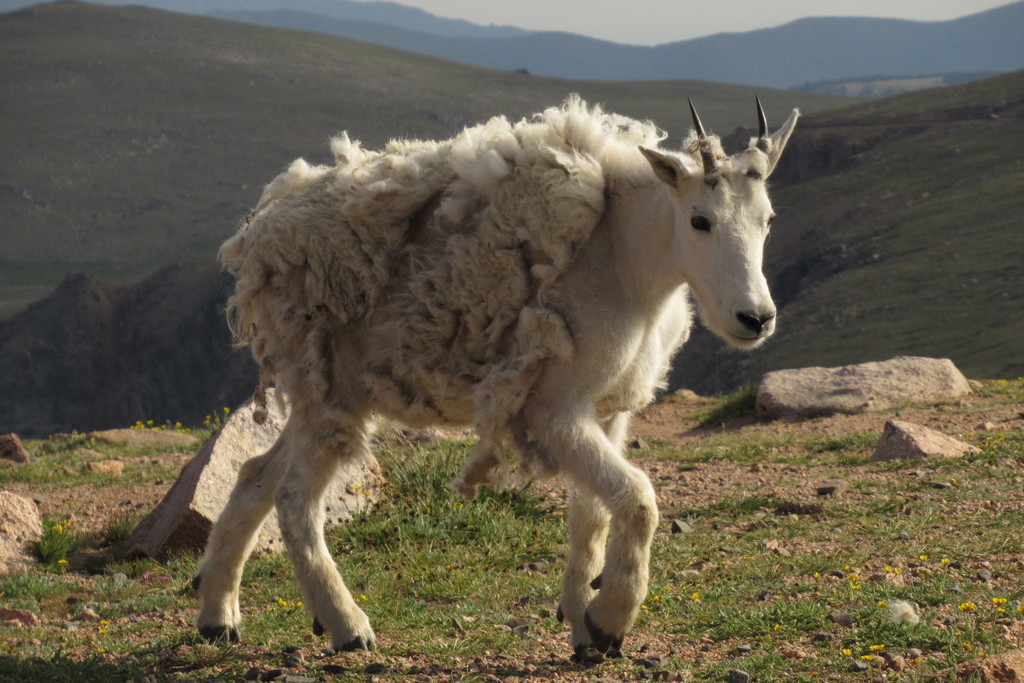
Rocky Mountain Goat
Photo © Harrison J Elkins
Photo © Harrison J Elkins — CC BY 4.0 — Source: iNaturalist photo #174162682Identification
The Rocky Mountain goat is a distinctive alpine mammal with a stocky, muscular build. Both males and females sport short black horns measuring 15–28 cm in length, complete with yearly growth rings, along with characteristic beards and short tails. Their most striking feature is their thick, woolly double coat of greyish-white fur—a dense undercoat covered by longer, hollow outer hairs that provides insulation against extreme cold and wind. Males are noticeably larger than females, standing about 1 meter at the shoulder and weighing roughly 30% more, with longer horns and more prominent beards. Their most remarkable adaptation is their specialized feet: cloven hooves that spread apart for traction, sharp dewclaws that prevent slipping, and inner pads perfectly designed for gripping steep, rocky terrain.
Range & Habitat
Mountain goats are endemic to the remote mountainous regions of western North America, inhabiting the Rocky Mountains, Cascade Range, and other peaks of the Western Cordillera. Their range spans from Washington, Idaho, and Montana northward through British Columbia and Alberta into the southern Yukon and southeastern Alaska, with the northernmost populations found along the Chugach Mountains in south-central Alaska. British Columbia alone contains half of the world's population. Introduced populations also exist in Idaho, Wyoming, Utah, Nevada, Oregon, Colorado, South Dakota, and Washington's Olympic Peninsula.
These are the largest mammals of their high-altitude habitats, typically remaining in alpine and subalpine zones that can exceed 13,000 feet in elevation. Though they occasionally descend to sea level in coastal areas, mountain goats are fundamentally creatures of extreme elevation, where the harsh environment itself serves as their primary defense against predators such as bears, pumas, and wolves.
Behaviour & Diet
Mountain goats are supremely adapted climbers, commonly navigating sheer rock faces, near-vertical cliffs, and icy passages with remarkable agility. Their powerful shoulder and neck muscles, combined with their specialized foot anatomy, allow them to traverse slopes exceeding 60 degrees. They generally avoid descending to lower elevations except during seasonal food shortages or severe weather. In spring, they molt by rubbing against rocks and trees, with males shedding their winter wool first and pregnant females shedding last. Their remarkable woolly coats enable them to withstand winter temperatures as low as −46°C and winds exceeding 160 kilometers per hour.
Best Time & Places to See It
For the best chance of observing mountain goats, visit the high alpine and subalpine zones of the Rocky Mountains, Cascade Range, or other peaks throughout western North America. British Columbia offers exceptional opportunities given its substantial population. Summer and early autumn are optimal seasons when goats remain at higher elevations, making them more accessible to hikers and photographers willing to venture into remote, rugged terrain. Winter observations are possible but require extreme caution and mountaineering experience.
Photography Tips
Photograph mountain goats in their dramatic cliff habitat during clear weather when lighting is optimal and visibility is excellent. Wide-angle shots capturing the goats against sheer rock faces emphasize their remarkable climbing ability and the extreme environments they inhabit. Early morning and late afternoon light enhances the texture of their woolly coats and creates dramatic shadows across the mountainsides. Because they often cling to near-vertical terrain, bring a telephoto lens to safely capture close-up details of their horns, beards, and distinctive facial features from a distance. Patience is essential—observe from a stable position and allow the goats to move naturally through their habitat.
Glacier National Park
Glacier, Canada
+162 birds+12 mammals
Where granite peaks pierce the clouds above the Columbia River valley, Glacier National Park protects one of the most dramatic mountain wilderness areas in western Canada.…
VIEW NATIONAL PARKKootenay National Park
Area G (Forster Creek/Mount Assiniboine), Canada
+181 birds+23 mammals
Where the spine of the Canadian Rockies rises above 3,000 metres, the high alpine realm around Forster Creek and Mount Assiniboine reveals one of the continent's…
VIEW NATIONAL PARKBanff National Park
Improvement District No. 9, Canada
+264 birds+33 mammals
Where the Canadian Rockies thrust skyward in a cathedral of limestone and ice, Banff National Park preserves a wilderness of astounding vertical drama. Glacier-carved valleys cradle…
VIEW NATIONAL PARKJasper National Park
Improvement District No. 12, Canada
+235 birds+34 mammals
Where the Canadian Rockies rise in dramatic succession across western Alberta, Jasper National Park spans over 11,000 square kilometres of subalpine and alpine terrain, glaciated valleys,…
VIEW NATIONAL PARKKenai Fjords National Park
Kenai Peninsula Borough, United States
+164 birds+19 mammals
Granite peaks and tidewater glaciers dominate Alaska's Kenai Peninsula, where nearly 7,900 square kilometers of pristine coastal wilderness descend from the Harding Icefield toward the Gulf…
VIEW NATIONAL PARKGlacier Bay National Park
Unorganized Borough, United States
+221 birds+15 mammals
Tidewater glaciers calving into fjords of impossible blue, where temperate rainforest rises steeply from the water's edge and alpine peaks pierce the clouds—this is the ecological…
VIEW NATIONAL PARKGrand Teton National Park
Teton County, United States
+247 birds+38 mammals
Where the Teton Range tears skyward in a dramatic escarpment above the Snake River valley, nearly 2,550 square kilometers of montane wilderness unfolds across Teton County,…
VIEW NATIONAL PARKYellowstone National Park
Park County, United States
+253 birds+43 mammals
Across nearly 11,400 square kilometres of the Rocky Mountain plateau, geothermal fury and pristine wilderness converge in one of Earth's most dynamic landscapes. Hot springs, geysers…
VIEW NATIONAL PARKMount Rainier National Park
Pierce County, United States
+187 birds+25 mammals
A volcanic colossus dominates the Cascade Range in western Washington, its 4,392-meter summit crowned year-round with glacial ice that cascades down toward temperate rainforest and subalpine…
VIEW NATIONAL PARKRocky Mountain National Park
Larimer County, United States
+259 birds+33 mammals
Where granite peaks rise above 12,000 feet and alpine tundra gives way to subalpine forest, Rocky Mountain National Park spans the Continental Divide across nearly 1,600…
VIEW NATIONAL PARKOlympic National Park
Jefferson County, United States
+263 birds+35 mammals
Where temperate rainforest meets alpine wilderness, Olympic National Park sprawls across nearly 11,000 square kilometers of the Pacific Northwest's most pristine landscape. The park's three distinct…
VIEW NATIONAL PARKWrangell-Saint Elias National Park
Unorganized Borough, United States
+155 birds+13 mammals
Where granite peaks thrust above 5,400 metres and vast fields of glacial ice dominate the landscape, Wrangell-Saint Elias encompasses one of North America's most extreme wilderness…
VIEW NATIONAL PARKWaterton Lakes National Park
Improvement District No. 04, Canada
+252 birds+31 mammals
Where the Continental Divide plunges toward the prairies of Alberta, glacier-carved valleys and emerald lakes pierce a landscape where montane forest meets alpine tundra. Waterton Lakes…
VIEW NATIONAL PARKYoho National Park
Area A (Kicking Horse/Kinbasket Lake), Canada
+207 birds+19 mammals
Where the Canadian Rockies meet the Columbia River watershed, a vast wilderness of 2,211 square kilometres unfolds across Yoho National Park in British Columbia. The landscape…
VIEW NATIONAL PARKKluane National Park and Reserve
Canada
+171 birds+17 mammals
Where granite peaks thrust through boreal forest to touch the sky, Kluane National Park and Reserve sprawls across southwestern Yukon as one of North America's most…
VIEW NATIONAL PARKGlacier National Park
United States
+246 birds+39 mammals
Where jagged peaks pierce a subarctic sky and glacial valleys carve through ancient rock, Glacier National Park spans the spine of the Northern Rockies along Montana's…
VIEW NATIONAL PARKNorth Cascades National Park
Whatcom County, United States
+120 birds+18 mammals
Jagged peaks rise abruptly from the western foothills of Washington's Cascade Range, where glaciers cling to elevations above 10,000 feet and meltwater feeds a landscape of…
VIEW NATIONAL PARKKodiak National Wildlife Refuge
United States
+221 birds+22 mammals
Where temperate rainforest meets subarctic coast, Kodiak National Wildlife Refuge sprawls across Alaska's largest island, a sanctuary defined by steep valleys carved by tidewater glaciers and…
VIEW WILDLIFE SANCTUARYAlaska Maritime National Wildlife Refuge
Alaska, United States
+391 birds+58 mammals
Where the North Pacific collides with Alaska's rugged coastline, a sprawling archipelago of islands, rocky outcrops, and coastal headlands forms one of North America's most remote…
VIEW WILDLIFE SANCTUARYNo community photos yet. Log in to add the first one.
No community observations of this species yet.