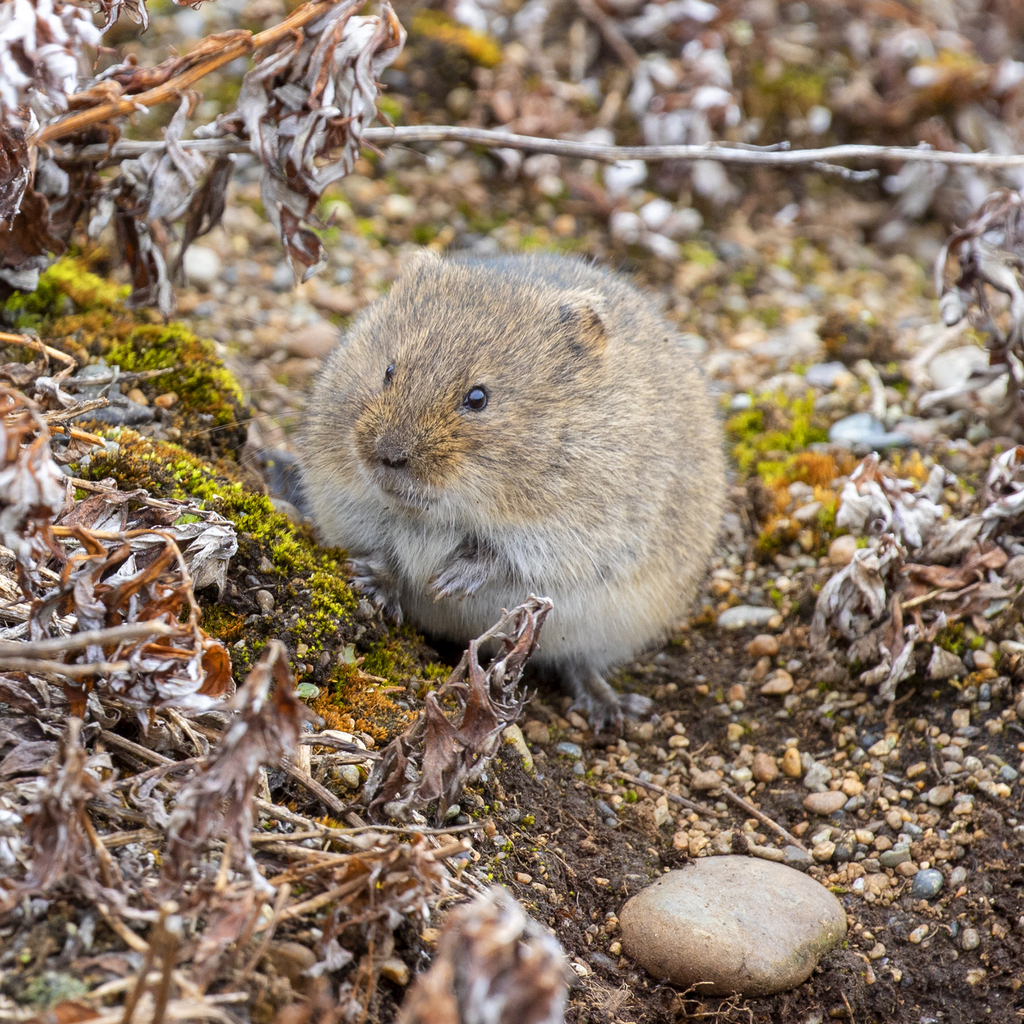
Root Vole
Photo © Dan Vickers
Photo © Dan Vickers — CC BY 4.0 — Source: iNaturalist #256036637Identification
The root vole is a medium-sized vole with distinctly short ears and a short tail, measuring typically about 18 cm in total length with a 4 cm tail and weighing around 50 grams. Its fur is yellowish brown on the back with paler sides and white underparts, providing effective camouflage in its natural habitat. A notable feature is sexual dimorphism—males are noticeably larger than females as adults—which can help observers sex individuals in the field.
Range & Habitat
The root vole is found across Northern and Central Europe, Asia, and northwestern North America, including Alaska and northwestern Canada. The species is particularly associated with damp tundra or moist meadows, characteristically occurring near water sources where vegetation is lush. In the western Netherlands, a relict population from the ice age has evolved into the subspecies A. o. arenicola, representing an isolated southern outpost of this otherwise northern species. Eleven recognized subspecies occur across the species' range, each adapted to its particular region.
Behaviour & Diet
Root voles are active year-round, employing different movement strategies according to season. In warm weather they create visible runways through surface vegetation, while in winter they tunnel through snow to access food and shelter. Their diet consists primarily of grasses, sedges, and seeds, with a particular preference for more abrasive plant materials than their common vole relatives. These rodents are industrious foragers that dig burrows to store seeds and roots—especially licorice root—to sustain themselves through winter months when food is scarce.
Best Time & Places to See It
Root voles are most active during the breeding season from May through June, when populations are at their highest levels. However, as year-round residents of their habitats, they can be encountered throughout the year in suitable locations. Damp tundra environments and moist meadows adjacent to water bodies offer the best prospects for observation. Those traveling to northern Europe, Asia, or northwestern North America—particularly Alaska and northwestern Canada—should search these moisture-rich habitats, where visible runways and burrow entrances often betray the presence of these secretive rodents.
Photography Tips
Photographing root voles requires patience and fieldcraft in often remote or difficult terrain. Early morning or late afternoon often yields the best activity when voles venture above ground. Look for their characteristic runway systems through grass and sedge meadows, which can lead you to promising observation spots. In winter, tracks and tunnel entrances in snow reveal recent activity. The contrast between their yellowish-brown fur and pale underparts makes them visually striking subjects when successfully photographed. Given their preference for damp habitats, be prepared for wet conditions and ensure your equipment is adequately protected.
Kodiak National Wildlife Refuge
United States
+221 birds+22 mammals
Where temperate rainforest meets subarctic coast, Kodiak National Wildlife Refuge sprawls across Alaska's largest island, a sanctuary defined by steep valleys carved by tidewater glaciers and…
VIEW WILDLIFE SANCTUARYAlaska Maritime National Wildlife Refuge
Alaska, United States
+391 birds+58 mammals
Where the North Pacific collides with Alaska's rugged coastline, a sprawling archipelago of islands, rocky outcrops, and coastal headlands forms one of North America's most remote…
VIEW WILDLIFE SANCTUARYYukon Delta National Wildlife Refuge
Bethel, United States
+156 birds+12 mammals
Across the Yukon Delta sprawls one of North America's most expansive coastal wetland sanctuaries, where the boreal subarctic climate strips down existence to essentials. This vast…
VIEW WILDLIFE SANCTUARYNo community photos yet. Log in to add the first one.
No community observations of this species yet.