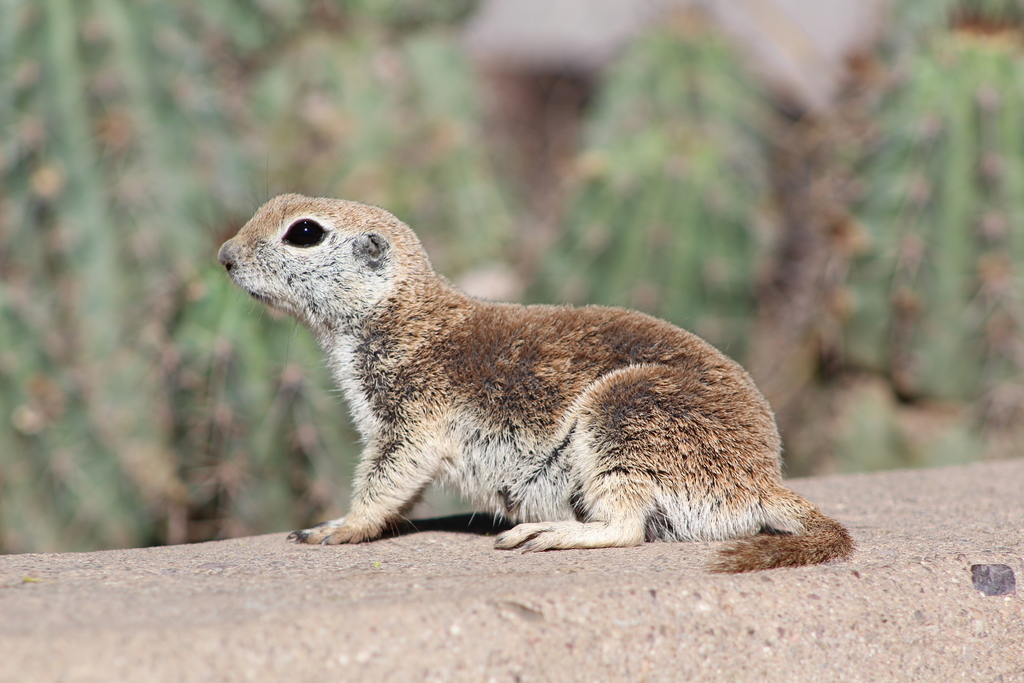
Round-tailed Ground Squirrel
Photo © Eliseo D Moreno
Photo © Eliseo D Moreno — CC BY-SA 4.0 — Source: iNaturalist photo #39559994Identification
Round-tailed ground squirrels are among the smallest ground squirrel species, weighing only around 125 grams (4.4 oz) as adults. Their most distinctive feature is their long, round tail, which measures 60 to 112 millimetres (2.4 to 4.4 in) long. The body averages 204 to 278 millimetres (8.0 to 10.9 in) in total length. They have long, hairy hind feet and a uniform sandy coloration that blends seamlessly with desert soil, with a lighter underside. Unlike many ground squirrel species, they lack fur markings entirely.
Range & Habitat
This species inhabits the deserts of the Southwestern United States, northeastern Baja California, and northwestern Mexico, particularly in Sonora. They are burrowing animals, excavating tunnels in loose soil often situated beneath mesquite trees and creosote bushes. These burrows provide essential shelter and protection in the harsh desert environment.
Behaviour & Diet
Round-tailed ground squirrels are well-adapted to extreme desert conditions and remain active even on the hottest days, though they reduce activity during peak afternoon heat. They undergo a winter torpor from late August or September until January or February, though they do not true hibernate. They are omnivores with a diet consisting primarily of green vegetation in summer, supplemented by seeds, insects such as ants, termites, and grasshoppers. They preferentially select foods with high water content—averaging 80%—a critical adaptation to their arid environment. These squirrels have evolved distinctive anti-snake displays, including horizontal tail movements and dirt-kicking, to defend themselves against their primary predators.
Best Time & Places to See It
These squirrels are most active from late January through April, when males emerge for the breeding season. They are diurnal and visible during daylight hours, though activity decreases during afternoon heat. Look for them in desert regions of the southwestern United States, Baja California, and Sonora, Mexico, particularly near mesquite and creosote bush areas where their burrows are concentrated.
Photography Tips
Photograph these diminutive squirrels during early morning or late afternoon when they are most active and light is optimal. Their camouflaged sandy coloration blends with the desert floor, so look carefully near burrow entrances. Capture their characteristic tail movement and alert posture, especially their defensive displays against threats. Wide-angle shots showing their burrow systems and surrounding desert habitat provide valuable context for understanding their ecology.
Death Valley National Park
Joshua Tree National Park
Madera Canyon
Saguaro National Park
Salton Sea National Wildlife Refuge
San Pedro Valley
Santa Rita Mountains
Sonoran Desert
Nothing matches these filters.
No community photos yet. Log in to add the first one.
No community observations of this species yet.