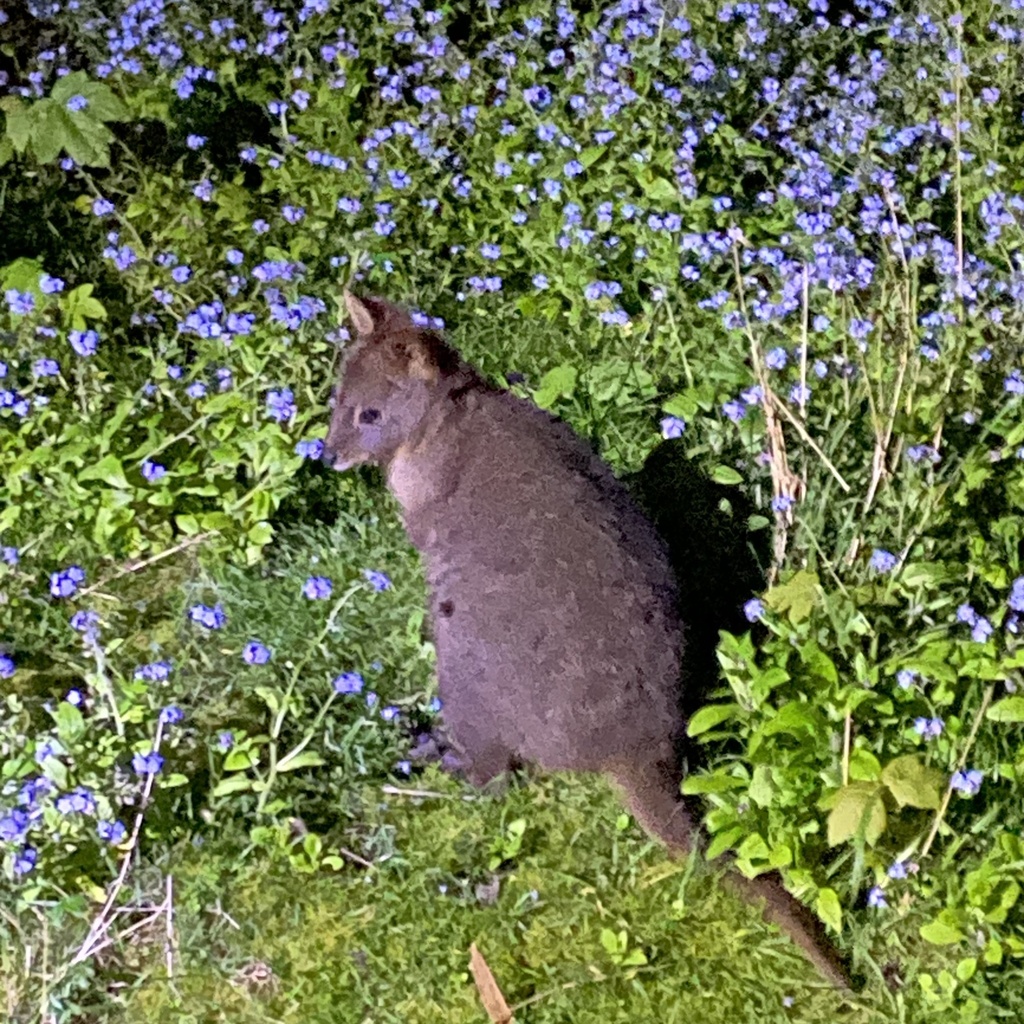
Rufous-bellied Pademelon
Photo © Dag Endresen
Photo © Dag Endresen — CC0 1.0 — Source: iNaturalist #187360286The Tasmanian pademelon (Thylogale billardierii), also known as the rufous-bellied pademelon or red-bellied pademelon, is the sole species of pademelon found in Tasmania, and was formerly found throughout southeastern Australia. This pademelon has developed heavier and bushier fur than its northern relatives, which inhabit northern Australia and Papua New Guinea. The scientific name honours J.J.H. Labillardier, who collected the first specimen on an expedition to what was then Van Diemen's Land in 1792. There are no recognised subspecies. == Description == The Tasmanian pademelon has a compact body with short, rounded, ears, thick fur over the limbs, head, and body and a tail covered with short hairs. It has greyish fur over most of the body with yellowish to rufous underparts, and, unlike most other pademelons, has no distinct facial or hip markings. Males reach around 6.5 kilograms (14 lb) in weight, 70–120 centimetres (28–47 in) in length including the 30–45 centimetres (12–18 in) tail, and are considerably larger than the females, which average 4.6 kilograms (10 lb). == Distribution and habitat == Pademelons are abundant and widespread across mainland Tasmania, and are also found on the nearby King and Furneaux Islands. They were formerly distributed throughout southeastern Australia, including…
Cradle Mountain-Lake St Clair National Park
Australia
+72 birds+8 mammals
Where glacial valleys plunge between quartzite peaks, Tasmania's Cradle Mountain-Lake St Clair National Park unfolds as a temperate wilderness of uncommon grandeur. The park's terrain ranges…
VIEW NATIONAL PARKFreycinet National Park
Coles Bay, Australia
+115 birds+9 mammals
Granite peaks rise abruptly from the Tasmanian coast where Coles Bay opens into the Freycinet Peninsula, sculpting one of southeastern Australia's most dramatically vertical national parks.…
VIEW NATIONAL PARKNo community photos yet. Log in to add the first one.
No community observations of this species yet.