Sambar
Photo © Renjith Jacob Mathews
Photo © Renjith Jacob Mathews — CC BY 4.0 — Source: iNaturalist #103932043Identification
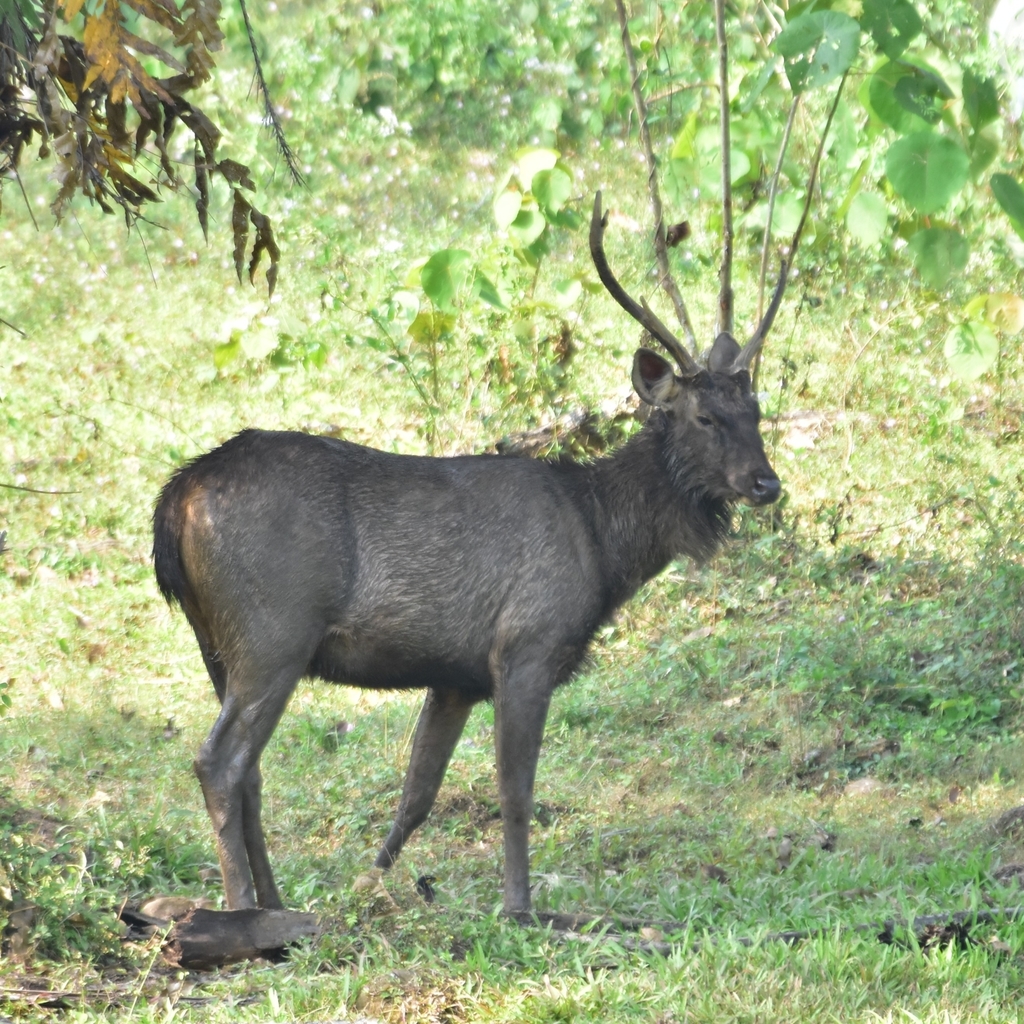
The sambar is a large deer, typically standing 102 to 160 cm at the shoulder and weighing between 100 and 350 kg, though individuals can reach up to 546 kg. Only the moose and elk among living deer species attain larger sizes. Males are noticeably larger than females, and western subspecies tend to be bigger than eastern ones.
Males carry distinctive rusine antlers, typically up to 110 cm long in fully adult individuals, with simple brow tines and forked beams ending in three tines. The shaggy coat ranges from yellowish brown to dark grey, sometimes with chestnut marks on the rump and underparts. A notable feature is the small but dense mane, more prominent in males. The relatively long tail is black above with a whitish underside. Adult males and pregnant or lactating females possess an unusual hairless, blood-red spot on the underside of the throat, which may ooze a white liquid and appears to be glandular.
Range & Habitat
Sambar are distributed across a vast range from the south-facing slopes of the Himalayas in Nepal, Bhutan and India through Myanmar, Thailand, Malaysia, Indochina, and southern China, extending to the Indonesian islands of Sumatra and Borneo. They are also native to Singapore, where they were rediscovered in the 1970s after being thought extinct, and have since rebounded to around 120 individuals. Individuals occasionally cross from India into Pakistan.
These deer inhabit elevations up to 3,500 m, preferring tropical dry forests, tropical seasonal forests, subtropical mixed forests with conifers, montane grasslands, and tropical rainforests. They favour dense cover of deciduous shrubs and grasses and seldom move far from water sources. Home range sizes vary considerably, recorded as 1,500 hectares for males and 300 hectares for females in India. On Sumatra, they are generally more abundant in lowlands.
Behaviour & Diet
Sambar are nocturnal or crepuscular animals with an unusual social structure for deer. Males live alone for much of the year, while females form small herds of up to 16 individuals, though in some areas average herds contain only three or four animals—typically a mother, her recent offspring, and perhaps a subordinate female. They are good swimmers and often congregate near water sources.
Their diet is highly varied, including grasses, foliage, browse, fruit, water plants, and numerous shrubs and trees depending on local habitat. Sambar are capable of remarkable bipedalism for deer, with stags standing to mark tree branches with their antlers and spraying urine on their own faces. Despite lacking antlers, females readily defend young from predators—relatively unusual among deer. When threatened by pack-hunting dholes or feral dogs, sambar lower their heads with erect manes and lash at attackers, preferring to engage in shallow water. They stamp their feet and make a distinctive ringing call known as "pooking" or "belling" when sensing danger.
Best Time & Places to See It
Sambar are best observed during crepuscular hours—dawn and dusk—when they are most active. Protected areas such as national parks and reserves in India, Sri Lanka, and Thailand offer the best opportunities to see them, where they sometimes congregate in large herds. Look for them near water sources, where they regularly gather.
In Singapore, Mandai is a known location where the recovering population can be encountered. Across their range in forested regions from the Himalayas to Southeast Asia, sambar inhabit areas with dense vegetation and nearby water, making these habitat characteristics useful for locating them.
Photography Tips
Photograph sambar during early morning or late afternoon when they are most active and lighting is optimal. Their large size and impressive antlers make them rewarding subjects, particularly during the breeding season when males are most visible and their behaviour is most active. The distinctive throat spot of adult males and the dark mane provide excellent focal points for close-up photography.
Position yourself near water sources where sambar congregate, and maintain a respectful distance. The animals' preference for dense cover means patience and careful stalking are necessary. Their striking coat coloration and long tail photograph well against forest backgrounds, while wading or swimming behaviour offers dynamic compositional opportunities.
Valmiki National Park
Ramnagar, India
+66 birds+6 mammals
Along Bihar's western frontier, where the Gandak River winds through subtropical forest and grassland, Valmiki National Park sprawls across terrain shaped by monsoon rains and seasonal…
VIEW NATIONAL PARKRanthambhore National Park
Sawai Madhopur, India
+294 birds+20 mammals
Granite ridges and ravines carved through the Aravalli Range frame this protected landscape in eastern Rajasthan, where deciduous forest mingles with open scrubland and seasonal water…
VIEW NATIONAL PARKKhao Yai National Park
Prachantakham District, Thailand
+377 birds+46 mammals
Evergreen dipterocarp forest blankets the rolling terrain of this national park in eastern Thailand, where limestone hills rise abruptly from the forest floor and seasonal streams…
VIEW NATIONAL PARKKinglake National Park
Australia
+164 birds+11 mammals
Where the volcanic plains of central Victoria rise into forested ridges, Kinglake National Park encompasses roughly 844 square kilometres of diverse habitat that represents one of…
VIEW NATIONAL PARKLake Eildon National Park
Australia
+119 birds+8 mammals
Across the rippled waters and wooded shorelines of central Victoria's sprawling reservoir system, Lake Eildon National Park encompasses nearly 870 square kilometres of transformed landscape where…
VIEW NATIONAL PARKGiant Panda National Park
Mianyang, China
+447 birds+47 mammals
Where the eastern slopes of China's Sichuan plateau descend into cloud-wrapped valleys, one of Asia's most biodiverse landscapes unfolds across more than 350,000 square kilometres. This…
VIEW NATIONAL PARKKanha Tiger Reserve
Kanha Kisli F.V., India
+321 birds+23 mammals
Where sal forests give way to emerald meadows and crystalline streams carve through ancient valleys, one of India's finest wilderness reserves unfolds across the Maikal Range.…
VIEW NATIONAL PARKTadoba National Park
Palasgaon Singru, India
+270 birds+20 mammals
Where sal forests meet open grasslands and rocky outcrops rise from red laterite soil, central India's landscape unfolds in raw, untamed beauty. Ancient teak woodlands and…
VIEW NATIONAL PARKBandhavgarh National Park
Garhpuri, India
+285 birds+17 mammals
Where granite ridges rise dramatically above sal and bamboo forests, one of India's most pristine tiger reserves unfolds across the Vindhyan plateau. Ancient rock formations tower…
VIEW NATIONAL PARKPanna National Park
Badgadi Kalan, India
+271 birds+17 mammals
Where granite gorges slice through central India's Vindhyan plateau, a landscape of stark beauty unfolds across nearly six hundred square kilometers. The Ken River carves through…
VIEW NATIONAL PARKKaziranga National Park
Kohora, India
+422 birds+26 mammals
Dawn breaks over the floodplains of the Brahmaputra, where tall grasslands stretch endlessly beneath monsoon-heavy skies. This sprawling wilderness of northeastern Assam is a mosaic of…
VIEW NATIONAL PARKBandipur National Park
Hirehalli, India
+302 birds+19 mammals
Where the Western Ghats descend into the Deccan plateau, ancient deciduous forests blanket a landscape carved by the Nugu River. Bandipur unfolds across 880 square kilometres…
VIEW NATIONAL PARKNagarahole Tiger Reserve
Nalkeri Forest, India
+323 birds+23 mammals
Where granite escarpments rise above dense deciduous forests and the Kabini River carves through pristine wilderness, one of India's most biodiverse landscapes unfolds across the Western…
VIEW NATIONAL PARKTaman Negara National Park
Kampong Samas, Malaysia
+393 birds+48 mammals
Where ancient rainforest meets limestone peaks, one of Southeast Asia's oldest protected wilderness preserves sprawls across 4,343 square kilometers of primordial landscape. Dipterocarp giants tower overhead,…
VIEW NATIONAL PARKWay Kambas National Park
Lampung Timur, Indonesia
+237 birds+20 mammals
Across the low swamplands of eastern Lampung, where freshwater wetlands merge into tidal mangrove forests along the Sunda Strait, sprawls one of Sumatra's most vital sanctuaries.…
VIEW NATIONAL PARKGir National Park
Asundrali, India
+258 birds+13 mammals
Dry deciduous forests cloak the rolling hills of western Gujarat where the Gir landscape rises as a final sanctuary for one of the world's rarest felids:…
VIEW NATIONAL PARKKosciuszko National Park
Australia
+211 birds+52 mammals
Where the Great Dividing Range reaches its highest peaks in southeastern Australia, Kosciuszko National Park encompasses a landscape of windswept plateaus, rocky ridges, and deep river…
VIEW NATIONAL PARKMount Buffalo National Park
Myrtleford, Australia
+124 birds+7 mammals
Granite peaks rise abruptly from the volcanic plains of northeastern Victoria, their exposed rock faces and windswept ridges defining Mount Buffalo National Park's rugged character. The…
VIEW NATIONAL PARKWolong National Nature Reserve
Wenchuan County, China
+333 birds+17 mammals
Where the Qingyi River cuts through the eastern flanks of the Minshan Range, a temperate montane forest cloaks steep valleys in dense canopy that thins dramatically…
VIEW NATURE RESERVENo community photos yet. Log in to add the first one.