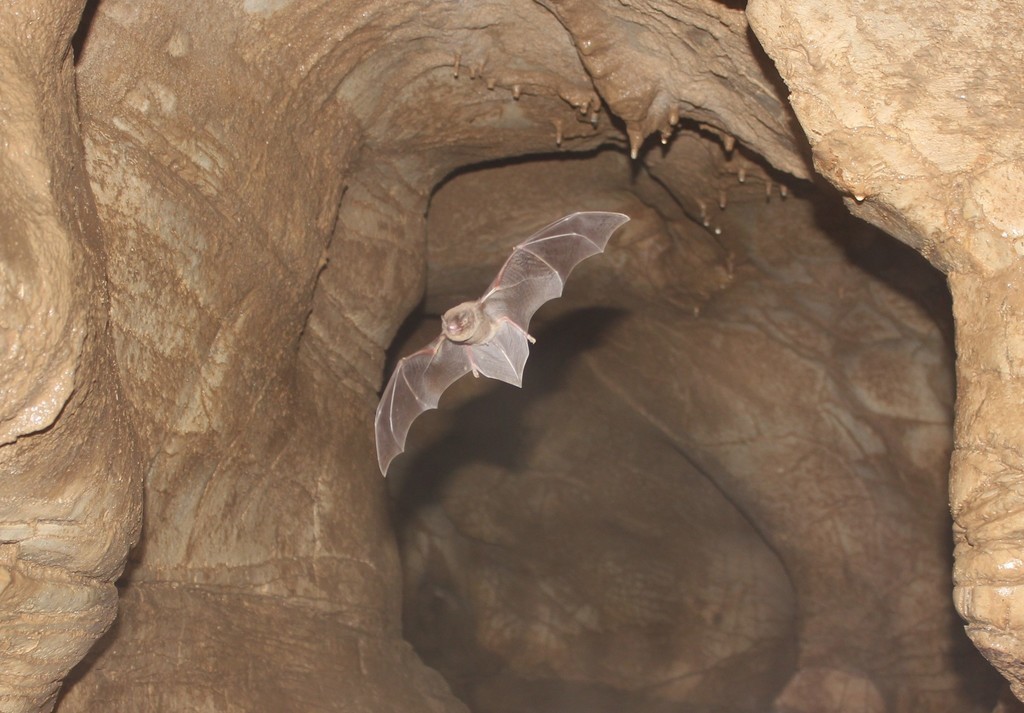
Schreibers’s Long-fingered Bat
Photo © Daria
Photo © Daria — CC0 1.0 — Source: iNaturalist photo #176555240Identification
Schreibers's long-fingered bat, also known as the common bent-wing bat, is an insectivorous species named after Carl Franz Anton Ritter von Schreibers. The species is recognized by its distinctive bent-wing appearance, which gives it its common name. With 11 recognized subspecies distributed across multiple continents, this bat shows considerable variation across its vast range, though specific morphological details distinguishing it from related species are best confirmed through expert examination.
Range & Habitat
This species has dispersed from subtropical origins to establish populations throughout the southern Palearctic, Ethiopic, Oriental, and Australian regions. In Europe, it inhabits the southern half of the continent from Iberia to the Caucasus, with the largest populations concentrated in the warmer Mediterranean area. The bat's range extends across an impressive array of countries spanning Africa, Asia, Europe, and Oceania, from Portugal and Spain in the west to the Philippines and Solomon Islands in the east, and from North Africa to Australia in the south.
Schreibers's long-fingered bats are highly colonial, establishing major roosts in large caves and mines, though they also utilize tunnels, ruins, and other man-made structures. Within these sites, they exhibit a remarkable adaptation: they cluster in "bell-shaped" hollows that trap body heat, raising roost temperatures above the surrounding cave environment. This behavior significantly reduces energy loss during their characteristically long torpor periods, the longest recorded lasting approximately 12 days.
Behaviour & Diet
These bats are insectivorous and form massive colonies ranging from a few dozen to several million individuals. They are highly migratory, moving multiple times annually in response to weather conditions in their roosting areas. The longest recorded migration spans 833 kilometers, demonstrating their considerable mobility and adaptation to seasonal changes.
A distinctive behavioral feature is their use of small openings to access their roosting hollows, which provides enhanced security from large predators during vulnerable hibernation periods. This selective occupation of sheltered microhabitats reflects their vulnerability when in torpor.
Best Time & Places to See It
The Mediterranean region offers the best opportunities to encounter this species, as it supports the largest European populations. Major roost sites in caves and mines throughout southern Europe—particularly in countries like Spain, Italy, Greece, and the Balkans—are prime locations. However, the bat's increasing range expansion, evidenced by its recent establishment in Poland in 2018, suggests that northern European locations may yield sightings in future years. Timing visits during active migration periods or emergence times at known cave roosts increases encounter probability.
Photography Tips
Photographing Schreibers's long-fingered bats requires patience and respect for their roosting sites. Early evening emergence from caves provides optimal opportunities to capture flight behavior. Use fast shutter speeds and high ISO settings to freeze rapid wing movements. Approach roosts cautiously and avoid flash photography, which can disturb colonies. Remote camera traps positioned near cave entrances may capture natural behavior without disturbance. Always obtain necessary permits and follow local regulations protecting these vulnerable populations.
Cap de Creus Natural Park
Roses, Spain
+245 birds+23 mammals
Where the Pyrenees tumble into the Mediterranean, Cap de Creus Nature Park unfolds across 300 square kilometres of one of northeastern Spain's most dramatic coastal wilderness…
VIEW NATURAL PARKCévennes National Park
Vebron, France
+187 birds+63 mammals
Where granite gorges slice through the limestone plateaux of southern France, the Cévennes Cœur National Park unfolds across nearly 3,500 square kilometres of one of Europe's…
VIEW NATIONAL PARKÉcrins National Park
La Chapelle-en-Valgaudémar, France
+143 birds+36 mammals
Where granite peaks and Alpine meadows converge across nearly 2,100 square kilometres, Écrins National Park forms one of the wildest mountainous strongholds of the French Alps.…
VIEW NATIONAL PARKParc del Garraf
Rat-Penat, Spain
+190 birds+15 mammals
Where limestone ridges rise abruptly from the Mediterranean coastal plain, Parc Natural del Garraf unfolds across 319 square kilometers of one of Catalonia's most dramatic protected…
VIEW NATURAL PARKForêts National Park
Lucey, France
+140 birds+50 mammals
Across the rolling plateaux of central Burgundy, where limestone uplands give way to deep valleys carved by time and water, lies a landscape of profound ecological…
VIEW NATIONAL PARKBükk National Park
Répáshuta, Hungary
+161 birds+15 mammals
Where forested limestone ridges rise across northern Hungary, Bükk National Park unfolds across nearly 900 square kilometres of temperate woodland, rocky gorges, and karst formations that…
VIEW NATIONAL PARKMontseny Natural Park
Viladrau, Spain
+156 birds+30 mammals
The Montseny Natural Park is one of Catalonia’s most remarkable protected areas, offering an extraordinary blend of biodiversity, scenic landscapes, and cultural heritage within easy reach…
VIEW NATURAL PARKSierra de Andújar Natural Park
Our Lady of Cabeza, Spain
+198 birds+19 mammals
Where granite gorges slice through Mediterranean scrubland and cork forests cascade down Andalusian hillsides, one of Spain's most pristine wilderness areas unfolds across 74,000 hectares of…
VIEW NATURAL PARKCamargue Regional Nature Park
Saintes-Maries-de-la-Mer, France
+378 birds+48 mammals
Where the Rhône Delta sprawls into the Mediterranean, a landscape of stark and haunting beauty emerges—vast salt marshes punctuated by shallow lagoons, reed beds, and scrubland…
VIEW NATURAL PARKRegional Park of the Catalan Pyrenees
Olette, France
+244 birds+63 mammals
Where granite peaks thrust skyward above cloud-laden valleys, a wild tapestry of Mediterranean and alpine ecosystems interweaves across the Franco-Spanish frontier. These Pyrenean slopes harbour extraordinary…
VIEW NATURE RESERVEStrandzha Nature Park
Kondolovo, Bulgaria
+215 birds+19 mammals
Where the Rhodope Mountains descend toward the Black Sea coast, ancient forests rise above limestone plateaus in a tapestry of ecological richness rarely found elsewhere in…
VIEW NATURAL PARKVratsa Balkan
Zgorigrad, Bulgaria
+128 birds+10 mammals
Where limestone cliffs plunge into deep river canyons and beech forests give way to rocky karst plateaus, one of Bulgaria's most dramatic mountain landscapes unfolds across…
VIEW NATURE RESERVEPort-Cros National Park
Hyères, France
+271 birds+29 mammals
Where Mediterranean granite islands rise from crystalline waters off the Provençal coast, Port-Cros National Park protects one of Europe's most intact marine and terrestrial ecosystems. The…
VIEW NATIONAL PARKCalanques National Park
Bouches-du-Rhône, France
+233 birds+42 mammals
Where limestone cliffs plunge dramatically into crystalline Mediterranean waters, Calanques National Park preserves one of Europe's most striking coastal landscapes. These steep-sided inlets, carved by erosion…
VIEW NATIONAL PARKNo community photos yet. Log in to add the first one.
No community observations of this species yet.