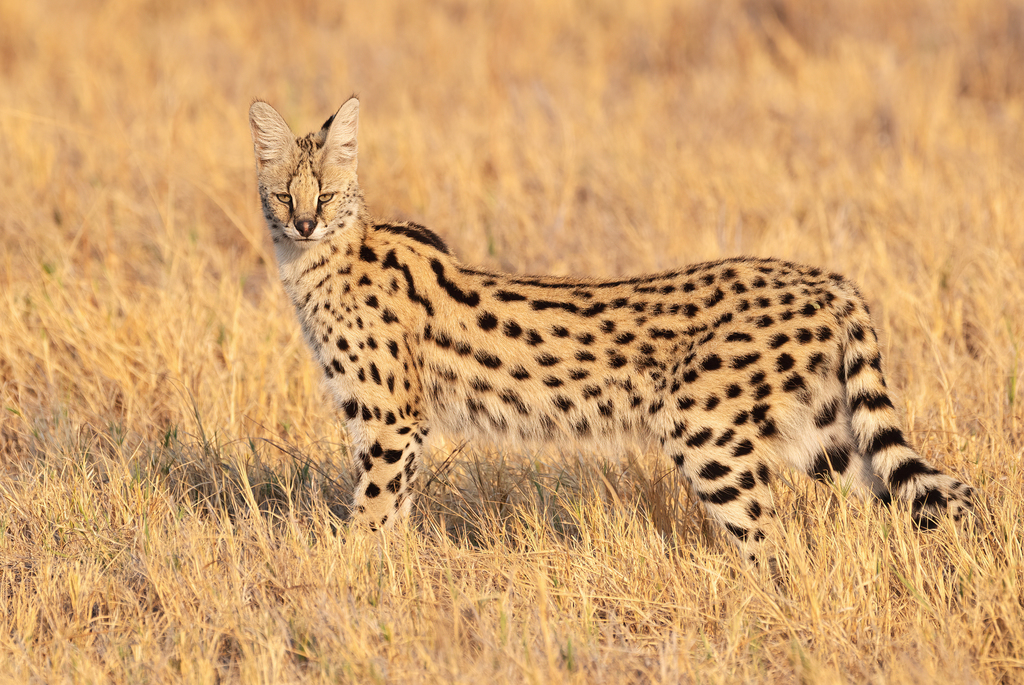
Serval
Photo © Morten Ross
Photo © Morten Ross — CC BY 4.0 — Source: iNaturalist photo #127018903Identification
The serval is a slender, medium-sized African cat standing 54–62 cm tall at the shoulder and weighing approximately 9–18 kg. Its most striking features are its small head, large ears with a distinctive white horizontal band, and exceptionally long legs—the longest of any cat relative to body size. The coat is golden-yellow to buff, extensively marked with black spots and stripes that vary considerably in size. A white chin, spotted cheeks and forehead, and a short black-tipped tail complete the distinctive appearance.
Range & Habitat
The serval is widespread throughout sub-Saharan Africa and is the sole member of the genus Leptailurus. Three subspecies are recognised: the nominate subspecies in Southern Africa, L. s. constantina in Central and West Africa, and L. s. lipostictus in East Africa. The species inhabits grasslands, wetlands, moorlands and bamboo thickets across its range, and occurs in many protected areas where hunting is either prohibited or regulated.
Behaviour & Diet
The serval is a solitary carnivore that is active both day and night. It hunts primarily rodents—especially vlei rats—along with small birds, frogs, insects and reptiles, using its acute hearing to locate prey in tall grass. The cat employs a distinctive hunting technique, leaping over 2 metres above the ground to land on prey with its forefeet, then delivering a killing bite to the neck or head.
Both males and females establish highly overlapping home ranges of 10 to 32 km², which they mark with feces and saliva. Mating occurs at varying times depending on location, typically once or twice yearly. After a two to three month gestation, females give birth to one to four kittens. Young are weaned at one month and begin hunting independently at six months, leaving their mother around 12 months of age.
Best Time & Places to See It
Servals are widespread across sub-Saharan Africa in protected areas, making them accessible in many national parks and reserves throughout the continent. As both diurnal and nocturnal hunters, they can be spotted at various times, though early morning and late afternoon often provide the best viewing opportunities when they are actively hunting in grasslands and wetlands. Their preference for open habitats makes them more visible than many other wild cat species.
Photography Tips
The serval's striking spotted coat, large ears and slender build make it a photogenic subject. Its characteristic hunting leap—bounding over 2 metres to catch prey—presents a dramatic photo opportunity, though patience is required. The long legs and elongated body are best captured with wider framing to show the cat's elegant proportions. Early morning and late afternoon light will enhance the golden-yellow coat and highlight the contrast of black markings. Photograph servals in their preferred grassland and wetland habitats to capture their natural hunting behaviour and habitat preference.
Serengeti National Park
Tanzania
+558 birds+57 mammals
Across Tanzania's northern plateau, where volcanic soils meet acacia woodland and open grassland, unfolds one of Earth's most dynamic ecosystems. The Serengeti National Park sprawls across…
VIEW NATIONAL PARKArusha National Park
Tanzania
+555 birds+16 mammals
Where the slopes of Mount Mawenzi rise above the Arusha region, a compact yet ecologically rich national park unfolds across montane forest, moorland, and alpine zones.…
VIEW NATIONAL PARKChobe National Park
Botswana
+446 birds+45 mammals
Where the Chobe River cuts a sinuous path through northern Botswana, the landscape transforms into one of Africa's most dynamic wetland-savanna mosaics. This national park encompasses…
VIEW NATIONAL PARKAmboseli National Park
Etonet/Lenkism ward, Kenya
+501 birds+43 mammals
Where the Amboseli basin opens toward the Tanzanian frontier, a shallow alkaline lake mirrors vast skies across one of East Africa's most iconic savanna landscapes. The…
VIEW NATIONAL PARKKilimanjaro National Park
Kenya
+207 birds+16 mammals
Africa's highest mountain rises not in isolation but as the centerpiece of a vast national park that sweeps across the borderlands of northern Tanzania, where savanna…
VIEW NATIONAL PARKTarangire National Park
Tanzania
+527 birds+50 mammals
Acacia woodland and grassland sweep across the Manyara Region where the Tarangire River carves through low hills and volcanic soils, creating one of East Africa's most…
VIEW NATIONAL PARKNgorongoro Conservation Area
Tanzania
+626 birds+55 mammals
Volcanic calderas and open grassland dominate this high plateau in northern Tanzania, where the landscape rises above 2,000 metres and ancient geological forces have shaped both…
VIEW WILDLIFE MANAGEMENT AREAQueen Elizabeth National Park
Uganda
+672 birds+30 mammals
Across the southwestern escarpment of Uganda, where the Western Rift Valley descends through ancient volcanic terrain, Queen Elizabeth National Park sprawls across more than 8,300 square…
VIEW NATIONAL PARKPilanesberg National Park
Moses Kotane Local Municipality, South Africa
+364 birds+49 mammals
Granite peaks and volcanic ridges rise unexpectedly from the savanna floor across this 734-square-kilometre expanse in the North West province, creating a landscape of profound ecological…
VIEW NATIONAL PARKKruger National Park
Ba-Phalaborwa Local Municipality, South Africa
+540 birds+91 mammals
Across the low-lying savanna of northeastern South Africa unfolds one of Africa's largest and most ecologically intact protected areas, where acacia woodlands merge into mopane scrub…
VIEW NATIONAL PARKBale Mountains National Park
Ethiopia
+397 birds+20 mammals
Where the Ethiopian highlands rise above 4,000 metres, the Bale Mountains create a landscape of stunning ecological extremes—from afroalpine grasslands swept by wind and mist to…
VIEW NATIONAL PARKNairobi National Park
Nairobi, Kenya
+515 birds+35 mammals
Just minutes from Kenya's capital, where the Nairobi River winds through acacia woodland and open grassland, lies one of Africa's most paradoxical wildlife sanctuaries. The park's…
VIEW NATIONAL PARKAberdare National Park
Mweiga ward, Kenya
+394 birds+30 mammals
Where the central highlands of Kenya rise to their elemental grandeur, the Aberdare range unfolds across Nyeri County as a montane stronghold of cool, misty forest…
VIEW NATIONAL PARKChyulu Hills National Park
Kibwezi East, Kenya
+232 birds+30 mammals
Volcanic cones rise abruptly from the Kenyan savanna floor, their flanks clothed in dense acacia woodland and grassland that transforms the Chyulu Hills into an ecological…
VIEW NATIONAL PARKNo community photos yet. Log in to add the first one.