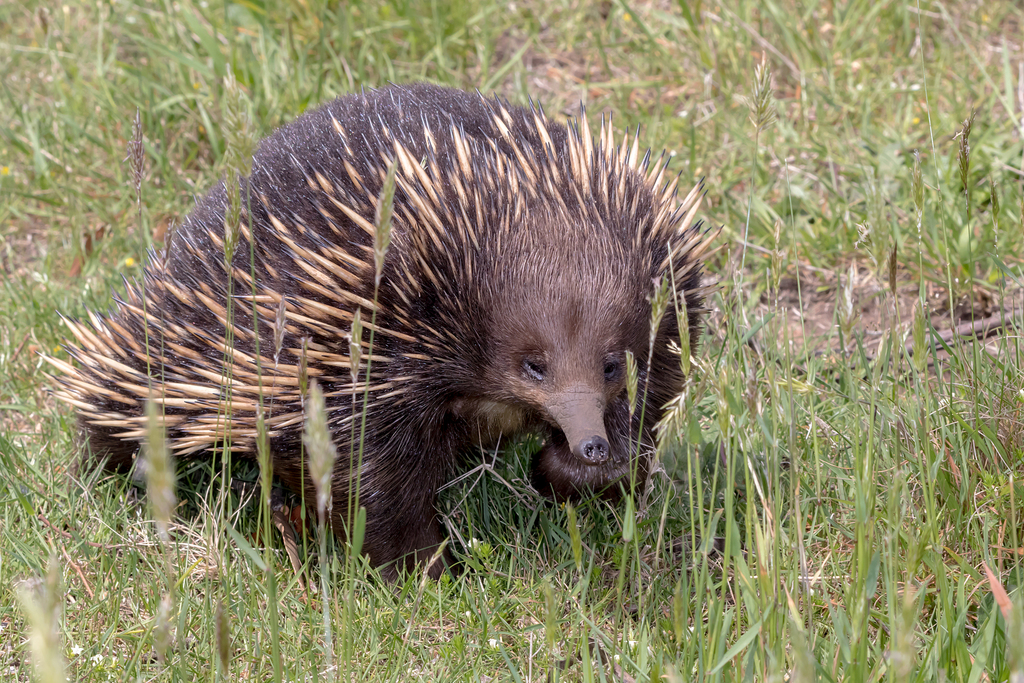
Short-beaked Echidna
Photo © Andrew Allen
Photo © Andrew Allen — CC BY 4.0 — Source: iNaturalist photo #56806189Identification
The short-beaked echidna is a distinctive monotreme covered in fur and sharp spines, with a characteristic elongated snout and a specialized tongue perfectly adapted for catching insects at remarkable speed. Its scientific name, Tachyglossus aculeatus, literally means "fast tongue" in Ancient Greek, reflecting its lightning-quick feeding mechanism. Unlike the larger long-beaked echidnas of New Guinea, this species is notably compact and represents the only living member of its genus.
The animal possesses extremely powerful front limbs and claws that enable rapid, forceful burrowing. Its snout is equipped with specialized mechanoreceptors and electroreceptors that allow it to navigate and locate prey underground. When threatened, the echidna's defensive strategy is simple but effective: it curls into a nearly impenetrable ball, relying on its sharp spines for protection rather than any aggressive capability.
Range & Habitat
The short-beaked echidna is Australia's most widespread native mammal, found throughout the continent in diverse environments from tropical rainforests to arid deserts. It also inhabits coastal and highland regions of eastern New Guinea, where indigenous peoples know it as the mungwe. Five subspecies occur across different geographic regions, each displaying variations in hairiness, spine length, and size, reflecting adaptation to local conditions.
Behaviour & Diet
This solitary, largely nocturnal creature avoids daytime activity during hot weather, as it cannot sweat and has poor heat tolerance. During the Australian winter, it enters deep torpor and hibernation, dramatically reducing its metabolism to conserve energy. Mating occurs as temperatures rise, representing the only time these otherwise solitary animals interact; males play no role in offspring care beyond the initial mating.
Short-beaked echidnas feed primarily on ants and termites, though populations in wetter regions also consume scarab larvae. Females lay a single egg annually, which hatches into a grape-sized newborn. The joey develops rapidly on exceptionally nutrient-rich milk, but by seven weeks becomes too large and spiky for the pouch and is left in the mother's burrow. Young echidnas become independent around six months of age.
Best Time & Places to See It
Early morning and dusk are optimal times to encounter short-beaked echidnas, as they avoid the heat of the day. During warmer months when animals emerge from torpor, sightings become more frequent. They can be encountered across most of Australia's varied habitats, from Tasmania to tropical Queensland and across to Western Australia, making them relatively accessible to travelers willing to search during active periods.
Photography Tips
Capture this remarkable monotreme during cooler parts of the day when it is most active. Ground-level photography works well to emphasize the echidna's powerful digging posture and distinctive spines. The animal's focused foraging behavior provides excellent opportunities for behavioral shots, particularly when its snout is engaged with soil or leaf litter. Overcast conditions suit photography better than harsh midday sun, given the animal's heat sensitivity and nocturnal nature. Patience is essential; allow the echidna to forage naturally rather than pursuing it, and keep a respectful distance to avoid stressing this slow-moving creature.
Barrington Tops National Park
Belair National Park
Ben Boyd National Park
Blue Mountains National Park
Bouddi National Park
Bribie Island National Park
Budj Bim National Park
Bunya Mountains National Park
Cape Range National Park
Nothing matches these filters.
No community photos yet. Log in to add the first one.
No community observations of this species yet.