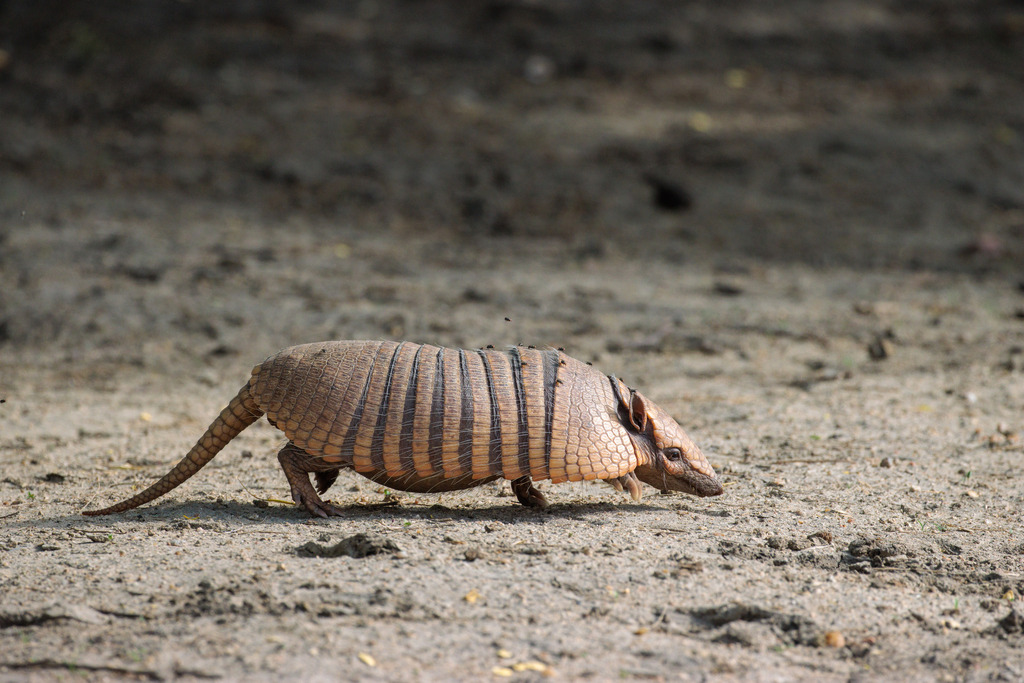
Six-banded Armadillo
Photo © Thomaz de Carvalho Callado
Photo © Thomaz de Carvalho Callado — CC BY 4.0 — Source: iNaturalist photo #473159390The six-banded armadillo (Euphractus sexcinctus), also known as the yellow armadillo, is an armadillo found in South America. The sole extant member of its genus, it was first described by Swedish zoologist Carl Linnaeus in 1758. The six-banded armadillo is typically between 40 and 50 centimeters (16 and 20 in) in head-and-body length, and weighs 3.2 to 6.5 kilograms (7.1 to 14.3 lb). The carapace (hard shell on the back) is pale yellow to reddish brown, marked by scales of equal length, and scantily covered by buff to white bristle-like hairs. The forefeet have five distinct toes, each with moderately developed claws. Six-banded armadillos are efficient diggers and form burrows to live in and search for prey. The armadillo is alert and primarily solitary. An omnivore, it feeds on insects, ants, carrion, and plant material. Due to their poor eyesight, armadillos rely on their sense of smell to detect prey and predators. Births take place throughout the year; gestation is 60 to 64 days long, after which a litter of one to three is born. Weaning occurs at one month, and juveniles mature by nine months. The six-banded armadillo inhabits savannas, primary and secondary forests, cerrados, shrublands, and deciduous forests.…
Emas National Park
Brazil
+333 birds+23 mammals
Across the high plateaux of central Brazil, where the cerrado grasslands roll toward distant horizons under an immense sky, Emas National Park anchors one of South…
VIEW NATIONAL PARKPantanal Matogrossense National Park
Brazil
+322 birds+17 mammals
Where the flooded forests of central Brazil meet vast seasonally inundated grasslands, Pantanal Matogrossense National Park sprawls across nearly 2,900 square kilometers of one of the…
VIEW NATIONAL PARKNo community photos yet. Log in to add the first one.
No community observations of this species yet.