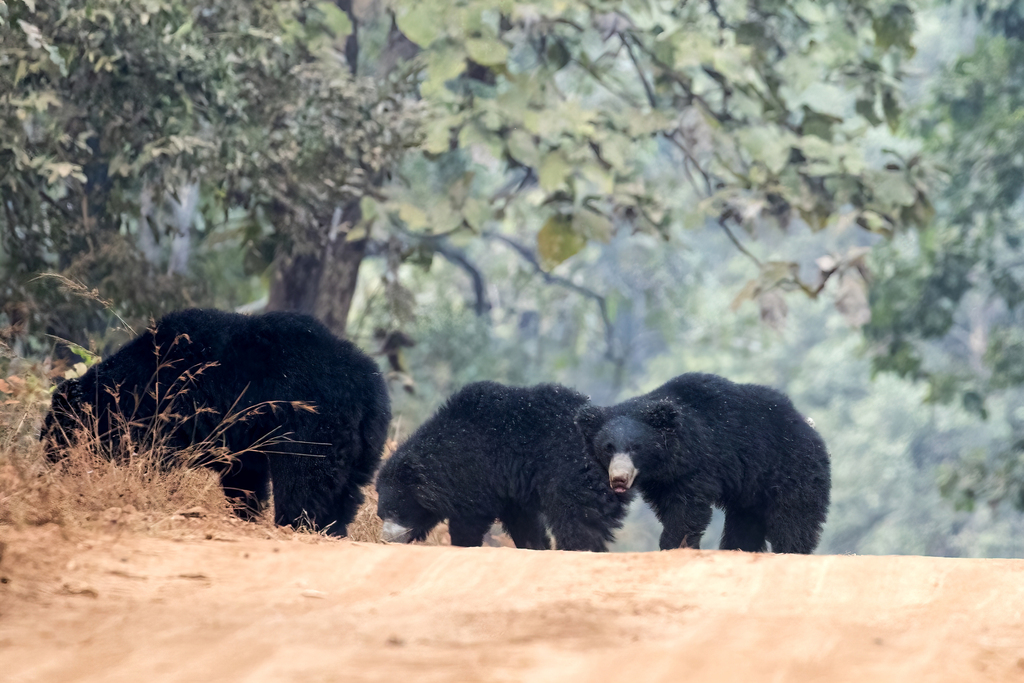
Sloth Bear
Photo © Ramesh Shenai Jr.
Photo © Ramesh Shenai Jr. — CC BY 4.0 — Source: iNaturalist photo #249620529Identification
The sloth bear is a medium-sized, distinctly shaggy bear with several unique features that make it recognizable in the field. Adults stand 60–92 cm high at the shoulder and measure 1.4–1.9 m in body length, with males weighing 80–145 kg and females 55–105 kg. The most striking characteristic is the bear's completely black fur (rusty in some specimens), often marked with a whitish Y- or V-shaped patch on the chest—a feature thought to serve as a threat display. The coat is long and unkempt, particularly heavy behind the neck and between the shoulders, where it forms a distinctive mane up to 30 cm long.
Several anatomical features reflect the sloth bear's specialized diet of insects. It has a thick, long muzzle with a bulbous snout and notably long, stretchy lower lip that can extend over its nose. Lacking upper incisors, it can suck up large numbers of insects with ease. The bear possesses large, sickle-shaped claws measuring 10 cm in length, highly developed for excavating termite mounds and ant nests. Other distinctive features include very large, floppy ears—the only bear species with long hair on its ears—and the longest tail in the bear family at 15–18 cm.
Range & Habitat
The sloth bear is native to the Indian subcontinent, where it inhabits forests and woodland areas suited to its insectivorous lifestyle. The species is currently listed as vulnerable on the IUCN Red List, primarily due to habitat loss and degradation. Historically, human activity has drastically reduced both the bear's habitat and its population through hunting for food and products including their bacula and claws.
Behaviour & Diet
True to its classification as myrmecophagous (ant and termite-eating), the sloth bear feeds primarily on ants and termites, supplemented by fruits. The species evolved specialized anatomical features—its long lower lip, missing upper incisors, and broad palate—specifically for extracting and consuming insects from their nests. This dietary specialization sets it apart from other bear species and reflects its convergent evolution with other ant-eating mammals.
Sloth bears breed during spring and early summer, with females giving birth near the beginning of winter. The species is generally solitary but can become aggressive when its territory is encroached upon by humans. Historically, sloth bears have been captured and tamed for use as performing animals and pets, practices that have further impacted wild populations.
Best Time & Places to See It
Sloth bears inhabit forested regions across the Indian subcontinent, where they forage in areas with abundant termite mounds and ant colonies. The species breeds during spring and early summer, which may influence activity levels and visibility. To encounter sloth bears, travelers should focus on protected forest areas within the bear's native range where habitat remains relatively intact.
Photography Tips
The sloth bear's distinctive appearance—shaggy black coat, prominent mane, and chest marking—makes for dramatic wildlife photography. The bear's specialized feeding behavior, involving excavation of termite mounds and insect extraction, offers excellent opportunities for behavioral shots. The animal's large claws and unique facial features, including its bulbous snout and large ears, are particularly photogenic. Exercise caution when photographing, as sloth bears may become aggressive if they feel their territory is threatened.
Valmiki National Park
Ramnagar, India
+66 birds+6 mammals
Along Bihar's western frontier, where the Gandak River winds through subtropical forest and grassland, Valmiki National Park sprawls across terrain shaped by monsoon rains and seasonal…
VIEW NATIONAL PARKRanthambhore National Park
Sawai Madhopur, India
+294 birds+20 mammals
Granite ridges and ravines carved through the Aravalli Range frame this protected landscape in eastern Rajasthan, where deciduous forest mingles with open scrubland and seasonal water…
VIEW NATIONAL PARKKanha Tiger Reserve
Kanha Kisli F.V., India
+321 birds+23 mammals
Where sal forests give way to emerald meadows and crystalline streams carve through ancient valleys, one of India's finest wilderness reserves unfolds across the Maikal Range.…
VIEW NATIONAL PARKTadoba National Park
Palasgaon Singru, India
+270 birds+20 mammals
Where sal forests meet open grasslands and rocky outcrops rise from red laterite soil, central India's landscape unfolds in raw, untamed beauty. Ancient teak woodlands and…
VIEW NATIONAL PARKBandhavgarh National Park
Garhpuri, India
+285 birds+17 mammals
Where granite ridges rise dramatically above sal and bamboo forests, one of India's most pristine tiger reserves unfolds across the Vindhyan plateau. Ancient rock formations tower…
VIEW NATIONAL PARKBandipur National Park
Hirehalli, India
+302 birds+19 mammals
Where the Western Ghats descend into the Deccan plateau, ancient deciduous forests blanket a landscape carved by the Nugu River. Bandipur unfolds across 880 square kilometres…
VIEW NATIONAL PARKNagarahole Tiger Reserve
Nalkeri Forest, India
+323 birds+23 mammals
Where granite escarpments rise above dense deciduous forests and the Kabini River carves through pristine wilderness, one of India's most biodiverse landscapes unfolds across the Western…
VIEW NATIONAL PARKNo community photos yet. Log in to add the first one.