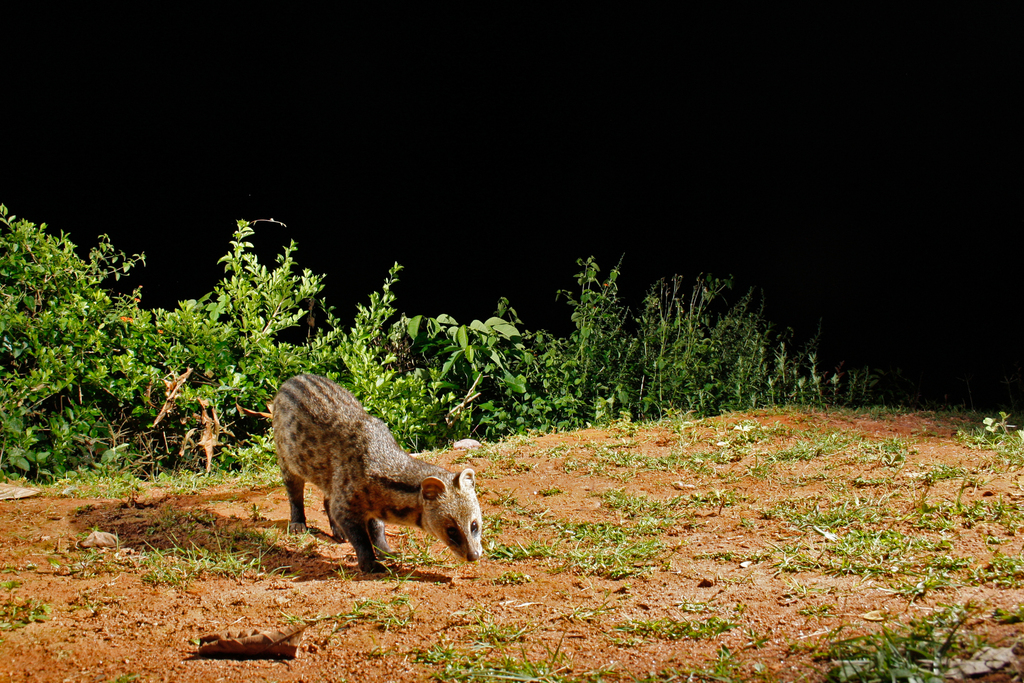
Small Indian Civet
Photo © kalyanvarma
Photo © kalyanvarma — CC BY 4.0 — Source: iNaturalist photo #348805101Identification
The small Indian civet is a compact carnivore with distinctive markings that make it recognizable in the field. Its coarse fur ranges from brownish grey to pale yellowish brown, typically adorned with five or six longitudinal black or brown bands running along the back and four or five rows of spots on each side, though some individuals have less distinct markings. Two dark stripes run from behind each ear to the shoulders, often accompanied by a third stripe crossing the throat. The short, rounded ears bear dusky marks, and the characteristic tail displays alternating black and whitish rings—seven to nine of each colour. Head to body length measures 53–58 cm with a tapering tail of 38–43 cm.
Range & Habitat
The small Indian civet is widespread across South and Southeast Asia, occurring throughout most of India, Sri Lanka, Myanmar, Thailand, Laos, Cambodia, Vietnam, and parts of China and Taiwan. This adaptable species thrives in remarkably diverse habitats, from grasslands and riverine areas to sal forests, deciduous forests, semi-evergreen forests, bamboo forests, and even tea plantations. It has been recorded at elevations ranging from near sea level to 2,500 metres in northeast India, demonstrating considerable ecological flexibility.
The species also inhabits agricultural and secondary landscapes across its range, contributing to its conservation status. It has even been introduced to Madagascar and islands in the Zanzibar Archipelago, where feral populations now exist in national parks and protected areas.
Behaviour & Diet
Small Indian civets are primarily nocturnal and mostly terrestrial, though they climb well and are highly adaptable in their shelter choices. They inhabit holes in the ground, under rocks, thick bush, burrows, and hollow logs—sometimes digging their own burrows but also opportunistically occupying those abandoned by other species. In suburban areas, they exploit gutters and other dark, hollow spaces. Occasionally they form pairs for mating and hunting, and in undisturbed areas they may hunt during daylight hours.
Their diet is notably varied and opportunistic: they feed primarily on rats, mice, birds, snakes, fruit, roots, and carrion, with some individuals observed taking poultry. Females typically bear four or five young per birth, with kittens opening their eyes after five days. Captive individuals have lived eight to nine years.
Best Time & Places to See It
Spotting small Indian civets requires nocturnal activity, as they are almost exclusively active after dark. Protected areas across their range offer the best opportunities: Chitwan National Park in Nepal, Khao Yai and Kaeng Krachan National Parks in Thailand, and various reserves throughout India's Western Ghats including Anamalai and Kalakkad Mundanthurai Tiger Reserves are documented hotspots. In Myanmar, Hlawga National Park and Hukawng Valley provide reliable habitat. Southeast Asian visitors should focus on Cambodia's Cardamom Mountains and protected forests, or Laos's semi-evergreen and mixed deciduous forests.
Photography Tips
Photographing small Indian civets demands night work. Camera traps have proven effective in surveys across their range and may be your best option for capturing natural behaviour. If pursuing active observation, use a headlamp with a red filter to minimize disturbance, allowing nocturnal hunting behaviour to continue. Focus on riverine areas and grasslands within protected reserves, particularly near water sources during the dry season. The species's distinctive striped and spotted coat photograph well but require careful exposure management in low light. Patience is essential—these are solitary, secretive animals that prioritize foraging over posing.
Khao Yai National Park
Prachantakham District, Thailand
+377 birds+46 mammals
Evergreen dipterocarp forest blankets the rolling terrain of this national park in eastern Thailand, where limestone hills rise abruptly from the forest floor and seasonal streams…
VIEW NATIONAL PARKPanna National Park
Badgadi Kalan, India
+271 birds+17 mammals
Where granite gorges slice through central India's Vindhyan plateau, a landscape of stark beauty unfolds across nearly six hundred square kilometers. The Ken River carves through…
VIEW NATIONAL PARKKaziranga National Park
Kohora, India
+422 birds+26 mammals
Dawn breaks over the floodplains of the Brahmaputra, where tall grasslands stretch endlessly beneath monsoon-heavy skies. This sprawling wilderness of northeastern Assam is a mosaic of…
VIEW NATIONAL PARKNo community photos yet. Log in to add the first one.
No community observations of this species yet.