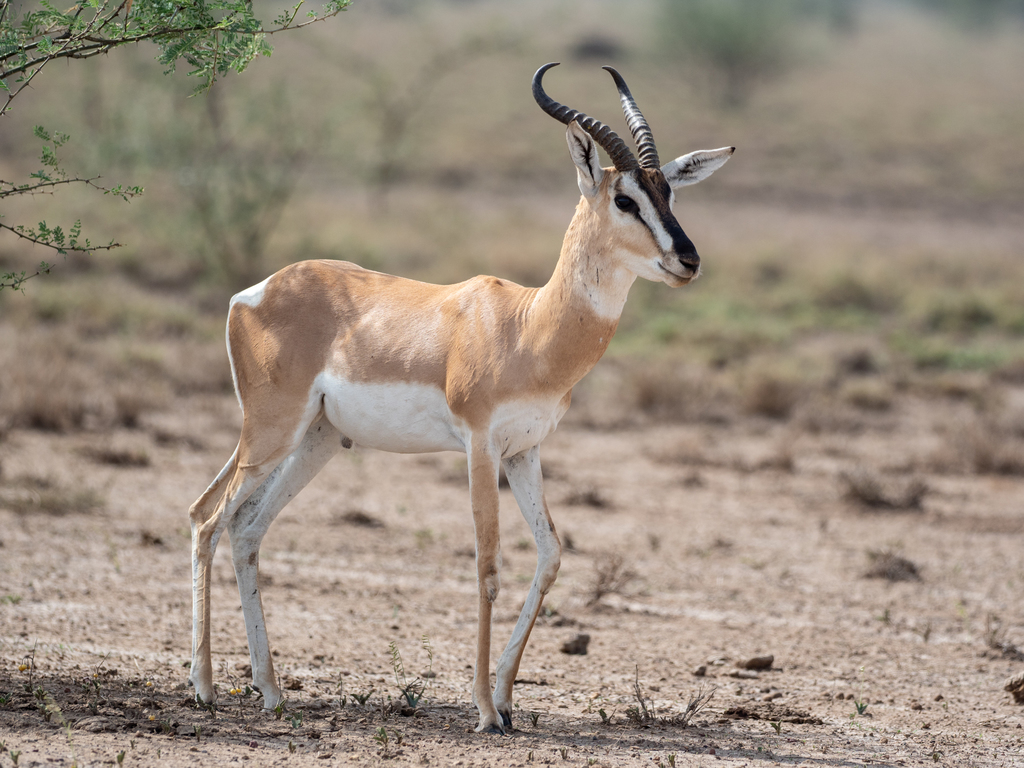
Soemmerring’s Gazelle
Photo © Forest Botial-Jarvis
Photo © Forest Botial-Jarvis — CC BY 4.0 — Source: iNaturalist #28854292Identification
Soemmerring's gazelle, also known as the Abyssinian mohr, is a tall gazelle standing 75–90 cm at the shoulder and weighing 35–45 kg. The species is characterized by tan flanks that gradually fade to white on the belly, paired with distinctively long black horns. These features combine to create an elegant, upright silhouette typical of larger gazelle species.
Where ranges overlap with Grant's gazelle, Soemmerring's and Grant's gazelles are so similar in appearance that they are often mistaken for one another, making field identification challenging for the untrained eye. The species is closely related to both Grant's gazelle and Thomson's gazelle within the genus Nanger.
Range & Habitat
Soemmerring's gazelle is native to the Horn of Africa, with populations found in Djibouti, Eritrea, Ethiopia, Somalia, and South Sudan. The species is now extinct in Sudan and possibly no longer present in parts of its former range. A notable isolated population exists on Dahlak Kebir island in the Dahlak Archipelago, where individuals have evolved into a dwarf form compared to mainland races.
These gazelles inhabit open steppes with brush and acacia trees, as well as more sparsely vegetated steppes with few trees. They are adapted to arid and semi-arid environments characteristic of the Horn of Africa region.
Behaviour & Diet
Soemmerring's gazelle feeds on acacia and bush leaves, grasses, and herbs, making them well-suited to their steppe habitat. Males are temporarily territorial during breeding season. The species can live up to 14 years in the wild, though their relatively small current numbers make them difficult to study comprehensively.
Best Time & Places to See It
Soemmerring's gazelle is classified as Vulnerable by the International Union for Conservation of Nature, a status it has held since 1986. The species has been extirpated from many parts of its former range due to hunting and habitat destruction, making sightings increasingly rare. Ethiopia and Eritrea represent the most likely locations for encounters, though visitors should be aware of the animal's scarcity and the conservation challenges it faces.
Photography Tips
The gazelle's striking long black horns and elegant tan-to-white coloration make for compelling wildlife photography subjects. Early morning or late afternoon light will best emphasize the subtle color gradations across the flanks and belly. Exercise patience and use telephoto lenses to avoid disturbing these vulnerable animals in their fragile populations across the Horn of Africa.
No community photos yet. Log in to add the first one.
No community observations of this species yet.