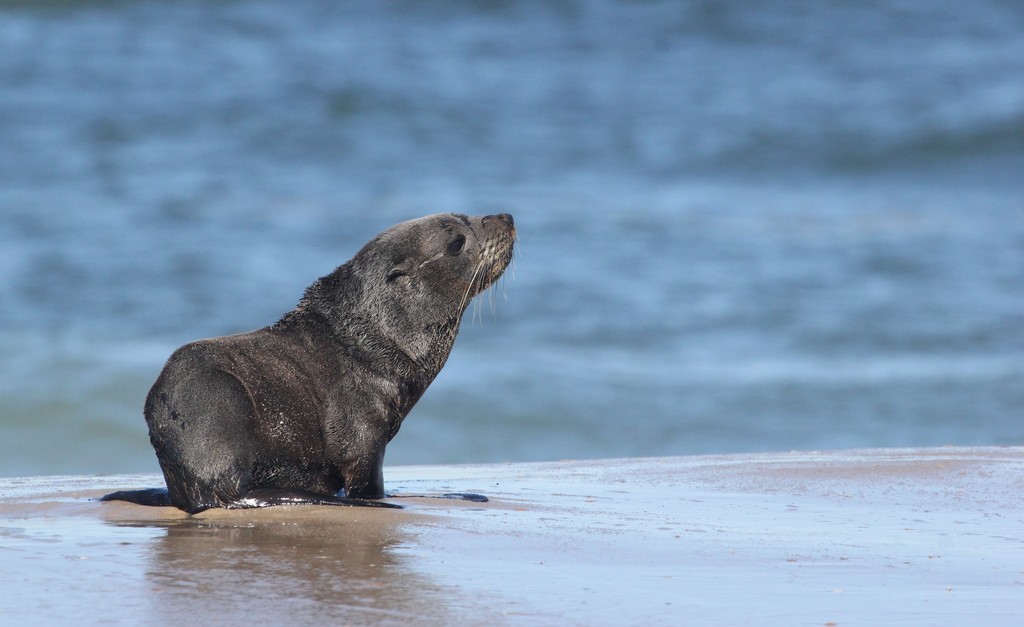
South American Fur Seal
Photo © Leo Lagos
Photo © Leo Lagos — CC BY 4.0 — Source: iNaturalist photo #74194982The South American fur seal (Arctocephalus australis) breeds on the coasts of Peru, Chile, the Falkland Islands, Argentina, Uruguay and Brazil. South American fur seals are of least concern on the IUCN Red List. The total population is around 300,000-450,000. Populations are affected by hunting and environmental stressors. Arctocephalus australis have a dark grey or brown fur coat and are sexually dimorphic. Males compete for territory and females to mate with, forming a dominance hierarchy. Breeding season is from October to December, whereas multiple pups are bred each season. South American fur seals are nocturnal, carnivorous hunters that primarily eat demersal and pelagic fish. They are social and often hunt in groups. Communication within the species occurs through a variety of vocalizations, such as guttural threats, barks, whimpers, or submissive calls from the males and growls or high-pitched wails to gather pups from females. Four subspecies may be recognized: A. a. australis (Falkland Island fur seal), A. a. gracilis (South American fur seal), A. a. forsteri (New Zealand fur seal), and an unnamed species (Peruvian Fur Seal). A description of the species and their distribution and habitat, conservation status, feeding behaviors, lifespan and mating practices, field identification, and additional behaviors…
Peixe National Park Lagoon
Brazil
+293 birds+4 mammals
Where the coastal plains of Rio Grande do Sul meet the Atlantic, Peixe National Park Lagoon sprawls across nearly 2,200 square kilometres of shallow waters, reed…
VIEW NATIONAL PARKCabo de Hornos National Park
Cape Horn, Chile
+88 birds+9 mammals
Where the Andes plunge into the Southern Ocean and the Drake Passage churns between two continents, Cabo de Hornos National Park sprawls across one of Earth's…
VIEW NATIONAL PARKPan de Azúcar National Park
Chañaral, Chile
+74 birds+4 mammals
Where the Atacama Desert plunges toward the Pacific, Pan de Azúcar National Park sprawls across 727 square kilometres of one of Earth's most extreme transitions—a landscape…
VIEW NATIONAL PARKNo community photos yet. Log in to add the first one.
No community observations of this species yet.