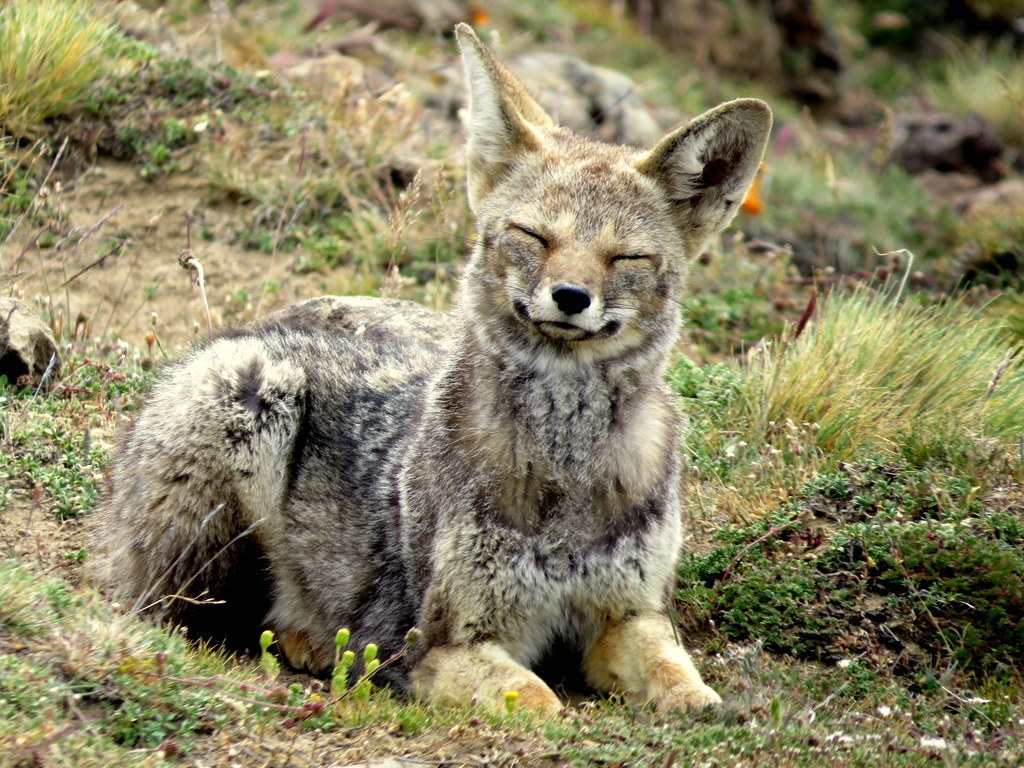
South American Gray Fox
Photo © Diego Carús
Photo © Diego Carús — CC0 1.0 — Source: iNaturalist photo #26456393Identification
The South American gray fox is a small canid, weighing just 2.5 to 5.45 kilograms and measuring 65 to 110 centimetres in length including its tail. Despite its name, the species displays considerable colour variation. The head is reddish-brown flecked with white, with distinctively large ears and a characteristic black spot on the chin. The body pelage is brindled with agouti guard hairs over a short, dense, pale undercoat, while the underparts are pale grey. The limbs are tawny with dark bars crossing the thighs, and the long, bushy tail features a dark dorsal stripe and dark tip with a paler, mottled underside.
Range & Habitat
Also known as the Patagonian fox or chilla, this species is endemic to southern South America, occurring in both Argentina and Chile across a vast latitudinal range from 17°S in northernmost Chile to 54°S in Tierra del Fuego. In Argentina, it inhabits the western semiarid regions, while in Chile it is present throughout the country. The fox was introduced to the Falkland Islands in the late 1920s to early 1930s, where it remains in large numbers, and was deliberately introduced to Tierra del Fuego in 1951 for rabbit control.
This adaptable species occurs across diverse habitats, ranging from the warm, arid scrublands of the Argentine uplands and the cold, arid Patagonian steppe to the forests of southernmost Chile, making it one of South America's most geographically versatile canids.
Behaviour & Diet
The South American gray fox is largely solitary and primarily nocturnal. Its diet is highly varied and opportunistic, consisting mainly of small mammals—especially rodents—along with birds, arthropods, bird eggs, reptiles, fruit, and carrion. Specific fruits consumed include Cryptocarya alba, Lithraea caustica, and Prosopanche species. The foxes sometimes approach human settlements in search of domestic poultry and sheep, though they typically avoid areas frequented by dogs.
Where their ranges overlap, gray foxes compete with the larger culpeo fox. The smaller gray fox compensates by consuming a greater proportion of rodents and arthropods, allowing for ecological partitioning between the two species. Breeding occurs in early austral autumn, around March, with a two-month gestation period followed by the birth of two to four kits in a den.
Best Time & Places to See It
The Patagonian steppe and southern Chilean forests offer the best opportunities for encountering this elusive species. March, the breeding season, may increase activity levels, though the foxes are largely solitary and primarily nocturnal, making them challenging to observe. The Falkland Islands and remote areas of southern Argentina and Chile, particularly around Tierra del Fuego, represent accessible locations for patient wildlife watchers. Early morning and dusk provide the best viewing windows.
Photography Tips
Given the fox's small size and nocturnal habits, a telephoto lens and camera trap setup will yield the best results. The distinctive facial markings—particularly the reddish-brown head, large ears, and black chin spot—photograph well in low light. The brindled pelage and dark-tipped tail are characteristic features worth capturing. Patience and stillness are essential, as these solitary animals tend to avoid areas with human activity. Early morning light in open Patagonian habitat offers ideal conditions for photography.
Pan de Azúcar National Park
Chañaral, Chile
+74 birds+4 mammals
Where the Atacama Desert plunges toward the Pacific, Pan de Azúcar National Park sprawls across 727 square kilometres of one of Earth's most extreme transitions—a landscape…
VIEW NATIONAL PARKTorres del Paine National Park
Torres del Paine, Chile
+143 birds+10 mammals
Where granite spires pierce the Patagonian sky, Torres del Paine commands one of South America's most dramatic landscapes. Across 4,106 square kilometres of southern Chile, jagged…
VIEW NATIONAL PARKPuyehue National Park
Puyehue, Chile
+110 birds+4 mammals
Across the volcanic spine of the Los Lagos Region, where the Andes descend toward temperate rainforest, Puyehue National Park encompasses nearly 2,600 square kilometers of one…
VIEW NATIONAL PARKVicente Pérez Rosales National Park
Puerto Varas, Chile
+109 birds+8 mammals
Where the Andes descend toward the temperate rainforests of Chile's Lake District, nearly 4,641 square kilometers of pristine wilderness unfolds across Vicente Pérez Rosales National Park.…
VIEW NATIONAL PARKSierra de las Quijadas National Park
Argentina
+168 birds+5 mammals
Sandstone cliffs and deeply incised canyons define this 1,137-square-kilometre expanse in San Luis Province, where the dry Chacoan landscape of central Argentina reveals an unexpected ecological…
VIEW NATIONAL PARKNo community photos yet. Log in to add the first one.
No community observations of this species yet.