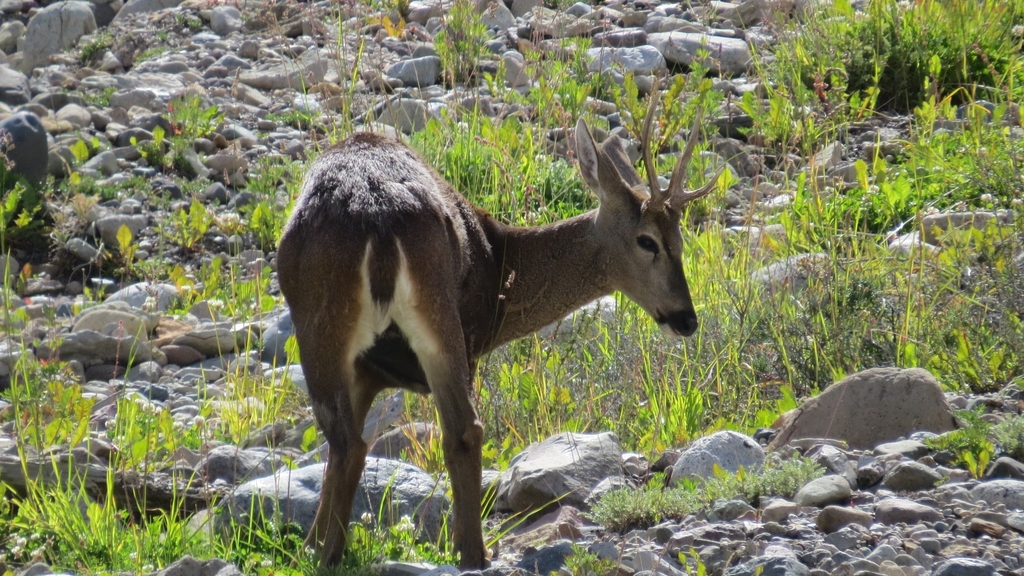
Southern Huemul
Photo © Nicolás Campos
Photo © Nicolás Campos — CC BY-SA 4.0 — Source: iNaturalist photo #611924054Identification
The southern huemul is a stocky, compact deer well-adapted to rough mountain terrain. It stands approximately 80–90 cm tall and weighs 70–90 kg depending on sex. The coat ranges from brown to greyish-brown with white undersides and a distinctive white-marked throat. Long, curled hairs provide excellent insulation against cold and moisture.
Sexual dimorphism is striking: only males bear antlers, which are shed annually toward the end of winter. Males display a distinctive black "face mask" forming an elongated heart-shape that curves around the forehead. Fawns are born unspotted and show no size difference between sexes at birth.
Range & Habitat
Native to the high mountains and cold valleys of the Andes in Argentina and Chile, the southern huemul prefers open periglacial scrubland, rocky bluffs, upland forests, and forest-borders. It occupies difficult, broken terrain throughout its range. Research indicates subtle habitat preferences: males and juveniles favor periglacial grasslands, females prefer bluffs, and fawns are found exclusively on bluffs.
Once widespread across southwestern South America, the species now occupies only fragmented populations. As of 2005, Argentina held an estimated 350–600 individuals in isolated groups. The species has suffered a 99 percent reduction in global population and more than 50 percent loss of its original range.
Behaviour & Diet
The southern huemul congregates in mixed-sex groups, with group size increasing as animals move away from rocky slopes. This pattern suggests predation risk is lowest on slopes and highest in open valley areas. The species is herbivorous, with diet studies identifying over thirty plant species consumed. Lenga beech ranks among the most important food items, though this overlap with introduced red deer populations often displaces huemul to marginal habitats.
The cougar is the species' only natural predator and remains a principal cause of mortality in Argentina. Reproductive rates have declined, and morbidity is increasing—concerns that researchers attribute to habitat fragmentation, invasive species, and competition for forage.
Best Time & Places to See It
Viewing opportunities are severely limited due to the species' endangered status and fragmented distribution. Argentina's Nahuel Huapi National Park represents one of the few accessible locations where southern huemul may be encountered, though sightings are never guaranteed. The species' preference for remote, high-altitude rocky terrain and its avoidance of open valleys make it inherently difficult to locate.
Travelers seeking this species should consult with local conservation authorities and park rangers in Argentina and Chile before attempting to visit. Since 2006, the huemul has been designated a Chilean National Natural Monument and appears on Chile's national coat of arms, reflecting its cultural and ecological significance.
Photography Tips
Photographing the southern huemul requires patience, high-altitude fitness, and realistic expectations. The species' preference for rocky slopes and difficult terrain demands sturdy footwear and proper mountaineering preparation. Early morning and late afternoon light will best reveal the subtle brown and greyish tones of the coat and highlight the distinctive white throat marking.
If fortunate enough to encounter males, the striking black face mask provides a compelling compositional element. The compact, muscular build and short legs adapted for steep terrain are characteristic features worth capturing. Respect the species' endangered status by maintaining distance and minimizing disturbance—telephoto lenses (400mm or longer) are essential both for wildlife photography ethics and practical visibility across mountain distances.
No community photos yet. Log in to add the first one.
No community observations of this species yet.