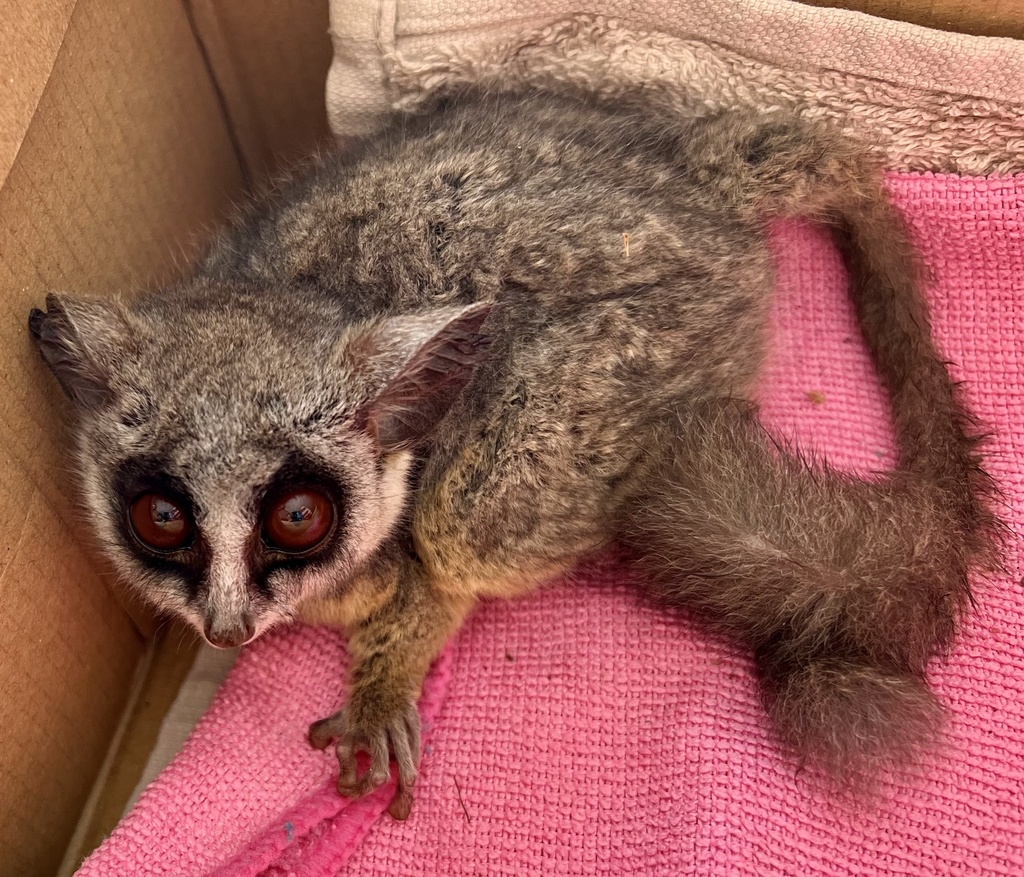
Southern Lesser Galago
Photo © Juvia Heuchert
Photo © Juvia Heuchert — CC BY 4.0 — Source: iNaturalist #124577946Identification
The Southern Lesser Galago is a small primate with a head-and-body length of 15 cm and a distinctive tail measuring 23 cm. Its most striking features are large, grey ears and striking orange eyes framed by diamond-shaped black eye-rings. The face is broad with a short muzzle and a whitish nose-stripe. The dorsal fur is greyish-brown, contrasting with white underparts that sometimes have a yellowish tinge. The flanks, inner limbs, hands, and feet display a warm yellowish coloration. The spatulate-tipped fingers and toes provide excellent grip for climbing, while the tail, darker than the body fur, is not particularly bushy.
Range & Habitat
This species inhabits mesic woodlands across southern Africa, occurring in Angola, Botswana, the Democratic Republic of the Congo, Malawi, Mozambique, Namibia, South Africa, Eswatini, Tanzania, Zambia, and Zimbabwe, with possible presence in Rwanda and Burundi. The Mohol bushbaby naturally favors savanna, miombo, and mopane woodlands, as well as riverine gallery forests. Within these habitats, Acacia and Mopane trees are particularly important, providing shelter, breeding sites, and food sources. The species lives in small groups of two to seven individuals nestled in thorny branches. Interestingly, breeding populations have established themselves in the suburbs of Johannesburg and Pretoria, including both escaped pets and individuals that have naturally dispersed from warmer regions.
Behaviour & Diet
The Southern Lesser Galago is primarily nocturnal, with feeding peaks occurring soon after sunset and sporadically throughout the night. Its diet consists predominantly of insects and tree gum—a sticky exudate from Acacia trees that seeps from punctures made by insects. The bushbaby particularly favors gum from sweet thorn (Acacia karroo) and umbrella thorn (Acacia tortilis). Seasonal behavior shifts noticeably: during winter months, it forages across the ground moving between gum trees, while in the wet summer season, it travels primarily through the canopy and consumes a much higher proportion of invertebrates. A remarkable adaptation is its ability to obtain most water hygroscopically from its solid food, enabling independent survival without regular water sources.
Best Time & Places to See It
The Mohol bushbaby is strictly nocturnal, making nighttime observation essential. Night drives and spotlight surveys in suitable habitat offer the best opportunities for encounter. Key regions include the miombo and mopane woodlands of Zambia, Zimbabwe, Botswana, and Namibia, as well as savanna regions throughout South Africa. The suburban woodlands around Johannesburg and Pretoria provide accessible locations where populations have become established. The wet summer season may yield higher invertebrate consumption and more arboreal activity, though the species remains active year-round.
Photography Tips
Photographing this elusive nocturnal primate requires specialized night equipment: a headlamp with a red filter to minimize disturbance, a camera capable of high ISO performance, and a fast lens (f/2.8 or wider). Spotlight surveys from vehicles are often most productive. Position yourself quietly near Acacia trees at dusk, as bushbabies emerge to feed. Their reflective orange eyes often betray their location in beam light. Keep movements slow and deliberate; these small primates are alert and can vanish quickly into thorny branches. Patience and multiple nights in suitable habitat significantly increase success rates for capturing images of this charismatic species.
Mapungubwe National Park
Musina Local Municipality, South Africa
+358 birds+29 mammals
Where the Limpopo River cuts through sandstone ridges at the convergence of South Africa, Botswana, and Zimbabwe, Mapungubwe National Park preserves a landscape of profound ecological…
VIEW NATIONAL PARKPilanesberg National Park
Moses Kotane Local Municipality, South Africa
+364 birds+49 mammals
Granite peaks and volcanic ridges rise unexpectedly from the savanna floor across this 734-square-kilometre expanse in the North West province, creating a landscape of profound ecological…
VIEW NATIONAL PARKKruger National Park
Ba-Phalaborwa Local Municipality, South Africa
+540 birds+91 mammals
Across the low-lying savanna of northeastern South Africa unfolds one of Africa's largest and most ecologically intact protected areas, where acacia woodlands merge into mopane scrub…
VIEW NATIONAL PARKMarakele National Park
Modimolle Local Municipality, South Africa
+341 birds+36 mammals
Granite ridges and sprawling grasslands dominate this 1,176-square-kilometre reserve in Limpopo's heartland, where bushveld transitions between rocky outcrops and open savanna. The park's rugged topography creates…
VIEW NATIONAL PARKEtosha National Park
Namibia
+356 birds+58 mammals
Across northern Namibia's stark semi-arid plateau, a vast shallow depression transforms seasonally into one of Africa's most dramatic wildlife theaters. Etosha National Park, encompassing more than…
VIEW NATIONAL PARKNo community photos yet. Log in to add the first one.
No community observations of this species yet.